The desire to contact intelligent life on other planets is much older than the UFO craze and the SETI movement. Several 19th century scientists contemplated how we might communicate with possible Martians and Venusians.
These early proposals — which predate by 150 years the first extraterrestrial message that was sent in 1974 — were based on visual signals, as the invention of radio was still decades away.
In fact, as history shows, ideas for interplanetary communication have largely been driven by whatever the current technology allowed — be it lamps, radios or lasers.

"You go with what you know," said Steven Dick, NASA Chief Historian.
Are we alone?
Over two thousand years ago, the ancient Greeks argued over the existence of life on other planets, but the idea really took off after the Copernican revolution.
"Once it was realized that all the planets go around the sun, it was not hard to imagine that the other planets could be like Earth," Dick said.
Galileo, Kepler and others considered the inhabitability of the planets, while being careful not to upset Church authority.
"The idea blossomed in the 17th century into the 'plurality of worlds' debate, but it remained controversial," said Dick, who has written several books on the topic.
One of the most influential proponents for extraterrestrial life was Bernard le Bovier de Fontenelle, who wrote Conversations on the Plurality of Worlds in 1686.
Despite the interest, there was no recorded discussion of how we might locate or contact these potential aliens until more than a century later.
Crop triangles and burning canals
Florence Raulin-Cerceau of the Alexandre Koyr? Center in Paris has documented the early attempts at communication with extraterrestrial intelligence (CETI), or what is now often called active SETI.
"As early as the 19th century, inventors imagined "sky telegraph" equipment to communicate with the supposed inhabitants of the solar system's planets," Raulin-Cerceau recently wrote with her colleague in the French magazine Pour la Science.
The first of these inventors was Carl Friedrich Gauss, the German mathematician. In the 1820s, he spoke of reflecting sunlight towards the planets with his land surveying invention, the heliotrope. He is also credited with the idea of cutting a giant triangle in the Siberian forest and planting wheat inside.
"The size and color contrast should have made the object visible from the moon or Mars, and the geometric figure could only be interpreted as an intentional construction," Raulin-Cerceau wrote.
Twenty years later, the astronomer Joseph von Littrow came up with a similar idea to pour kerosene into a 30-kilometer-wide circular canal that would be lit at night to signal our presence.
Concentrated light
The second half of the 19th century saw more realistic proposals, according to Raulin-Cerceau.
In 1869, the French inventor and poet Charles Cros imagined using a parabolic mirror to focus the light from electric lamps towards Mars or Venus. He figured the light could be flashed on and off to encode a message.
"Cros granted that the planets could be inhabited by beings not able to respond, but he was still persuaded that 'the eternal isolation of the spheres [will be] vanquished,'" wrote Raulin-Cerceau.
A light-based "Morse code" was also considered by the British statistician Francis Galton in 1896. He took care not to assume that Martians would have our same base-10 counting system, as they probably wouldn't have 10 fingers.
Around the same time, A. Mercier, a member of the Astronomical Society of France, devised a plan to place several reflectors on the Eiffel Tower that could direct sunlight towards Mars. He also considered using the moon as a giant screen on which to project light beams.
Could aliens have seen any of these light displays?
"It depends on how much money you think the Martians are spending on their telescopes," said Seth Shostak of the SETI Institute.
Radio turns on
It is now generally assumed that radio is a more suitable means of extraterrestrial communication. Radio waves are less affected by cosmic dust than visible light, and there is less of a radio background to deal with in the sky.
Two of radio's pioneers showed interest in interplanetary radio communication. In 1901, Nikola Tesla reported receiving a strange signal, possibly from Mars, on his giant transmitting tower in Colorado Springs. Nineteen years later, Guglielmo Marconi told reporters about his detection of radio emissions that appeared to come from outer space.
However, the switch to radio-based SETI did not happen immediately.
As late as the 1920s, many people (including Albert Einstein) still considered visual-based communication more practical, since radio transmitters were not yet capable of focusing a beam on a distant planet.
What's more, scientists gradually became convinced that Mars did not have the right conditions to support life, so any presumed extraterrestrials likely lived much, much further away.
"It seemed hopeless to receive messages from other stellar systems, so people said 'Forget it.'" Shostak explained.
It wasn't until 1959 that radio-based SETI started to be taken seriously. In that year, Giuseppe Cocconi and Philip Morrison showed that radar transmitters of the time were already powerful enough to send signals many light years through space.
"If we can do it, then the aliens might be doing it," Shostak said.
In the year that followed, Frank Drake performed Project Ozma, the first radio sky survey to look for intelligent signals.
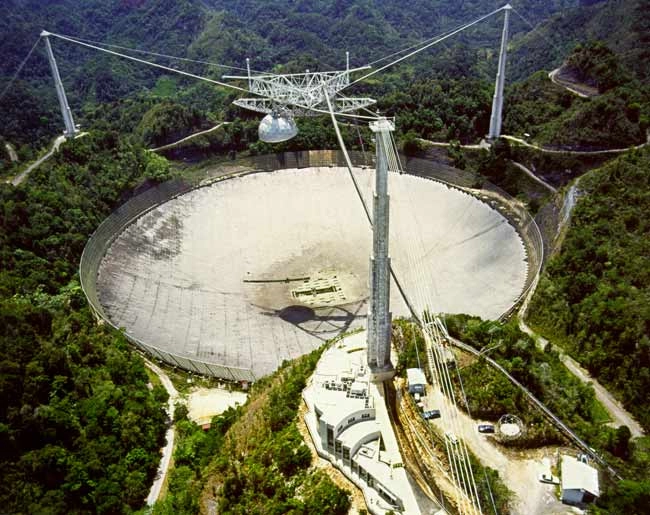
And then in 1974 — a century and half after Gauss — Drake transmitted the first actual SETI message using the Arecibo radio telescope. Scientists are still waiting for a response.
