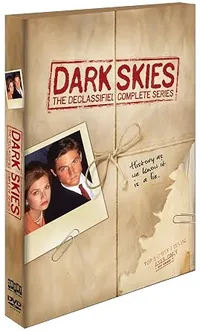
By the fall of 1996, everybody wanted to believe. The first three seasons of "The X-Files" had been a smash hit for Fox, turning FBI agents Fox Mulder and Dana Scully into household names, and bringing aliens and conspiracy theories into the mainstream. It was such a lucrative combination that, unsurprisingly, other networks wanted a piece of their own.
On paper, "Dark Skies" (which debuted on NBC 30 years ago this week) looked like a blatant rip-off, with its pair of good-looking leads, talk of extra-terrestrial invasions, and high-reaching government cover-ups. Its "history as we know it is a lie" tagline was also a direct descendant of "The X-Files"' famous "trust no one" catchphrase.
But this was no by-the-numbers imitator. Instead, "Dark Skies" was a 1960s-set period drama that posited the notion that a network of "here and hostile" aliens had infiltrated US culture and had been manipulating key historical events for years. Want to know who killed JFK? Look out for the extraterrestrial shooter on the grassy knoll.
"In the early stages, ['Dark Skies'] was, 'Let's do "Forrest Gump" meets "War of the Worlds",'" co-creator Brent V. Friedman said in a 2010 retrospective documentary. "'Let's do a complete revisionist history of the 20th century as if aliens really existed.' That kind of opened the door to all sorts of possibilities — we just went in and mined history for all of these interesting incidents and put a 'Dark Skies' spin on them."
Sounds like the kind of show Mulder himself might want to watch…

The series' masterminds did everything they could to play up 'Dark Skies'' fictional cover-up vibe. The pilot episode's opening narration 'claims' that "This program is presented as fiction to protect those people fighting in the resistance," while their original pitch to networks had an ingenious conspiracy theory theme.
"We created an ultra-classified briefing book as our pitch," co-creator Bryce Zabel recalled in a 2011 interview with Icon vs Icon. "Inside there was a memo that basically said, 'This truth has to be revealed to the public, but it's such a radical truth that if we try to do it by covert means, it'll blow too many people's minds. Therefore, you need to do a TV series.'
"The briefing book basically had a gold foil seal on it, and it said that if you broke the seal, you accepted the penalties of treason if you were to speak about this. Then we wrapped it in brown wrapping paper, put twine around it, and stamped 'Top Secret' on it. We left those with network executives."

NBC ultimately agreed to share a story that had — allegedly — been kept under wraps for over three decades. In the show's complex mythology, the famous Roswell incident of 1947 alerted the US government to the presence of aliens, prompting President Harry S. Truman to form the top-secret Majestic 12 (an organization some conspiracy theorists believe to be real) to monitor the threat.
It turns out that the familiar "Gray" aliens (another crossover with "The X-Files") are under the influence of a power-hungry race of parasites known as the Hive. They've taken control of the Grays' sophisticated tech and are now out to absorb the human race into their collective consciousness.
When he takes a job as a congressional aide in Washington DC in 1961, idealistic college graduate John Loengard's (Eric Close) investigation into the funding of UFO-research scheme Project Blue Book uncovers much more than he'd expected. Knowing too much, he's soon forcibly recruited to Majestic 12 by its inscrutable boss, Captain Frank Bach (the reliably brilliant late J. T. Walsh), who gives him a crash course in the Hive and their ways.

In the meantime, John's girlfriend Kim Sayers (Megan Ward) has started working for First Lady Jackie Kennedy, but is soon implanted by one of the Hive's spider-like Ganglions. John manages to perform an experimental extraction on her, and the pair go on the run, founding the eponymous Dark Skies movement to expose the extraterrestrial threat.
As the couple criss-cross the US, they set out to foil various Hive schemes, most of them led by under-the-influence former Majestic agent Jim Steele (Tim Kelleher). But they also have to stay one step ahead of Bach, who gradually develops a marriage of inconvenience with Loengard — they need each other, despite their mutual distrust, and very different goals and motivations.
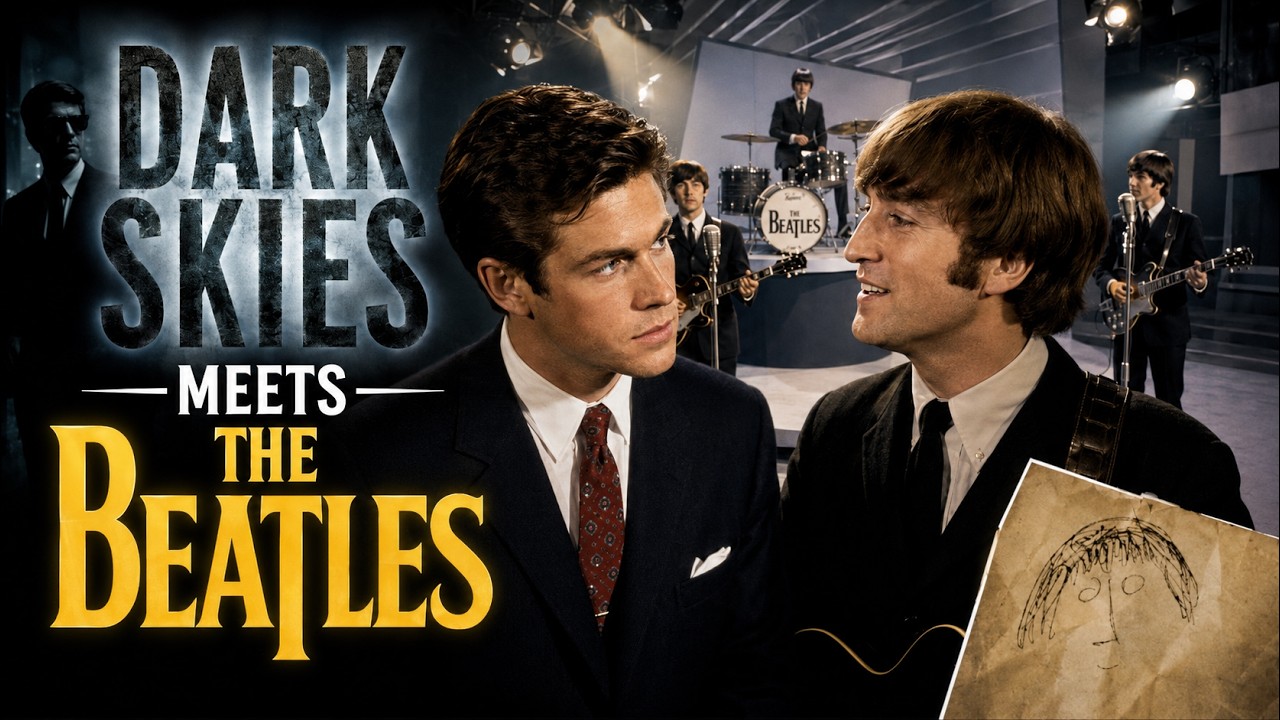
There's impressive attention to detail throughout, whether the show is imagining elaborate crop circles, or recreating 1960s fashions, cars, and backdrops. The storyline also intersects with numerous famous events of the era (Vietnam, the Warren Commission, the Watts Riots in Los Angeles), as well as famous figures from politics and pop culture — the Hive even attempts to use the Beatles' famous 1964 performance on "The Ed Sullivan Show" to bring the populace under control.
Zabel, the son of a history teacher, had worked as a correspondent for CNN in a previous life, and relished the chance to dive into America's recent past to inform the story, using his collection of Time and Newsweek magazine back issues for research.
"History books are about the big picture, you get the trends and all that," he explained in the aforementioned DVD doc. "But in those magazines you'd find all those different things that were happening at the same time in detail. We would constantly match those up with [stories of] UFO events."
One thing "Dark Skies" did not have, however, was government agents in black suits. With the first "Men in Black" movie shooting nearby (it would be released in 1997, becoming one of the best space movies of all time), network executives got nervous about Majestic agents adopting the same look — even though the concept of "men in black" was already well known and, more to the point, scenes had already been shot with actors in black suits.

"'Men in black' were out there in the zeitgeist," Zabel pointed out, "but when I made this argument to one of the executives who came down to the set, they said, 'If you don't get your guys out of black suits today, we will shut down the production and burn the negative.'"
They subsequently became — as star Megan Ward put it — "men in dark gray," as some scenes were reshot and others colorised in post-production. Majestic's goons would become known as "Cloakers" in "Dark Skies" mythology.
By the time the show's first season concluded in May '97, the timeline had reached 1967s Summer of Love. By this point, Kim's Ganglion had reawakened, she'd gone full Hive, and her and John's two-year-old son were now on board the alien mothership. John embarked on a daring mission to rescue the boy with his new partner, Soviet agent Juliet Stuart (a pre-"Star Trek: Voyager" Jeri Ryan), while Bach was seemingly dead at the hands of a Hive mole who'd infiltrated Majestic 12. It was a hell of a cliffhanger, but it was left unresolved when the show was cancelled after a single season, apparently the victim of high production costs and lower-than-expected ratings.

However, there was plenty more story left to tell. Friedman and Zabel always envisioned their show as a "Babylon 5"-style five-year arc, with subsequent seasons covering the decades leading up to a big finale set — and potentially broadcast — in 2000. Even when they were first pitching the series, they'd already devised a "Dark Skies" chronology running from the dinosaur era through to the then-future of 2020.
"This was a reaction to other shows that felt like they were just making it up as they went along," said Friedman. "We said, 'Well, let's do the antithesis, let's come out with a whole blueprint, so we've got a big epic show, we can actually prove to people that we've thought this through.' In the span of a month or so, we thought out five seasons, and we just kept falling in love with the idea — let's put in more details, because we had history to mine from.
"It's a very subversive show," he added, "and I'm still shocked to this day that this was allowed to go on [TV]."
'Dark Skies' is available on DVD in the US and UK. There are also some full season uploads on YouTube.