
Latest articles by Stephanie Pappas

A new visitor is swinging by the solar system: a never-before-observed comet that hails from the Oort Cloud.

Speaking on the BBC show 'Panorama,' Microsoft's Brad Smith warned that unless checks are put in place, artificial intelligence could lead to a dystopian future

Satellite observations of different climate variables don't quite add up, suggesting these measurements might be missing something about the atmosphere.

The permanent oxygenation of Earth's atmosphere took twice as long as previously believed and finally finished up to 100 million years later than expected.

The lost continent is a submerged chunk of crust that broke off from Gondwana 80 million years ago.

Former Trump intelligence director John Ratcliffe told Fox News that more unexplained sightings of flying objects will soon be declassified.

The enormous Baikal-GVD will look for the particles from 4,300 feet (1,310 meters) below the lake surface.

A new form of active matter known as swirlonic matter clumps together in quasi-particles that bend the laws of physics.

A camera at an observatory in Hawaii captured a red sprite and a blue jet in the same frame.

Two meteor enthusiasts have found a piece of an iron meteorite that fell over Sweden in November 2020.

Cosmologists simulated 4,000 versions of the universe in order to understand what its structure today tells us about its origins.

The chunk of space rock that killed the nonavian dinosaurs may have been a piece of a comet that Jupiter's gravity kicked onto a collision course with Earth.

When the plasma of the Van Allen belts drops in density during a solar storm, it can set up the perfect conditions for electrons to travel nearly as fast as light.

Particles called axions may be the reason the 'Magnificent 7' cluster of neutron stars emits extreme X-rays.

It could mean a "negative" leap second.

The ability to cancel and induce magnetic fields from a distance could improve biomedicine.
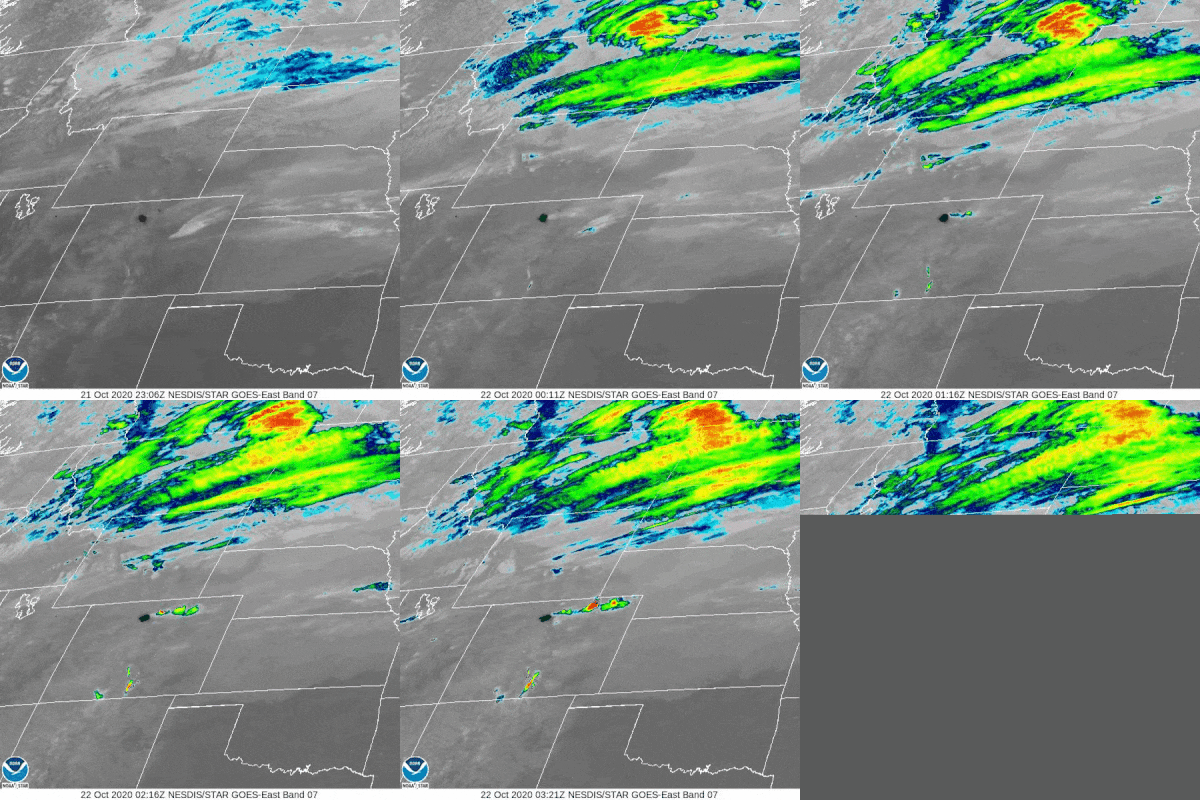
The spread of the fire was visible from space.

Scientists have measured the shortest unit of time ever, the time it takes for a particle of light to cross a hydrogen molecule.

A new computer reconstruction of the tectonic plates of 60 million years ago reveals the existence of a lost plate called Resurrection.

New satellite imagery of California reveals not just the extent of its wildfire damage, but the depth of the loss.

The magnetic fields are more than a thousand times stronger than the magnetic field used in MRI machines..

Smoke blankets the West Coast in the new images.

The solidification of the inner core may have strengthened Earth's magnetic field.

