
Latest articles by Brandon Specktor

From the best places to find them to what they might breathe, here are the newest clues we discovered about alien life.

The eROSITA X-ray telescope just revealed two strange bubbles of X-ray energy, sitting smack-dab inside the Fermi Bubbles.

The Gaia space observatory just released its most detailed map of the universe yet, including the trajectories of hundreds of millions of stars.

Australian scientists tested all 36 receivers on the ASKAP radio telescope for the first time ever, mapping 85% of the sky in 300 hours.

Astronomers have discovered a previously unknown galactic collision between the Milky Way and the mysterious 'Kraken galaxy.'

Astronomers report a strange new feature of the aurora-like STEVE, which they are calling 'streaks.'

An epic photo shows the ESO's Very large Telescope firing four orange lasers at a distant star system.

Lenticular clouds look like saucers and form when wind meets mountains. This photo is one of the Royal Meteorological Society's favorites of the year.

Climate archivists have found the coldest day ever in the Northern Hemisphere, set by Greenland in 1991

An epic series of satellite images shows smokes from the California wildfires clashing with hurricanes in the Eastern United States and Gulf Coast.

Scientists used marine fossils and orbital data to recreate 66 million years of climate history. Its shows that climate change is anything but 'normal.'

New NASA imagery shows that the St. Patrick bay ice caps have vanished from Arctic Canada, two years sooner than scientists predicted

Scientists traced a fast radio burst (FRB) to a known star inside the Milky Way for the first time.

The United States Space Force has a new recruit in their mission to keep planet Earth safe. His name is Ghost, and he likes to go clip-clop on the beach.

Scientists unveiled the largest 3D map of the universe ever, showing its expansion rate over 11 billion years.

NASA combined 10 years of solar observations into a single, gorgeous time-lapse video.
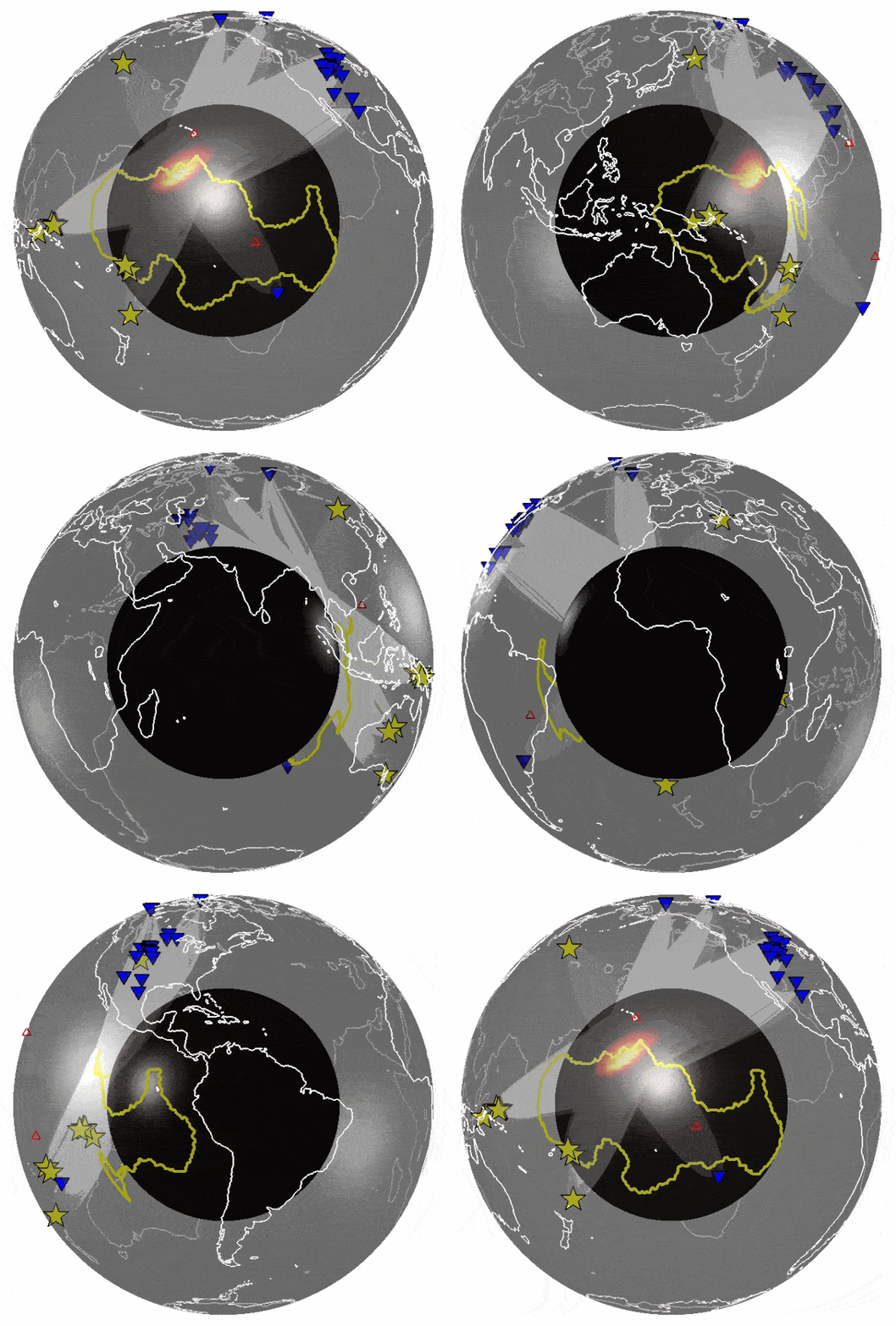
Using thousands of seismic wave recordings, researchers mapped the mysterious 'blobs' deep below the Pacific Ocean and found they are even bigger than imagined.

Twin shock waves produced by the galaxy's central black hole could have inflated the gargantuan Fermi Bubbles about 6 million years ago, a new study suggests.

Researchers figured out why this galaxy looks like an enormous X in invisible radio light.

Photographer Andrew McCarthy photographed the demarcation between the moon's light and dark sides for two weeks to create this unbelievably crisp image of our satellite's Earth-side craters.

An unusually strong polar vortex kept an ozone hole open over the North Pole for nearly a month — now, it's finally shut again.

The alleged exoplanet Fomalhaut b was discovered in 2004 and disappeared in 2014. Astronomers now say it was never a planet to begin with.

A record-size hole in the ozone layer has been detected over the North Pole, but it should disappear in a few weeks.

