





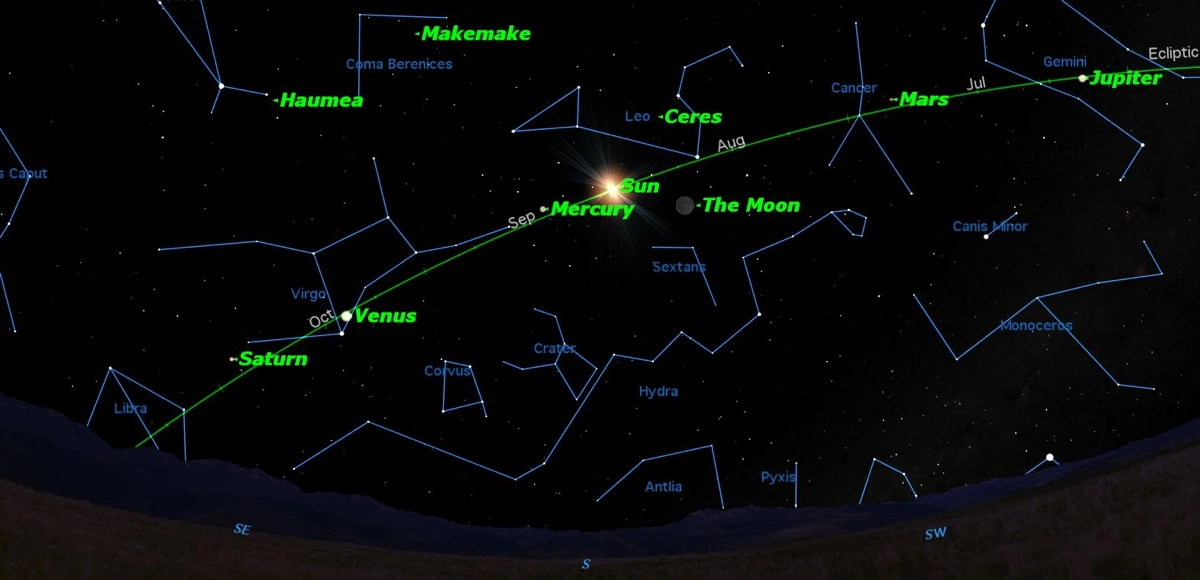
People are often curious about "alignments" of planets and right now there is quite a bit of a planetary alignment going on. But you won't be able to see it because the celestial meet-up occurs during the daytime, with the sun spoiling the show.
This is where planetarium software comes in handy, since it can help visualize things which you could never see with your eyes. With the click of a button you can remove the Earth's atmosphere and see the September sky undimmed by the light of the sun.
At present the sun, moon and five brightest planets — Mercury, Venus, Mars, Jupiter and Saturn — are all grouped within the span of four zodiac constellations: Gemini, Cancer, Leo, and Virgo. This is another way of saying that all seven objects are very close to falling in a straight line. Not only that, but three dwarf planets are not far away from this line: Ceres, Haumea, and Makemake. [Best Stargazing Events of September 2013 (Sky Map Gallery)]
Because these objects are close together in our sky and lie along a line does not mean that they are close together in space. In fact, they are spread through a wide depth of space.
The moon is nearest, currently 240,000 miles (390,069 kilometers) away. At the moment, it is between us and the sun, New Moon falling on Thursday, Sept. 5 at 7:36 a.m. EDT (1136 GMT). The side lit by the sun is facing away from us, and the "dark side" is facing towards us.
The sun is the next nearest object in this picture. At 93,699,454 miles (150,794,654 km), the sun is slightly farther away than its average distance, which is what astronomers use as a "measuring stick" for distances within the solar system. We call this the "astronomical unit" or AU, and it converts to 92,955,807 miles (149,597,871 km).
Because distances in space become unwieldy when measured in units familiar on the Earth's surface, using this large astronomical unit makes relative distances clearer. So, an alternate way of describing the sun's distance is to say that it is 1.008 AU away, a lot easier to comprehend than millions of miles.
Just to the left of the sun, as seen from the Northern Hemisphere, is the planet Mercury, 1.367 AU away. Or, in other words, about a third of the sun’s distance farther away from us.
A bit further to the left are Venus and Saturn, currently visible low in the western sky just after sunset. Both are in the constellation Virgo. Venus is just slightly farther away from us than the sun, 1.098 AU, considerably nearer than Mercury. Saturn is much farther away, 10.39 AU.
Off to the right of the sun, again as seen from the northern hemisphere, are the planets Mars and Jupiter, visible in the morning sky just before sunrise. Both are currently in constellation Gemini. Mars is more than twice as far away as the sun at 2.256 AU, and Jupiter farther still at 5.616 AU.
Finally we have three "dwarf planets."
This is a relatively new category of solar system object, distinguished by their medium size (smaller than planets, but larger than asteroids). Ceres is the nearest of the dwarf planets, 3.358 AU, which places it farther than Mars, but closer than Jupiter. Until recently, Ceres was classed with the asteroids, but astronomers now feel that its large diameter, 592 miles (952 km) warrants special place among the dwarf planets.
Haumea and Makemake, also dwarf planets, are marked by their vast distances from the sun, 51.52 AU and 53.17 AU respectively. To put these numbers in perspective, Neptune is 30 AU away and Pluto is 39 AU.
All these distances shrink to nothing when compared to those of the background stars. The nearest star in this picture, Sirius, is the bright star in the lower right corner, just setting in the southwest.
Sirius is 543,000 AU away from us, more than 10,000 times farther than Makemake. All the other stars in the picture are farther still.
Editor's note: If you snap a great photo of the planets, moon or any other night sky view that you'd like to share for a possible story or image gallery, send photos, comments and your name and location to managing editor Tariq Malik at spacephotos@space.com.
This article was provided to SPACE.com by Starry Night Education, the leader in space science curriculum solutions. Follow Starry Night on Twitter @StarryNightEdu.
