This weekend's full moon will be a somewhat special one in
that it will also carry the title of "harvest moon" for those living
in the Northern Hemisphere.
The moon officially turns full when it reaches that spot in
the sky opposite (180-degrees) to the sun in the sky and this moment will occur
on Sunday at 06:10 Greenwich Time (2:10 a.m. EDT . . . or in the Pacific Time
zone, it actually falls on Saturday night, October 3 at 11:10 p.m. PDT).
It turns out that this full moon is also the one that comes closest
on the calendar to the September
equinox. In 2009 this circumstance comes later than usual . . . into the
month of October, as opposed to the more traditional month of September.
Between 1970 and 2050, there are 18 years when the harvest
moon comes
in October. The last time was in 2006 and next time will be in 2017. The
2009 version of the harvest moon comes unusually late, although it can occur as
early as September 8 (as in 1976) or as late as October 7 (as in 1987).
Not a few people are under the impression that the harvest
moon remains in the night sky longer than any of the other full
moons we see during the year, but that's not so. What sets the harvest full
moon apart from the others is that farmers at the climax of the current harvest
season can work late into the night by the moon's light. It rises about the
time the sun sets, but more importantly, at this time of year, instead of
rising its normal average 50 minutes later each evening, the
moon seems to rise at nearly the same time each night.
For example, at New York City, moonrise on Oct. 3 is at 5:58
p.m. On Oct. 4, moonrise is 6:24 and on Oct. 5, it's 6:53. So compared to the
normal 50 minutes per night, around the time of the harvest moon moonrise comes
about 27 minutes later.
In actuality, the night-to-night difference is greatest for
more southerly locations. For example: Cocoa, Florida, located near latitude
28.4-degrees N, sees moonrise come an average of 34 minutes later. Meanwhile,
the difference is less at more northerly locations; at Priddis, Alberta, Canada located at latitude 50.9-degrees N, the average difference is 19 minutes.
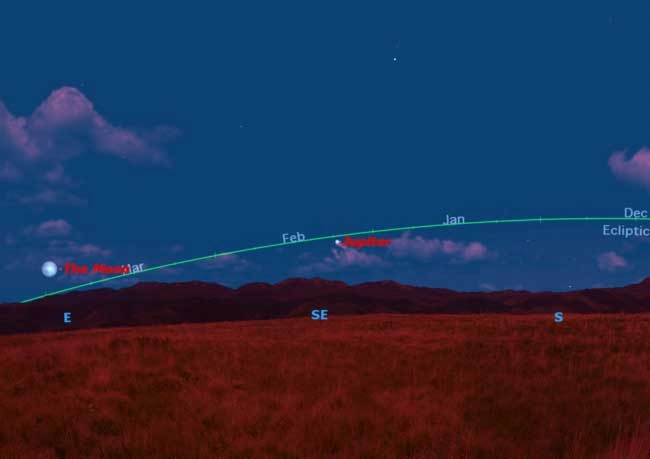
The reason for this seasonal circumstance is that the moon
appears to move along the ecliptic and at this time of year when rising, the
ecliptic makes its smallest angle with respect to the horizon for those living
in the Northern Hemisphere.
In contrast, for those living in the Southern Hemisphere, the ecliptic at this time of year appears to
stand almost perpendicular (at nearly a right angle) to the eastern horizon.
As such, the difference for the time of moonrise exceeds the average of 50
minutes per night. At Canberra, Australia (35.3-degrees S), for instance, the
night-to-night difference amounts to 63 minutes.
Interestingly, for those who live near 60-degrees north latitude, the
moon does indeed appear to rise at the same time each night around the time of
the harvest moon. And for those who live even farther to the north, a paradox:
the moon appears to rise earlier! At Reykjavik, Iceland (latitude
64.2-degrees N), for instance, the times of moonrise on Oct. 3, 4 and 5 will be,
respectively, 5:58 p.m., 5:54 p.m. and 5:50 p.m. So from Reykjavik, the moon
will seem to rise four minutes earlier each night.
Joe Rao serves as an
instructor and guest lecturer at New York's Hayden Planetarium. He writes about
astronomy for The New York Times and other publications, and he is also an on-camera
meteorologist for News 12 Westchester, New York.