


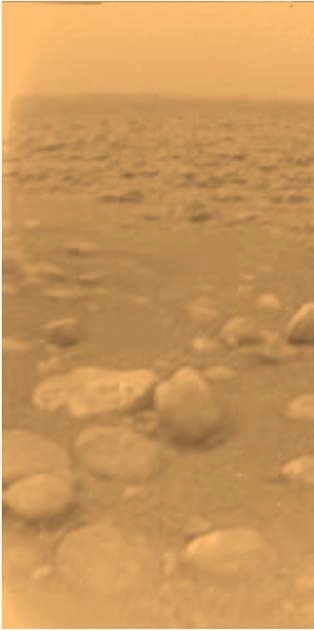
U.S. and European researchers arelauding the effectiveness of a network of ground-based telescopes that hasapparently salvaged a wind experiment feared lost during a mission to thesurface of Saturn's moon Titan.
Astronomerswere able to use a global group of radio telescopes and a simple signal tonebleated by Europe's Huygens probe during itsJan. 14 Titan landingto determine the moon's wind characteristics.
Earlyanalysis of the data has given researchers a good look at the winds of Titan,despite a communications errorthat prevented the probe's primary data target - NASA's Cassiniorbiter currently circling Saturn - from receiving wind observations from theHuygens probe.
"Theoriginal idea was to use Cassini's onboard receiverfor Doppler ranging and later the ground stations were for a second line ofsight," said Walter Brisken, a staff scientist forthe National Radio Astronomy Observatory (NRAO), in a telephone interview. "Butwe were pretty sure we had the sensitivity needed and were fairly confidentthat things would work out."
Briskenworked at the NRAO's Green Bank Telescope (GBT) inWest Virginia which first detected the Huygens probe's signal announcing itssuccessful entry into Titan's atmosphere. Other ground-based telescopes,including nine from the Very Large Baseline Array, monitored the Huygens signal.The Huygens probe itself was built by the European Space Agency (ESA).
Bycombining Doppler shift data from the Green Bank Telescope and other radioinstruments, astronomers now know that while Titan's winds are relatively weakat the moon's surface, they reach nearly 270 miles (434 kilometer) an hour atan altitude of about 75 miles (120 kilometers). At an altitude of about 37miles (59 kilometers), Huygens found highly variable winds that may be a regionof vertical wind shear, mission scientists said.
"I've neverfelt such exhilarating highs and dispiriting lows than those experienced whenwe first detected the signal from the GBT, indicating 'all's well' and thendiscovering that we had no signal at the operations center, indicating 'all'slost,'" said Doppler wind experiment principal investigator Michael Bird, ofGermany's University of Bonn, in a written statement. "The truth, as we havenow determined, lies somewhat closer to the former than the latter."
Ground-basedobservations of the Huygens probe's descent gave astronomers a glimpse at thenorth-south attributes of Titan's winds, but it was the Cassinispacecraft that was expected to return data on the moon's east-west windpatterns. While that data is lost, Huygens researchers say the ground data wasable to track the spacecraft's Titan descent to within three-quarters of a mile(one kilometer) and ultimately yield a three-dimensional picture of the probe'slanding.
"It's sortof an awakening of sorts," Brisken said. "Now that wehave the technology to do this so easily, it might be a more normal thing inthe future."
- Touchdown on Titan: Huygens Probe Hits its Mark
- Complete Coverage of the Cassini-Huygens Mission
