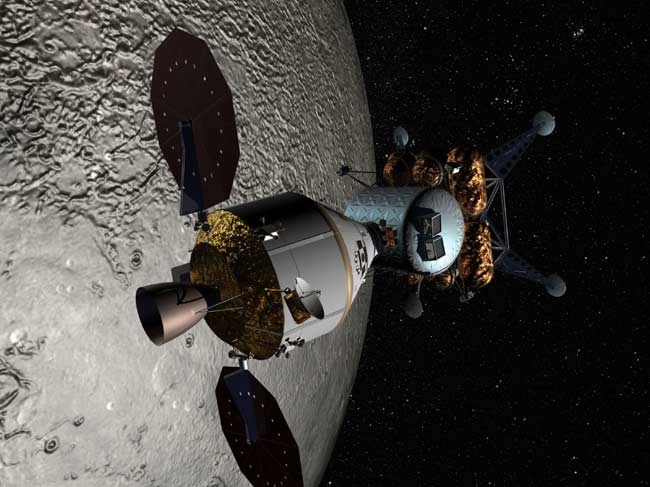
NASAis appraising a human mission to a near-Earth asteroid--gauging the scientificmerit of the endeavor while testing out spacecraft gear, as well as masteringtechniques that could prove useful if a space rock ever took aim for ourplanet.
Spaceagency teams are looking into use of Constellation hardware for a human Near-EarthObject (NEO) mission--an effort underway at NASA's Ames Research. Another studyis delving into use of Constellation components to support an automated Marssample return mission. That study is led by NASA's Jet Propulsion Laboratory in Pasadena, California.
TheConstellation Program encompasses NASA's initial efforts to extend the humanpresence throughout the solar system.
Majorpieces of the Constellation Program--such as the Orion crew vehicle--are meant tosupport transport of humans and cargo to the Moon and to the InternationalSpace Station, while future efforts would sustain missions to Mars and beyond.
Astronauts,engineers and scientists at NASA's Johnson Space Center in Houston, Texas have been lookinginto the capabilities of the Orion vehicle for a mission to a near-Earthasteroid.
Significant assets
"Ahuman mission to a near Earth asteroid would be scientifically worthwhile,"said Chris McKay, deputy scientist in the Constellation science office at the NASA Johnson Space Center. "It could be partof an overall program of understanding these objects. Also, it would be useful,instrumentally, in terms of understanding the threat they pose to the Earth."
Stationedat NASA's Ames Research Center located in California's Silicon Valley, McKaytold SPACE.com that work is underway to evaluate the science enabled bysending crews to asteroids, and to judge how best to assure safe and efficientexploration.
Asteroidsare relics from early solar system formation, McKay pointed out. "Then there'sthe whole, what I call the 'Bruce Willis factor'...the star in the movie Armageddon...andthe ability to send significant assets to an asteroid."
"There'sa lot of public resonance with this notion that NASA ought to be doingsomething about killer asteroids...to be able to send serious equipment to anasteroid," McKay observed. "The public wants us to have mastered the problem ofdealing with asteroids. So being able to have astronauts go out there and sortof poke one with a stick would be scientifically valuable as well as demonstratehuman capabilities," he said.
McKayemphasized that it's premature to send off a piloted mission to an asteroid todo countermeasure activities. "There could be testing of various approaches.But we don't know enough about asteroids right now to know the best strategyfor mitigation," he said.
Forward looking reasons
"It'sa terrific mission if we can do it...and if it programmatically makes sense,"said Former Apollo astronaut, Russell Schweickart, Chairman of the B612Foundation, a group with the goal of significantly altering the orbit of anasteroid, in a controlled manner, by 2015.
Schweickartsaid that there are a number of "forward looking reasons" to put asteroids onNASA's lofty Moon, Mars and beyond agenda.
Thevalue of asteroids for on-the-spot resources, for one, was noted bySchweickart. Secondly, validating command and control skills in piloting up to anasteroid would be beneficial, he said.
Furthermore,a human venture to a space rock may well accelerate precursor robotic surveysof asteroids, Schweickart observed. "Early unmanned visits to asteroids...it'sthe same pattern as we did with the Moon and we're doing right now with Mars.It's all pretty logical," he told SPACE.com.
Publicawareness regarding asteroids, via a human exploration initiative, would behelpful, Schweickart said. It's an opportunity for the public to be educated inreality, not in terms of Hollywood's version of asteroid-busting as seen in the movie, Armageddon.
Quick dash
Clearly,it will be first-things-first in testing the new Constellation architecture.And that means going to low-Earth orbital missions to wring out the systems andprocedures. These are likely to be followed in rather quick succession by lunarorbital and landing missions.
"Buta very natural, early extension of the exploration capabilities of this newvehicle architecture would be a 'quick dash' near-Earth asteroid rendezvousmission," said Dan Durda, a senior research scientist in the Department ofSpace Studies at the Southwest Research Institute, Boulder, Colorado.
"Thatkind of early demonstration mission might last no more than 60 or 90 days,"Durda said, "and take the crew no farther than a few lunar distances away fromEarth."
Durdasaid he could imagine that such a flight might be made before the first lunar landingeven--perhaps after a lunar orbital mission or two--in order to try outspacecraft systems on an even longer-duration flight.
Primo science and samples
Whatwould a space crew do once they've arrived at an asteroid?
There'sclearly engineering and program benefits, but also factoring in scientificinvestigations, the humans-to-an-asteroid idea becomes even more compelling,Durda suggested.
Still,as NASA's NEAR-Shoemaker and Japan's Hayabusa robotic efforts verified, good asteroidscience can be done minus humans on the scene.
"Butlook at how having astronauts actually there on the Moon improved both thequantity and quality of the science return from Apollo," Durda responded."People have the judgment and creativity to select the best places to explore,"he said, and coupled with the dexterity offered by on-site, no-delay use oftelerobotics in early missions, can gather primo science and samples.
Access to space resources
Ingeneral, a human mission to an asteroid offers an opportunity to takelunar-capable hardware and extend its reach to deep-space much sooner thanwould development of a full-up Mars-capable spacecraft, advised formerastronaut, Tom Jones, a veteran of four shuttle flights.
Expeditionarytreks to the asteroids enable NASA to grapple with many of the deep-spacechallenges in operations, communications, and life support without committingto a multi-year Mars mission profile, Jones told SPACE.com.
"Andwe should gain immediate scientific returns, potential access to spaceresources like water, and familiarity with complex operations around objectsthat present a potential hazard to Earth," Jones added.
Canthe infrastructure coming out of the Orion Crew Exploration Vehicle work beutilized for asteroid journeys?
TheCrew Exploration Vehicle could be the nucleus of an asteroid mission, Jonessaid, furnishing some of the propulsion, communication, and habitation spaceneeded, as well as the obvious reentry capability.
"Byusing the low Earth orbit-rendezvous approach planned for lunar missions, aspacecraft using other Constellation or International Space Station componentsmight be able to perform a multi-month mission to a near-Earth object in afavorable orbit," Jones said.
Deep-space thoughts
Ahuman mission to an asteroid could be viewed somewhat as a gap-filler.
"Aftera lunar visit, we face a long interval in Earth-Moon space while we build upexperience and technology for a Mars mission," Jones suggested. An asteroidmission "could take us immediately into deep-space, sustaining programmomentum, adding public excitement, and reducing the risk of a later Marsmission," he said.
"Near-Earthobject exploration is especially important if the Moon turns out to be bereftof extractable resources," Jones pointed out. "Astronauts could collect a richarray of samples from the most scientifically interesting sites on thenear-Earth object--dating back to the earliest days of the solar system--set up apilot resource extraction experiment, demonstrate technology necessary for afuture near-Earth object deflection mission, and look back at Earth frommillions of miles away. The view would be breathtaking," he said.
Ahuman journey to an asteroid stretches our deep-space legs, Jones said, "andchallenges ourselves operationally even after we return to the Moon."
Thekey to sustaining a long and spirited exploration program "is to keep newresults coming in and our imaginations looking out...way out beyond the Moon,"Jones concluded.
- IMAGES: Walking on the Moon in 3D
- Solving Settlement Problems: Dealing with Moon Dust
- Earth's Air Trapped in Moon Dirt, Scientist Speculates
- Wanted: Fake Moon Dirt
- All About the Moon