

newsarama.com
advertisement
Dark Matter: Hidden Mass Confounds Science, Inspires Revolutionary Theories

By Andrew Chaikin
Editor, Space & Science
posted: 07:00 am ET
08 January 2002

Cosmic Mysteries 1: Dark Matter

Once upon a time a bit more than 100 years ago many scientists believed that seemingly empty space wasnt empty at all, but was filled with a substance called luminous ether. This mysterious stuff, never seen in any laboratory on Earth, was thought to explain how gravity from one celestial body could affect another.

By the end of the 19th century, though, luminous ether had gone the way of countless other scientific misconceptions. Today, another mysterious substance beguiles astronomers, and this one isnt going away. In fact, its been at the forefront of cosmological theories for decades. Its called dark matter, and it is now widely accepted by astronomers as the stuff most of the universe is made of.

"Weve known that it exists for more than 25 years," says astronomer Virginia Trimble of the University of California Irvine. "But we dont know what the hell it is." able -->


SCIENCE TUESDAY
Visit SPACE.com to explore a new science feature each Tuesday.
>>Go to Science Tuesday archive page

   Images

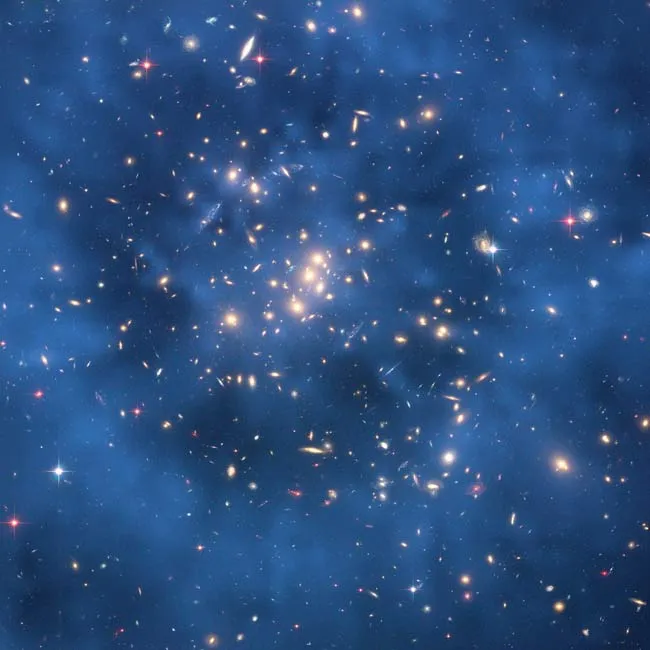
The cluster of galaxies EMSS 1358+6245 is about 4 billion light-years away in constellation Draco. When imaged with the Chandra X-ray Observatory, scientists determined the mass of dark matter there is four times larger than normal matter. Click to enlarge.


This first image of a dark matter object is a nearby red dwarf star. Six years ago, it gravitationally focused light from a blue background star in another galaxy in a so-called microlensing event. Since then, red dwarf has moved slightly in the sky and so is clearly separated in the new image.


A computer simulation shows the expected distribution of dark matter in the universe. Colored dots indicate galaxies, which appear to trace out the major features in the dark matter.

   Related SPACE.com STORIES

Dark Matter, Real Matter Work in Concert to Build Cosmos


Moon Helps Hunt for Mystery Particles


'Groundbreaking' Discovery: First Direct Observation of Dark Matter

   TODAY'S DISCUSSION
What do you think of this story?
>>Uplink your views

How can astronomers be so certain of something they have never seen? The answer comes from observations of how stars and galaxies move, studies that have been going on for more than 50 years. Within spiral galaxies, individual stars and clouds of gas are orbiting faster than they should if they were only being affected by the gravity of the galaxys visible matter. The same is true for clusters of galaxies: The motions of individual galaxies cant be explained by the gravity of what astronomers can see.

To explain these observations, astronomers have deduced that galaxies are surrounded by vast halos of a different, unseen kind of matter.

This so-called dark matter is invisible to us because it does not radiate energy. But it does have mass, and that means it can supply the extra gravity necessary to hold galaxies, and clusters of galaxies, together. Even in the bizarre world of cosmology, its a strange proposition.

But is dark matter the only explanation?

Perhaps scientists dont entirely understand the way gravity works; perhaps Isaac Newtons famous law of gravitation needs some revising. But that idea, says the University of Arizonas Chris Impey, is not very popular.

"Definitely most astronomers are extremely unwilling to give up Newtons law," he says. "So its essentially a choice of two evils: You either hypothesize that Newtons law is wrong, and that our knowledge of the gravity theory is incomplete. Or, you hypothesize a fundamental microscopic particle that has never been detected in any physics lab, whose properties are only constrained by these astronomical observations. Which is a pretty uncomfortable position for physicists to be in."

Still, as Trimble explains, dark matter is the lesser of the two evils, simply because it requires fewer departures from accepted physics.

To explain the observations by revising the theory of gravity, astronomers would have to identify a few different effects, each of which would operate at a different distance scale. But with dark matter as the explanation, Trimble says, "You only need one Tooth Fairy."

And even though astronomers cant see dark matter directly, they can observe its effects by looking at clusters of galaxies that act as gravitational lenses. The gravity of these clusters bends the light from more distant galaxies, just as an optical lens would. By analyzing these effects using computer models, astronomers have determined the mass of these clusters and found that once again, dark matter must be abundant.

In fact, astronomers believe there is so much dark matter in the universe that it outnumbers normal matter by a ratio of perhaps 10 to 1.

If you could see dark matter, say astronomers, most galaxies, including our own Milky Way, would appear 10 times larger than they do in telescopes. All the familiar inhabitants of the cosmos stars, galaxies, planets, and clouds of gas and dust are just a small fraction of whats out there.

And yet, for something so ubiquitous, dark matter has proved incredibly elusive. Here on Earth, dark matter could be passing by us or perhaps, through us but we dont notice. In part thats because dark matter rarely, if ever, interacts with normal matter. Its also far more widely scattered than normal matter. "Compared to anything that were aware of on Earth," says Trimble, dark matter is "incredibly diffuse."

Next Page: So what's dark matter like?

1 2    | >> Continue with this story >


Starry Night Screensaver
$19.95
Explore More


Site Map | News | SpaceFlight | Science | Technology | Entertainment | SpaceViews | NightSky | Ad Astra | SETI | Hot Topics
Image Galleries | Videos | Reader Favorites | Image of the Day | Amazing Images | Wallpapers | Games | Community
about us | FREE Email Newsletter | message boards | register at SPACE.com | contact us | advertise | terms of service | privacy statement
DMCA/Copyright
  What is This?