


SAN DIEGO -- The previous record holder for largest known star has been bumped into fourth place.
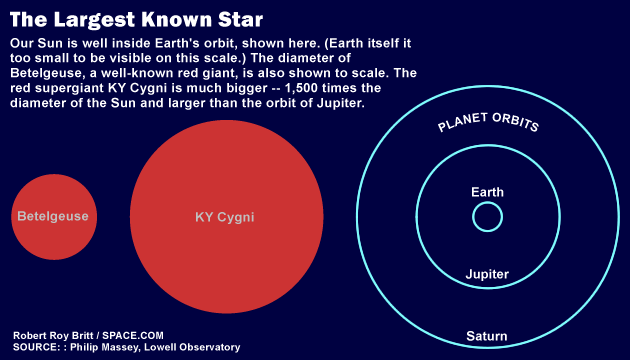
In a survey of 74 known supergiant stars in our Milky Way Galaxy, three have emerged as larger than any others so far measured. Each of the new chart toppers is about 1,500 times the diameter of our Sun, or roughly 7 times bigger than the Earth's solar orbit.
If Jupiter tried to exist in its same orbit around any of these newly measured supergiants, it would be vaporized.
The finding was announced here today at a meeting of the American Astronomical Society.
These are not abnormal stars. Rather, they're bloated senior citizens suffering a fate similar to that forecast for our Sun. However, the Sun, now middle-aged, has never been and never will be as massive as the supergiants, and so it will only achieve red giant status at about 100 times the diameter it is today. Even that will be bad news for Earth in a few billion years.
The newly crowned largest stars, already known to astronomers as KW Sagitarri, V354 Cephei and KY Cygni, are all in our Milky Way galaxy and within 10,000 light-years of the Sun. A light-year is the distance light travels in a year, about 6 trillion miles (10 trillion kilometers).
They barely beat out the star that was bumped from first to fourth, known popularly as Herschel's Garnet Star.
More significant than finding record setters, astronomers were also able to make more accurate measurements of each stars' temperature -- about 10 percent warmer than thought -- and the combined observations lay to rest a longstanding discrepancy with theory.
"For the first time in many decades there is good agreement between the theory of how large and cool these stars should be, and how large and cool we actually observe them to be," explained Philip Massey, an astronomer at Lowell Observatory who led the work.
Despite their tremendous diameters, the stars are not the most massive in the universe, said MIT undergraduate student Emily Levesque, who presented the findings. At just 25 solar masses, these red supergiants would look like wimps in a weigh-in against stars that can be up to150 times the mass of the Sun.
The most well-known red supergiant is Betelgeuse, which is about 650 times the diameter of the Sun and, owing in part to its proximity, is the 10th brightest star in our night sky.
- The Heaviest, Brightest Star Known
