





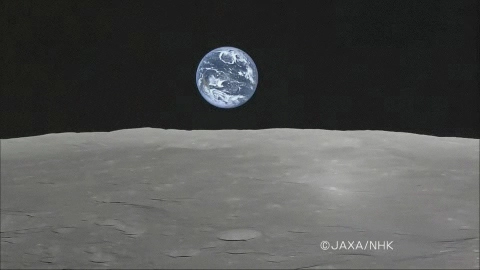
A Japanesespacecraft orbiting the moon has beamed back stunning footage of a round, blueEarth rising above the lunar horizon.
The high-definitionvideo camera aboard Japan?s lunar orbiter Kaguya caught the rare view of thefull Earth as it rose above the moon?s horizon on April 5, the Japan AerospaceExploration Agency (JAXA) officials said in a recent statement after releasing a shortvideo of the event.
?This isthe first time that a high-[definition] image of the ?Full Earth-rise? has beencaptured from space,? JAXA officials said.
The sun,Earth, moon and Kaguya have to line up just right in order to present a full,orb-like Earth to the spacecraft?s camera, an arrangement that only occursabout twice a year, they added.
The three-tonKaguya spacecraft recorded the rising Earth view from lunar orbit at a distanceof about 236,121 miles (380,000 km) from its home planet.
The probe?shigh-definition television camera, which was provided by the Japan BroadcastingCorporation (NHK), has recorded an Earthrise before during aNov. 7, 2007 orbit. But that pass caught a waning Earth, not the full,bright disc spotted on April 5, JAXA officials said.
Named aftera moon princess in a Japanese folktale, Japan?s Kaguya spacecraft launchedtoward the moon in September 2007 on a one-year mission to explore thelunar surface. JAXA officials have since said that the flight of Kaguya, alsoknown as the SELenological and ENgineering Explorer (SELENE), may be extended.
The 55billion-yen ($480 million) orbiter carries 14 science instruments, includingthe high-definition camera, to study the lunar surface from an altitude ofabout 62 miles (100 km). The probe has also successfully deployed two miniaturesatellites to map the moon?s gravitational field.
- NEW VIDEO: A Full Earthrise at the Moon
- The Top 10 Views of Earth from Space
- Vote: The Best Moon Image
