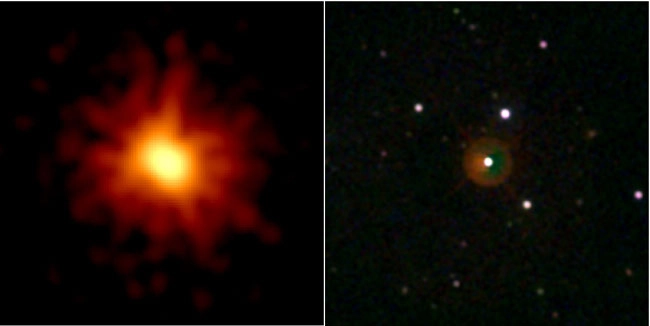
A powerfulstellar explosion that has shattered the record for the most distant objectvisible to the naked eye was detected by NASA's Swift satellite on Wednesday.
Theexplosion, known as a gamma-rayburst, also ranks as the most intrinsically bright object in the universeever observed by humans.
"It'samazing ? we've been waiting for a flash this bright from a gamma-ray burstever since Swift began observing the sky three years ago, and now we've got onethat is so bright that it was visible to the naked eye even though its sourceis half-way across the universe," said David Burrows of Penn StateUniversity, who directs the continuing operation of Swift's X-ray telescope andthe analysis of the data it collects.
Gamma-raybursts are the most luminous explosions in the universe since the BigBang and occur when massive stars run out of nuclear fuel. The stars' corescollapse to form black holes or neutron stars and release an intense burst ofhigh-energy gamma-rays and jets of energetic particles.
The jetsrip through space at nearly the speed of light, heating the surroundinginterstellar gas like turbocharged cosmic blowtorches, often generating abright afterglow.
"Theseoptical flashes from gamma-ray bursts are the most extreme such phenomena thatwe know of," said Swift science team member Derek Fox, also of Penn State. "If this burst had happened in our galaxy, it would have been shiningbrighter than the Sun for almost a minute ? sunglasses would definitely beadvised."
Penn State astronomer and Swiftteam member Peter Meszaros said an unusual combination of circumstances mayhave made the burst's afterglow so exceptionally bright in the visiblewavelengths of light.
"Whenthe jet that formed during the explosion of the star slammed into thesurrounding gas clouds, shock waves were generated that heated the jet,"he explained. "The exceptional brightness of this burst requires the jetto have just the right combination of magnetic fields and velocity, whichoccurs very rarely."
Astronomersdon?t know for sure what made the burst, dubbed GRB 080319B, so bright, butfurther analysis of the event is under way. The burst could possibly have beenmore energetic than others, or the burst's energy may have been concentrated ina jet aimed directly at Earth.
Theafterglow of GRB 080319B was 2.5 million times more luminous than the mostluminous supernova ever recorded, making it the most intrinsically brightobject ever recorded.
Astronomershave placed the star in the constellation Bo?tes. They have estimated it to be7.5 billion light years away from Earth, meaning the explosion took place whenthe universe was less than half its current age and before Earth formed.
The mostdistant previous object that could be seen by the naked eye is the galaxy M33,a relatively short 2.9 million light-years from Earth.
The burstwas detected by Swift at 2:12 EDT on March 19 and was one of five gamma-raybursts detected that day, the same day that famed science fiction writer Arthur C.Clarke died.
"Coincidentally,the passing of Arthur C. Clarke seems to have set the universe ablaze withgamma-ray bursts," said Swift science team member Judith Racusin, a Penn State graduate student.
- Video: Searching for SuperStars
- The 10 Brightest Stars
- Top 10 Star Mysteries