





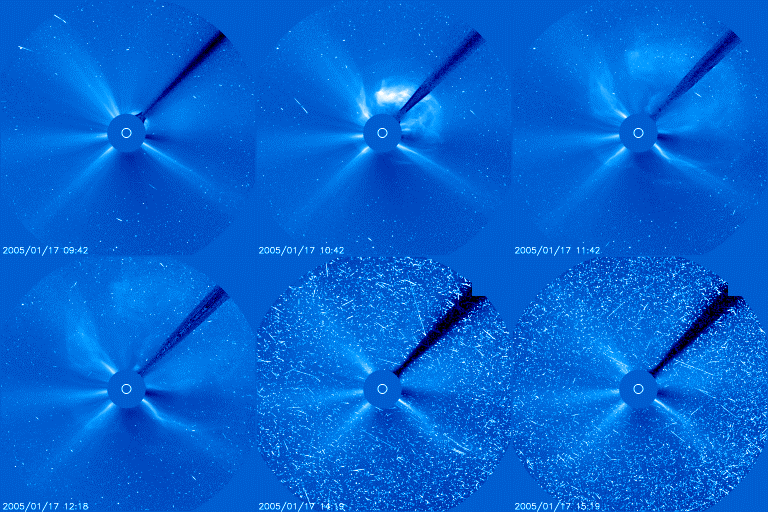
The Sun-watching SOHO spacecraft turns 10 this Friday, Dec. 2, having survived a trio of near-death experiences and outlasted its original mission timeline by eight years.
Oh, and it has provided unprecedented pictures of the Sun, allowed the discovery of more than 1,000 comets, and served as the foundation for a space-weather forecast system that did not exist a decade ago.
The Solar and Heliospheric Observatory (SOHO) is a collaboration between NASA and the European Space Agency (ESA). Its data and images have helped scientists make significant advances in understanding how the Sun works.
"It's impossible to overstate the importance of SOHO to the worldwide solar science community," Joe Gurman, U.S. project scientist for SOHO at NASA's Goddard Space Flight Center, said today. "In the last ten years, SOHO has revolutionized our ideas about the solar interior and atmosphere and the acceleration of the solar wind."
It's also hard to fathom how the craft endured so long. In 1998 it lost control. Three months later its gyros went kaput. And in 2003 its high-gain antenna became stuck and the mission seemed doomed yet again.
"I tip my hat to SOHO's engineering and operations teams, whose skills and dedication have overcome multiple technical challenges over the last decade," said Bernhard Fleck, ESA Project Scientist for SOHO.
Among SOHO's accomplishments:
- Supplying the most detailed and precise measurements beneath the surface of the Sun.
- Providing the first images of a star's turbulent outer shell (the convection zone) and of the structure of sunspots beneath the solar surface.
- Making the Sun transparent by creating images of the sun's far side, including stormy regions there that will turn with the sun and threaten the Earth.
- Discovering a mechanism that releases more than enough energy to heat the Sun's atmosphere (corona) to 100 times its surface temperature.
- Monitoring the Sun's energy output (the "total solar irradiance" or "solar constant") as well as variations in extreme ultraviolet radiation, both of which are important to understand the impact of solar variability on Earth's climate.
- Identifying the source regions and acceleration mechanisms of the solar wind, a thin stream of ionized gas that constantly flows from the sun and buffets Earth's magnetosphere.
One of SOHO's most important contributions is data that led to the discovery that a series of eruptions of ionized gas (coronal mass ejections) from the Sun blasts a "highway" through space where solar energetic particles flow. These particles disrupt satellites and are hazardous to astronauts outside the protection of Earth's magnetic field.
SOHO data are freely available over the Internet, and people all over the world have used images from the observatory to discover more than 1,000 comets.
The observatory was originally designed for a two-year mission, but its scientific insights have proven so valuable that NASA has consistently granted extensions, the latest of which allows the spacecraft to monitor a complete 11-year solar cycle.
The Sun is now near the low point in this 11-year cycle of activity.
- Top 10 Sun Images from SOHO
- SOHO Image Wallpaper for Your Desktop
- SOHO Cool! Image Gallery
