


You might havethought Saturn's moon Titan was a somewhat dead issue after the Cassinispacecraft did not find convincing evidence for methane seas that scientistshad predictedwould exist.
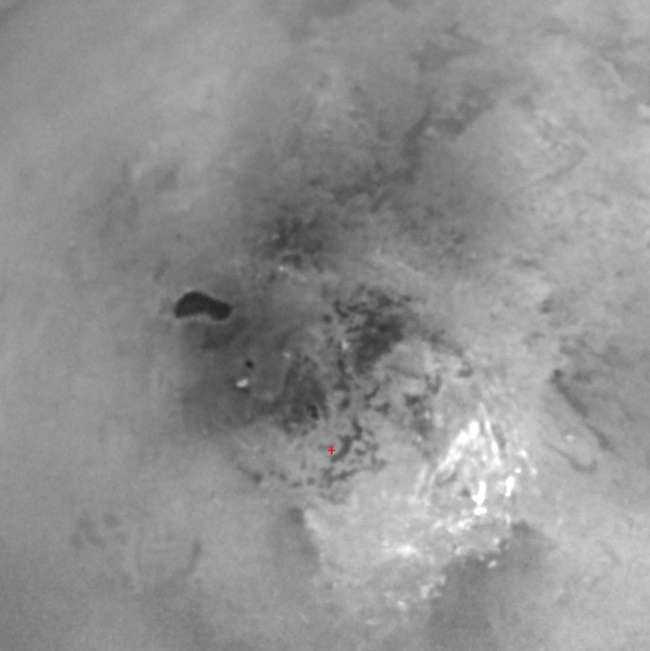
But the smoggy moonis back in the news today as a new Cassini image reveals a darkfeature that scientists speculate might be a lake.
The feature is"remarkably lake-like," according to a NASA statement that noted theappearance of smooth, shore-like boundaries unlike any seen previously onTitan.
"I'd saythis is definitely the best candidate we've seen so far for a liquidhydrocarbon lake on Titan," said Alfred McEwen, imaging team member and aprofessor at the University of Arizona.
The feature is145 miles long by 45 miles wide (230 by 70 kilometers), or about the size ofLake Ontario on the U.S. Canadian border.
The possiblelake is under the densest clouds on Titan. Scientists speculate methane rainsmight have fallen there recently.
"It'spossible that some of the storms in this region are strong enough to makemethane rain that reaches the surface," Cassiniimaging team member Tony DelGenio of NASA's GoddardInstitute for Space Studies in New York. "Given Titan's cold temperatures,it might take a long time for any liquid methane collecting on the surface toevaporate. So it might not be surprising for a methane-filled lake to persistfor a long time."
It's alsopossible the feature was once a lake, but has since dried up, leaving behinddark deposits, said Elizabeth Turtle, Cassini imaging team associateat the University of Arizona. Or the region is simply a broad depression filledby dark, solid hydrocarbons falling from the atmosphere onto Titan's surface.In this case, the smooth outline might be the result of a process unrelated torainfall, such as a sinkhole or a volcanic caldera.
A previousimage of Titan revealed what scientist believe to be avolcano.
"It isalready clear that whatever this lake-like feature turns out to be, it is onlyone of many puzzles that Titan will throw at us as we continue ourreconnaissance of the surface over the next few years," said Carolyn Porco, imaging team leader at the SpaceScience Institute in Boulder, Colo.
Officials plan39 more Titan flybys.
- Cassini Special Report
