This story was updated at 12:32 p.m. ET.
WHITE SANDS, New Mexico ? NASA launched a powerfulemergency escape system for its new Orion spacecraft on a successful testflight Thursday, even as plans for the crew capsule are still beingrestructured.
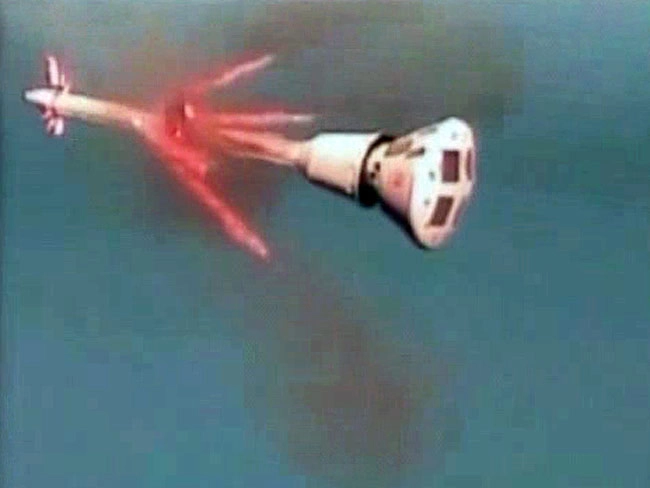
Called Pad Abort-1, the $220 million Orionescape system test showcased the system that could be used to rescue a crewand its spacecraft in case of emergencies at the launch pad. The test wasconducted here at the U.S. Army?s White Sands Missile Range in New Mexico.Liftoff occurred on time at 9 a.m. EDT (1300 GMT).
"Beautiful flight!" a test flight controllersaid after liftoff. This SPACE.comgraphic shows how the escape system would work.
Roaring off into New Mexico skies, the Launch Abort Systempropelled a boilerplate Orion crew module to some 6,000 feet (1,828 meters)altitude on an arcing trajectory above the desert landscape. The entire testlasted just 97 seconds.
After a rapid-fire sequence of events, including mid-airreorientation, drogue and main parachute deployments, the capsule landed about6,919 feet (2,108 meters) ? a bit farther than expected.
"Wow,that went like clockwork from what I can see," said JayEstes, NASA's deputy manager of the Orion project office. "That's anamazing test."
Thelaunchabort system is designed to activate within milliseconds in the event of anemergency on the launch pad or during initial ascent.
NASAofficials reveled in the launch escape system's successful test, which was thefirst of its kind in more than 40 years.
"It'sthe first abort system the U.S. has developed since Apollo," said DougCooke, NASA's associate administrator for exploration systems, after the test."It was a tremendous success."
Safer space vehicles
NASA officials noted that, although Orion is a componentof the agency?s Constellation program that?s now under both White House andCongressional scrutiny, today?s test is part of the space agency?s ongoingmission to develop safer space vehicles for all human spaceflight applications.
?It?snice to know it?s there. You never really want to use it, but having it thereand knowing you have an out is a big plus," NASA astronaut Scott Altmantold SPACE.com after watching the successful test launch. "It?s the abortsystem that adds that extra level of safety that?s going to get us to the placewe want to be for ascent abort safety."
President Barack Obama said in an April 15 speech atNASA?s Kennedy Space Center that he favors use of the Orion Crew ExplorationVehicle in a stripped-down version to serve as an astronautlifeboat attached to the International Space Station.
Today?s Pad Abort-1 test made use of three solidpropellant rocket motors: an abort motor, an attitude control motor, and ajettison motor:
- The primary motor is the abort motor, which is used to propel the crew module away from the pad.
- The attitude control motor steers the vehicle to actively maintain stability and reorient it as needed.
- The jettison motor pulls the whole launch abort system away from the crew module and clears the way for parachute deployment and landing.
In addition to the motor stack, the launch abort systemalso included a fairing assembly that covered the boilerplate Orion crewvehicle and its nose cone.
The test flight was initiated by command from a speciallybuilt mobile operations facility ? a large trailer acting as mission control.That command ignited both the Launch Abort System?s abort and attitude controlmotors, pulling the crew module in an upward trajectory from the pad to aroughly mile-high altitude.
Government, industry team
An array of NASA centers and contractors were involved intoday?s Pad Abort-1 test.
The test module and launch abort system stack were builtat NASA?s Langley Research Center in Virginia. Systems installation andintegration took place at NASA?s Dryden Flight Research Center at Edwards AirForce Base in California.
NASA?s Langley leads the development of the LAS inpartnership with the space agency?s Marshall Space Flight Center. Dryden isconducting the launch abort flight test effort for the Orion Project Office atthe Johnson Space Center, Houston.
On the industrial side of the test, Lockheed Martin isthe prime contractor to NASA for the Orion crew exploration vehicle. OrbitalSciences Corporation is responsible for the design, development, test andintegration of the Launch Abort System for Lockheed Martin.
?I know my guys areflying high,? said former astronaut Frank Culbertson, now Senior Vice Presidentand Deputy General Manager of Orbital Sciences Corporation?s Advanced ProgramsGroup.
Culbertson toldSPACE.com that today?s test was important for a number of reasons.
?You needed tocomplete this test to make sure you really did understand what you weredoing?because we are going to continue to fly people in space," he said."Whether it?s a commercially provided vehicle, or a governmentvehicle?you?re going to need a launch abort system to insure their safety.?
Alliant Techsystems, or ATK, developed the attitudecontrol motor, which includes eight thrusters producing up to 7,000 pounds ofthrust. ATK also developed the abort motor to pull the capsule away from thelaunch pad.
Aerojet of Sacramento, Calif., developed the jettison motor, which is the only motor of the three thatwould be used in all flight cases to pull the escape tower from the crewmodule.
Whileeuphoria, slaps on the back, and thumb's up signs were part of the visible scene here,where the Orion program is headed remains foggy.
?Right now we?re inthe process of trying to define what the program going forward is going to beand what the sequence will be,? said Douglas Cosens, Aerojet's Orion projectexecutive. ?We don?t know exactly what the next steps are as the Administrationand Congress figure out the next steps for human spaceflight and for the Orionprogram. But certainly what took place here today is a demonstration of aninnovative and new technology. We have lots of hope for the future of thissystem.?
- The Best Manned Spacecraft of All Time
- NASA's Most Memorable Missions
- How Can Astronauts Escape From an Exploding Rocket?
LeonardDavid has been reporting on the space industry for more than five decades. Heis past editor-in-chief of the National Space Society's Ad Astra and SpaceWorld magazines and has written for SPACE.com since 1999.