
newsarama.com
advertisement
Will Nuclear Power Put Humans On Mars?
Plasma Rockets Could Propel Man to Mars
Nuclear Power: The Future of Spaceflight?
NASA Prods Public to Tell Agency Where to Go; What to Do
NASA To Go Nuclear; Spaceflight Initiative Approved
By Leonard David
Senior Space Writer
posted: 12:20 pm ET
05 February 2002

NASA GOES NUCLEAR


ALBUQUERQUE,NEW MEXICO For the first time in a decade, NASA has been given the go-aheadto say the N word nuclear power for space.


TheWhite House-backed NASA budget for fiscal year 2003 includes a major nuclearsystems initiative that sets the stage for faster trip times by spacecraftexploring the solar system and powering human outposts on distant worlds.


Thatannouncement was heralded here at the Space Technology & ApplicationsInternational Forum (STAIF-2002) meeting, an amalgam of conferences thatincludes the 19th symposium on space nuclear power and propulsion.


Battlingdistance and time


InMondays budget briefing in Washington, D.C., new NASA chief, Sean OKeefe,declared that the space agency was ready to battle a distance and timedilemma that now inhibits the organizations exploration and discovery agendafor the 21st century.


Towrestle with, defeat and conquer that distance and time paradox, OKeefe saidNASA seeks a nuclear power and propulsion capability. Doing so, however, comesat a price the deferral of the Pluto Kuiper-Belt flyby and Europa orbitermissions, both in NASAs Outer Planets program that is now cancelled. In itsplace is a new effort that is tagged the New Frontiers Program.


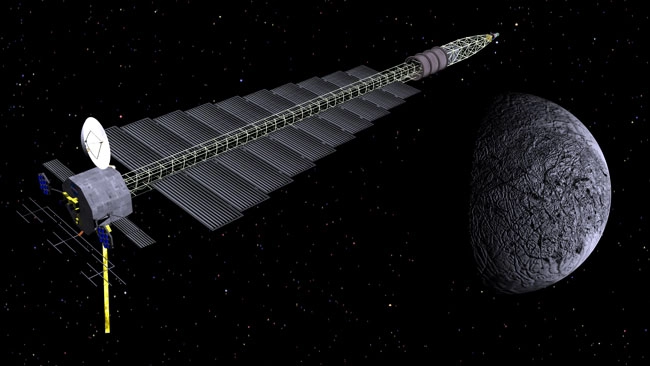
Thesespacecraft missions would ostensibly benefit by NASAs new space nuclear powerinitiative. For instance, a future Pluto probe -- propelled by nuclear electricengines, would permit orbiting that distant planet instead of a quick flyby andrelaying data in higher fidelity, OKeefe said.


Steamengines for space


Thespace agencys nuclear systems initiative consists of two parts, both of whichinvolve partnering with the Department of Energy, said Edward Weiler, NASAshead of space science during the budget briefing.


Onthe development side, work on radioisotope generators (RTGs) is to be startedup again. The civilian inventory of RTGs currently is one, Weiler said.


Moneyis also to be spent on a new technology, specifically on a StirlingRadioisotope Generator (SRG). This device, among its duties, could powerrobotic Mars rovers, especially for missions of long duration. SRGs are beingevaluated as a high-efficiency power source alternative to replace RTGs, likethose used on the Viking, Galileo, Cassini, and Voyager spacecraft missions.


Weilersaid the nuclear initiative also is gearing up to conduct research in nuclearpower and propulsion, such as nuclear fission reactors coupled to ion driveengines.


For40 years, NASA has been doing planetary science in the same way. That is, youaccelerate for 5 to 10 or 15-minutes and then you stopand you coast, and youcoast, and you coast. Occasionally, Jupiter will be just in the right spot andyou can get a little slingshot effectbut its not always there. Thats not theway to do exploration. Thats exploring the west by going in covered wagons,Weiler said.


Rather,Weiler added, the space nuclear initiative allows NASA to start development ofthe steam engine, so we can get the railroads going out there into the solarsystem.


Werenow in an environment where we can talk about nuclear initiatives.
This is the right thing to do for science and exploration, Weiler said.


Welcomednews


NASAsspace nuclear agenda was strongly applauded here at the STAIF-2002 meeting.Experts from such agencies as the Department of Energy, Los Alamos NationalLaboratory and Sandia National Laboratory, including numbers of old-timers inpower and propulsion, expressed satisfaction that the space agency is openlyembracing space nuclear power again.


Thiskind of announcement is welcomed news, said Gerald Kulcinski, associate deanfor research at the College of Engineering at the University ofWisconsin-Madison.


Kulcinskitold SPACE.com that there is an increasing enrollment of studentsinterested in the nuclear industry over the last few years. We see thataccelerating in the next few years, mainly in the area of power production inthe United States. This kind of announcement will add to that because there isa particular resonance between space and nuclear that makes students want to gointo areas they see as having a future, he said.


Thetwo fields reinforce each other in a sense. People who are trained forterrestrial fission plants can also apply themselves in space fission, andvice versa, he said.


Pieceof the action


Kulcinskisaid that there is danger in the next 5 to 10 years of losing the corporatehistory of the past nuclear program in the United States. If we dont startsomething soon, you wont have anybody to teach the younger folks. Then thefederal government will have to reinvent a lot of this technology all overagain, he said.


RogerLenard, a staff member of Sandia National Laboratory, said that NASAs reactivationof space nuclear power and propulsion is not surprising.


Youcome up with a nuclear answer because we continue to discover that operating inspace requires power and good propulsion, Lenard said.


Itturns out that nuclear has a piece of that actionat least in the near-term. Inthe longer-term, there may be breakthrough technologies. And if they comeabout, we want to exploit them. Right now, we know how to do nuclear fission.It will give us a factor of 10 to 20 improvement in specific impulse. It willgive us a factor of a couple million improvement in total energy. We ought totake advantage of that, Lenard said.


Lenardstressed that tapping nuclear fission for space propulsion will mean doing thebest job possible with what is technologically available. Youll get a systemthat will perform quite well, but it wont be the highest performance systemyou can havebut its one you can build in, say, six years. Even though it maynot be the highest performance system, itll beat anything else weve got outthere, he said.


Inmoving out on space nuclear propulsion concepts, Lenard said that dealing withsafety and environmental issues is an early, must-do step that helps guide anydevelopment program in this arena.


Staythe course


GaryBennett, an aerospace consultant with a long history in space nuclear power,including NASA work, said the space agency must be prepared to stay thecourse on developing a space reactor program.


Bennettsaid that NASA must put together not only a technical team but a political teamas well. These teams need to work over at least a decade of time and spanvarious administrations.


Ithink people need to understand it is big bucks and a long-term commitment,Bennett said. We need to be realistic going into this. There is no fast, cheapway of doing a space reactor. People need to realize that these things taketime to do and they cost moneybut they are well worth doing, he said.


Militarytakeover of space


Outsidethe STAIF meeting in downtown Albuquerque, protesters of space nuclear powerstood on street corners.


Sponsoredby the Global Network Against Weapons and Nuclear Power in Space, based inGainesville, Florida, signs called out: Star Wars is a bad seed; No weaponsin space; No nuclear rocket; and End aerospace corporation welfare.


NASAsOKeefe is seeking a closer relationship between the space agency and themilitary, said Bruce Gagnon, coordinator of the Global Network group.


Themilitarys taken over the space program and the distinction between civilianand military is being rubbed out, Gagnon told SPACE.com. The real debate hasto be about what kind of seed were now poised to carry into the heavens. Whatwe see coming out of NASA, the military, and the Department of Energy is thisbad seed of war, greed, and environmental degradation, he said.


Gagnonsaid that space-based laser weapons would be powered by nuclear reactors,orbiting hardware viewed as an element of national missile defense.


Weknow that the nuclear rocket thats being developed is going to have militaryimplications. As long as NASA stays in bed with the militarists and the peoplepromoting nuclear power in space, the public support for NASA, which alreadyhas its problems, is going to continue to drop. So the people of the world aregoing to turn on the space program, Gagnon said.


New Starry Night Enthusiast Version 6
$79.95
Explore More


Site Map | News | SpaceFlight | Science | Technology | Entertainment | SpaceViews | NightSky | Ad Astra | SETI | Hot Topics
Image Galleries | Videos | Reader Favorites | Image of the Day | Amazing Images | Wallpapers | Games | Community
about us | FREE Email Newsletter | message boards | register at SPACE.com | contact us | advertise | terms of service | privacy statement
DMCA/Copyright
  What is This?