


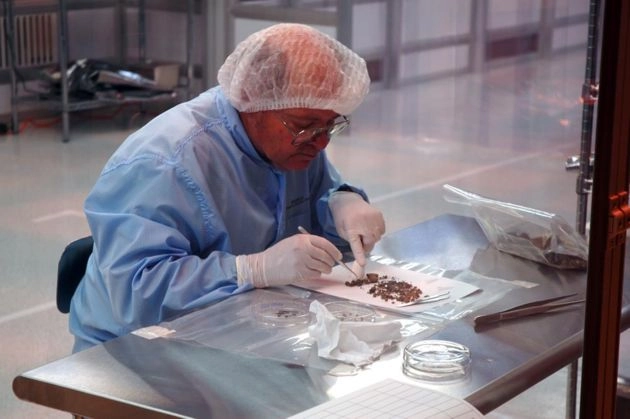
In a teleconference with reporters today, mission officials said contamination is their greatest worry, since desert dirt entered the capsule. They need to retrieve the Sun samples in pristine form. The goal is to learn more about the Sun's composition and the history of the solar system and planet formation.
The team might seek advice on handling the wafer-thin collector devices from the semiconductor industry, said Don Burnett, Genesis principal investigator from the California Institute of Technology.
Surprise
"We should be surprised that we have anything," said Don Sevilla, Genesis payload recovery leader at NASA's Jet Propulsion Laboratory (JPL).
Sevilla said experts are "peeling back the layers of the onion," using a flashlight and a small mirror on a stick to explore inside the fractured, garbage-can-sized capsule. A prime particle-gathering device "appears intact," he said, and another appears to be "in very good condition."
But pieces of the fragile collectors are "strewn about the canister," so scientists are being very methodical about extracting them.
"It is amazing given the amount of breach in the canister just how clean it is inside" Sevilla said. "We're not talking about great clods of dirt."
No timetable has been created for moving the science samples from a Utah facility to a NASA center for ultimate study. Sevilla said engineers are still busy collecting tools to do unexpected "sawing and snipping" that will take place over the weekend.
Genesis, which launched in 2001, carries a $264 million price tag.
The scientists said they were demoralized when they first saw the craft stuck more than halfway into the desert floor. Attitudes have changed.
"The science team is really excited," said Roger Wiens, flight payload leader from the Los Alamos National Laboratory. Wiens expects to "meet many if not all" of the mission's initial goals.
The investigation
Meanwhile, Sevilla said three pyrotechnic devices that were supposed to deploy the parachute system failed to trigger as planned. They have been "safed" to allow study of the capsule.
"None had been fired," he said. "This points to a command and control problem," not to any failure of the parachutes themselves.
NASA also announced today that Michael Ryschkewitsch, director of the Applied Engineering and Technology Directorate at NASA's Goddard Space Flight Center, would lead the Genesis Mishap Investigation Board (MIB) in an effort to determine the exact cause of the disaster. The group is due to report back in mid-November.
The optimistic assessment led one reporter to ask if future sample-return missions might forego the theatrics of using Hollywood stunt pilots to make mid-air retrievals of capsules, and instead simply design the shells to survive a freefall.
"The lessons from this one will affect all future sample returns," said Gentry Lee, a JPL engineer.
