





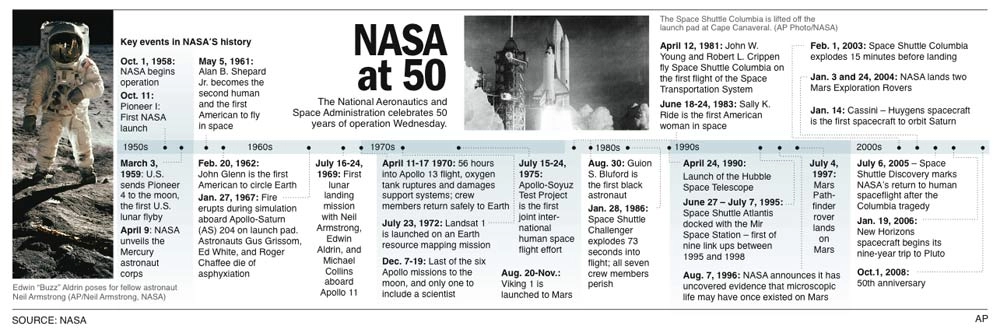
Editor?snote: As NASA celebrates its 50th birthday today, the agency looksback on a history of stunning successes while honoring those lost in its tragicsetbacks. Here, space commentator Jim Banke takes a look at what the futuremight bring for America?s space program in the 50 years to come.
CAPECANAVERAL, Fla. - As NASA marks its golden anniversary on Oct. 1, 1958, thequestion is inevitably raised: What will the U.S. space agency be like another50 years from now?
Officiallyask NASA managers and they?ll tell you their only thinking as far ahead as thereturn to the moon with Project Constellation and its Orion spacecraft and Aresrockets - with a nod to the ultimate goal of landing humans on Mars.
Ask aboutthe specifics of going to Mars with humans and you learn that, officially, NASAhas eyes only for the moon right now, not that there?s anything wrong withthat.
Unofficially,as in off the record on deep background, every space cadet who works for NASA,either directly for the agency or as a contractor, appears to have their own dreamof whatmight be in 50 years.
Someclearly have agendas, hidden or otherwise, while others relate pie in the skywishful thinking about a spaceship in every garage, a fusion generator in everykitchen. Some are pessimistic and reflect in their vision their own bitterfeelings about how far we have not progressed since the heady days of Apollo.
It?s clearthat no one has a good handle on the future, and that?s probably a good thing.Anyone who professes an all-knowing, set-in-stone vision of the future shouldbe kept at arms length unless they are clearly of divine origin.
NASAAdministrator Mike Griffin has his head on straight when it comes to predictingthe future. In a March 2007 essay for Aviation Week & Space Technology headdressed the topic of ?Human Space Exploration: The Next 50 Years.?
?It is sovery easy to be completely wrong, since a variety of radically differentfutures in spaceflight can be presumed with equal apparent credibility today,?Griffin wrote. ?The one thing of which we can be certain is that in trying toenvision the world of 2057, two generations in the future, we will be wrong.?
Griffin?swords ring true, but a certain Jedi master from a popular film franchise saidit more simply: ?Impossible to see, the future is.?
During thepast few months world events have insinuated them into the world of spaceflightand are sure to have some effect, as yet undefined. They include:
- The unprecedented rise of the space program in the presidential election rhetoric, which has candidates talking about extending the life of the space shuttle program and injecting new money into NASA?s budget.
- Russia?s adventures with Georgia has Congress suddenly asking hard questions about our reliance on Soyuz spacecraft at the International Space Station, a discussion that also has implications for the Shuttle program.
- The nation?s financial crisis and what will likely result in billions of tax dollars being paid out as a solution, making it more difficult for Congress to do anything positive with NASA?s budget.
So thefuture of space in 50 years can?t be foretold in detail, it?s always in motion.Sounds like it?s time to take the plunge and offer some debatable ideas.
SomePredictions
The onething we can predict with certainty is that by the year 2058 we will not havespaceships capable of flying faster than light, despite the suggestion ofanother science fiction franchise that predicts the invention of warp drive in2063.
Now for theuncertainty. Try this out for size, in 2058:
NASA isstill around and narrowly focused on exploration and the goal of extendinghuman presence throughout the solar system. The first humans have long since landedon Mars and there is a thriving science colony near the moon?ssouth pole.
Constructionhas begun on a radio telescope on the moon?s far side and the lunar base has beenestablished for years as one of the nation?s centers for excellence in fusionand alternative energy research.
NASA probescontinue to reconnoiter the planets not only in our system, but with newtelescopes and imaging techniques we are exploring planet in other systems andhave discovered several Earth-like planets.
While proofof life - ancient and bacteria-sized - exists throughout the solar system,there is still no sign of intelligent life in the universe, not that NASA islooking.
In fact, by2058, the U.S. military?s space program has evolved considerably and there theones charged with keeping on eye on the stars for any potential threat, whetherfrom intelligent life or accidental rock throwing.
It will bethe military, in the name of national security, that will develop some of themore exotic and interesting spacecraft of the 21st Century, and will by 2058 beclose to achieving the goal of a single-stage-to-orbit spaceplane - if theyhaven?t already.
In themeantime, the commercial space world by 2058 has become a major component ofthe space program, bigger and busier and more productive than NASA and themilitary combined.
Commercialspace will almost exclusively be who you turn to when you want to travel to orfrom low-Earth orbit. The number of nations in the launch business or capableof launching something into orbit will be surprisingly greater than in 2008.
Commercialspace tourism each year will provide hundreds of people the opportunity tovacation in an orbiting hotel, launching from spaceports sprinkled throughoutthe world.
Trips toorbit the moon will be possible, and lunar hotels at the Sea of Tranquility maynot be out of the question.
(Pleasenote that we cannot guarantee a room with a window view of the Apollo 11 lunarlanding site at the Sea of Tranquility, which is surroundedby a security gate and is considered off limits so no one disturbs NeilArmstrong?s and Buzz Aldrin?s footprints.)
Suborbitalhops as thrill rides - popular in the first quarter of the century - willbecome pass? by 2058 as the space planes grow larger and become integrated withthe world?s air traffic system so that 45-minute hops from Miami to Tokyobecome possible.
Along thosesame lines, the cargo folks like FedEx and UPS also will embrace thistransportation mode for when it positively has to be on the other side of theplanet on the same day.
HalfFull
Look aheadto 2058 and the details are unclear, but I am optimistic that we will continuemoving off the planet and into the universe.
When NASAcelebrates its 100th birthday, it will do so toasting successes and rememberingdevastating setbacks. It will honor the brave astronauts who make the trip andeveryone else who makes it possible.
It will doso recognizing countless new and unexpected benefits for all in medicine,electronics, manufacturing, home improvement, entertainment and so much more.
We willmove off this planet and return to the moon, then go on to Mars. From there thegiant moons of Jupiter or Titan at Saturn look promising. There are asteroidsto explore as well.
And thenthe rest of the galaxy awaits us, perhaps something to consider for the next 1,000years.
Jim Banke is a veteran aerospace commentatorand consultant based in Cape Canaveral, Fla.
- New Video - NASA at 50: Part 1, Part 2
- Images - 50 Years of Spaceflight: The Road Ahead
- Video - Back to the Moon with NASA's Constellation