





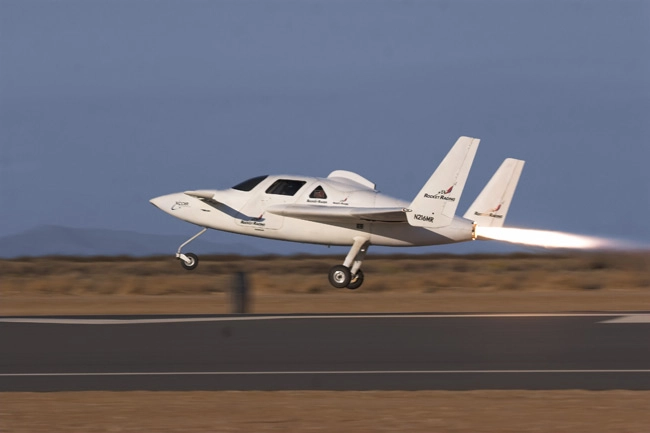
NEW YORK - Rocket mavens, markyour calendars: The date of the first Rocket Racing League race has been set.
On Aug. 1-2, the league willstage a high-flying version of NASCARwith rockets at the EAA AirVenture air show in Oshkosh, Wisc., in itsfirst-ever exhibition race. Two racers will fly planes powered by rocketengines on a 2-lap circuit around an airborne raceway.
Pilots in the races will view thesky racecourse on 3-D helmet displays, while the roughly 700,000 peopleexpected to attend will watch the action on multiple 50-foot (15-meter) projectionscreens.
?We?re using 21st centurytechnology to create a 21st century sport for 21st century people,? said GrangerWhitelaw, Rocket Racing League CEO, during a press briefing here at the YaleClub. ?We?re very excited about announcing our first public exhibition race.?
The Rocket Racing League was foundedin 2005 by Ansari X Prize founder Peter Diamandis and Whitelaw, anIndianapolis 500 veteran. The competitors will be piloted Mark 1 X-Racerrockets based on the EZ-Rocket design developed by the firm XCORAerospace in Mojave, California.
?I?m very proud of the incredibleprogress that?s been made by this team, ? Diamandis said. ?This is anincredibly important and exciting sport that will be as interesting to kids asit will be to adults.?
The league currently has six teamsthat will compete in four series of races throughout the year. After the firstEAA AirVenture exhibition, later races will be staged at the Reno NationalChampionship Air Races in Reno, Nev., between Sept.10-14; at Aviation Nation atNellis Air Force Base in Las Vegas, Nev., on Nov. 8-9, and at the X Prize Cupin Las Cruces, N.M., in late October.
The initial racer design waspowered by XCOR?s liquid oxygen and kerosene rocket engine, though Whitelawannounced Monday that a second engine type, fueled by liquid oxygen andethanol, will also be available.
Mesquite,Tex.-based Armadillo Aerospace, founded by computer game-developer JohnCarmack, will build the new engines, which can be stopped and restarted. Since theengines burn liquid oxygen and ethanol, the company added a salt water solutionto the fuel to produce a bright yellow glow from the racers.
?We?rebuilding a robust set of technologies together that should be safe for thepilot, cost effective, and spectacular for the crowds,? Carmack said via avideo link.
FullRocket Racing competitions will be point-based competitions that run four lapsaround an aerial racetrack, with racers switching their engines on and off toconserve their 10-minute or so supply of fuel, league officials have said.
Duringthe exhibition races, two team-owned rocket planes are expected to fly,Whitelaw said. The Bridestine Rocket Racing team, founded by former U.S. Navypilot Jim Bridestine, and Santa Fe Racing team led by Albuquerque landdeveloper Marc Cumbow will reserve the first two league racers, Whitelaw said.
?I?vebeen seeing the tremendous amount of exposure NASCAR has gotten, and I thinkthis is the next generation,? Bridestine said. ?I think it?s going to be a lotmore exciting [than NASCAR].?
TheRocket Racing Composites Corp. also announced the acquisition of the VelocityAircraft company of Sebastian, Fla., which will construct airframes for the league?sRocket Racers. The cockpit seats for all the Rocket Racers will be reinforcedto withstand impacts of up to 20G forces, and the league plans to add safetymeasures to the racers similar to that of F-1 and Indy Cars.
Thecomposites firm and racing league itself are part of the Rocket Racing, Inc.,an umbrella firm that also includes a research and development branch based inLas Cruces, Whitelaw said.
?What?sreally important, and unusual in this type of business, is a focus on safety,?said Scott Baker, president of Velocity, Inc. ?Those advances are going to findthemselves entering into the world of general aviation. We?re looking forwardto some exciting times ahead.?
- VIDEO: The Rocket Racing League
- VIDEO: Rocket Racing Visionaries
- Special Report: The New Space Race
