





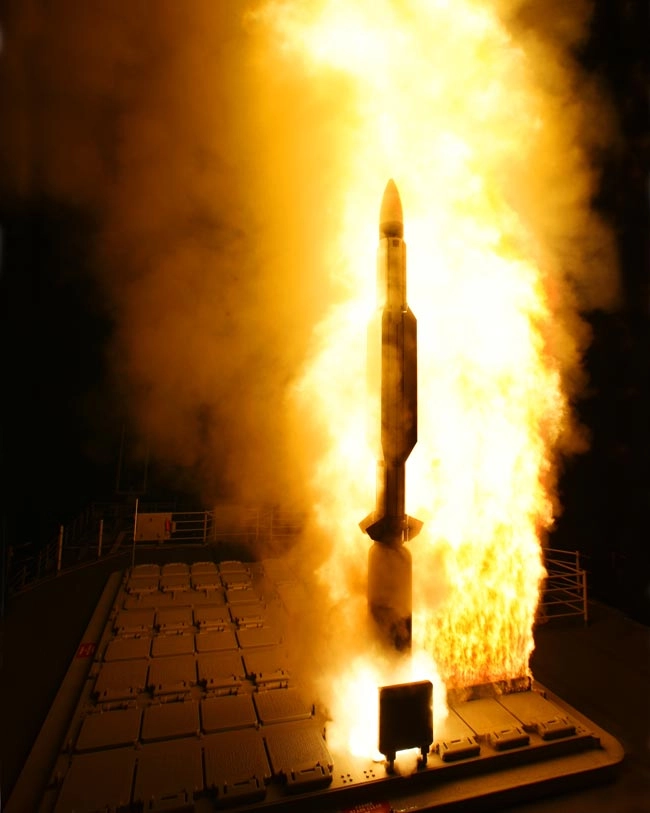
Debris from the Department of Defense's planned shoot-downof a spy satellite may be visible to skywatchers in the northwestern UnitedStates and Canada, according to the U.S. Naval Observatory.
Although it's hard to predict what will happen if the rocketsucceeds in impactingthe satellite, there is a chance that observers will see broken-off piecesof the satellite reflecting sunlight or burning up as they fall through Earth'satmosphere. The window of opportunity for the attempt is open for the next 10days or so, though bad weather and high seas make it unlikely the exercise willoccur today.
"There is a possibility that if someone were to have clearskies in the Pacific Northwest or Canada, they might see some of thedebris," said Geoff Chester, public affairs officer for the U.S. NavalObservatory in Washington, D.C. "We just don't know. If the debris does enterthe atmosphere then it's actually quite possible to see it anywhere along theground track of the satellite."
Because only two satellites have been shot down before,each under unique conditions, experts don't have much experience to go on inpredicting what to expect.
"Depending on the size of the fragments, it's possiblethat you might be able to track some with the naked eye, some withbinoculars," said Chester. "We just don't know. It's virtuallyimpossible to predict exactly what it's going to look like. If the debris entersthe atmosphere then you would see something that would be akin to a swarm ofmeteors."
In addition to favorable weather conditions, many factorshave to go right for this sky show to appear.
"They have to hit it first," Chester told SPACE.com."It depends entirely on how many pieces this thing winds up getting busted upinto. It's quite possible you would see the debris entering the atmosphereanywhere along the ground track of the satellite."
The satellite's path will take it east from Hawaii to thenorthwestern U.S. and British Columbia, then over the whole of Canada, downacross the Atlantic, over West Africa, and back over the south Atlantic.
The actual impact will not be visible to anyone, because itwill occur over Hawaii during daylight, Chester said. Even if the Department ofDefense does not attempt to shoot down the satellite tonight, all futureattempts will also be during daylight over Hawaii.
If Hawaii were dark at the time of the impact, there wouldbe a chance that observers would see a cloud of hydrazine gas created when thesatellite's liquid fuel spewed into the vacuum of space.
"The hydrazine would probably form a bright expandingcloud that would move rapidly across the sky along or close to the originalsatellite ground track and slowly dissipate," Chester said. "But Idon?t know for sure."
In any case, there would not be a bright explosion to see becausethe rocket sent to impact the satellite is only supposed to hit it, not explodeupon impact.
SPACE.com contacted several large ground-basedobservatories, and none reported having plans to attempt observations.
- Satellite Shoot Down: How It Will Work
- Military's Motives Questioned in Shooting at Satellite
- Vote: What Cosmic Duo Would You Trust to Destroy a Wayward Spy Satellite?
