





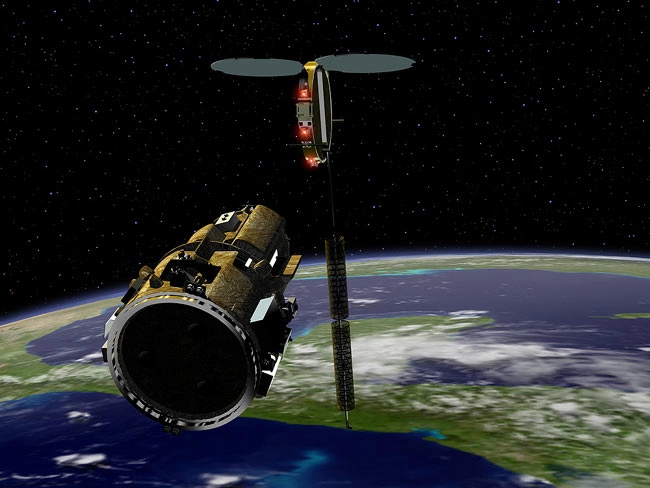
A software glitch,subsequent navigation errors and excessive fuel use led to the failure of anautomated NASA spacecraft designed to rendezvous with a Pentagon satellite withouthuman help last year, according to an investigation summary released late Monday.
In the10-page summary, NASA investigators said the robotic DART spacecraft "repeateda pattern of excessive thruster firing in response to incorrect navigationaldata onboard..." leading to its failedrendezvous.
A lack oftraining and expertise among DART's design team also contributed to thespacecraft's failure, the investigation summary stated.
The summarywraps up a 70-page report by NASA's Mishap Investigation Board (MIB) that will not bereleased because the document contains sensitive material protected by the InternationalTraffic in Arms Regulations (ITAR), NASA has said. A teleconference on themishap summary with NASA's Marshall Space Flight Center engineer Scott Croomes,who chaired the MIB, is set for Tuesday at 2:00 p.m. EDT (1800 GMT).
The 800-pound(362-kilogram) DART spacecraft - short for Demonstration for AutonomousRendezvous Technology - launchedfrom California's Vandenberg Air Force Base on April 15, 2005 atop an OrbitalSciences-built Pegasus XL rocket. The spacecraft was expected to rendezvouswith MUBLCOM, or Multiple Path Beyond Line of SiteCommunication; a small communications satellite launched for the U.S. military in 1999.
DART's$110-million missioncalled for the spacecraft to approach within 16 feet (five meters) of MUBLCOMand perform a series of intricate maneuvers near the older satellite, allwithout human intervention. The mission was to occur throughout a 24-hourperiod. But while DART ultimately found and approached the MUBLCOM satellite,it apparently closed to within 300 feet (91 meters) and ran out of fuel,bumpinginto the target spacecraft while both vehicles were 472 miles (760 kilometers)above Earth.
"Less than11 hours into the mission, DART collided with MUBLCOM," the investigationsummary states. "MUBLCOM did not appear to experience significant damage, andthe impact actually pushed it into a higher orbit."
According tothe mishap summary, DART's velocity measurements by its primary globalpositioning system (GPS) receiver were off by about 1.9 feet per second (0.6meters per second), an inaccuracy that persisted in the spacecraft despite acomputer reset because the needed software patch was never installed. DART's maincomputer repeatedly detected its velocity anomaly, reset itself, then againdetected the same glitch, the summary stated.
An initialmismatch between expected and actual position appears to have started thecontinuous cycle - which forced the excessive thruster firings - but it wasstill not enough to lead DART into failure, according to the summary report. Acomputer logic setting that regulated how much weight the spacecraft gave itsestimated and measured orbital speed and positions was set too high, allowing the initial glitch to continue, the summary stated.
Many ofDART's failings could have been avoided if the mission's team membersthoroughly reviewed and applied data and experience from previous NASAprojects, investigators found.
NASA approvedthe DART mishap investigation board's report in February, but said last monththat the document will be only released entirely internally as needed. NASA'sMarshall Space Flight Center in Huntsville, Alabama managed the DART missionfor the space agency.
