


Despite living well beyond their primary mission lifetimes, NASA twin Mars rovers have been busy little robotic bees.
The robot Spirit, while some showing signs of age, has found signs that water once flowed atop the rocks of its Gusev Crater landing site. The rover has spent more than a month gradually climbing the Columbia Hills.
"I would say that this is the most powerful evidence [of water] in the rocks at Gusev Crater," said Steven Squyres, the rovers' principal investigator from Cornell University. "We had evidence...that a little bit of water percolated through the plains there."
Squyres spoke during a press briefing today at NASA's Jet Propulsion Laboratory (JPL) in Pasadena, California.
During the briefing researchers added that Spirit's twin, Opportunity, is suffering from a jammed drill. Despite its problems, the rover has photographed a mysterious rock that defies explanation, as well as a batch of red spherule-like objects that scientists don't yet understand. Opportunity has most likely reach the deepest point of its journey into Endurance Crater, a stadium sized hole carved in the robot's Meridiani Planum landing site, they added.
Opportunity bottoms out
Just as Spirit has gone up, so its twin Opportunity has gone down, rolling more than 32 feet (10 meters) into Endurance Crater at Meridiani Planum.
"In terms of depth, we've pretty much reached the end of the line," Squyres said, adding that only blueberries and sand dunes - which could end Opportunity's science mission if it were to bog down one - lie ahead. "We built a wonderful rover, but we didn't build a dune buggy."
But that hasn't stopped Opportunity from making a pair of perplexing finds. The rover has found lumpy, odd rock unlike anything its seen to date. Researchers hope to swing by the rock on the way out of Endurance for further study.
"It could just be one big mass of concretions," Squyres said. "I just don't know."
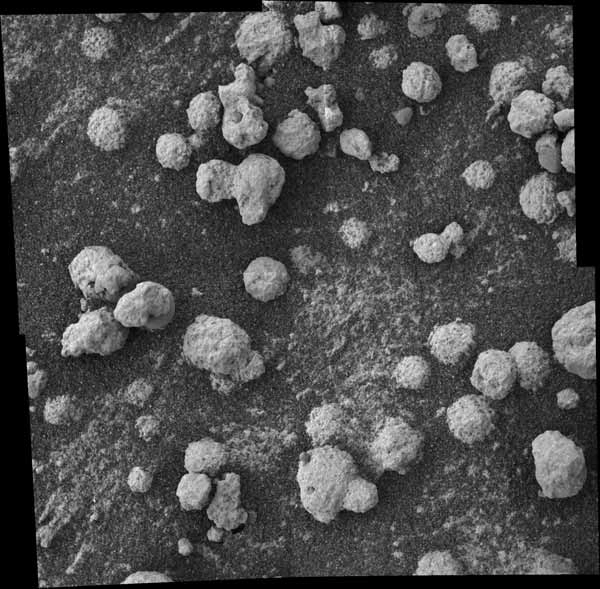
On top of that, Opportunity's robotic arm-mounted Microscopic Imager has detected small, red objects that researchers don't yet understand.
"We have no idea what it was," said Zoe Learner, a science team member and graduate student from Cornell who has studied Mars' blueberry formations.
The red formations are coarse, not always round and some of them appear to have even smaller objects weathering out of them, she said. They may be a kind of red-coated blueberry or an altogether type of concretion, but more study is needed, she added.
Meanwhile, researchers are also considering sending Opportunity to the edge of a nearby tendril of sand dunes, but only if it won't endanger the robot.
Snooping around Clovis
Sitting 29.5 feet (9 meters) above the Gusev Crater plains, the Spirit rover is currently at what researchers believe is a rich area for peering into the region's potentially watery past.
The rover has found an outcrop consisting of both pristine and transformed material, allowing researchers a chance to contrast the two and determine what role -- if any -- water may have played in altering nearby rocks. One such altered rock is Clovis, where the rover is currently perched, contains greater concentrations of sulfur, chlorine bromine, materials that can be easily deposited by water or other liquid, than other targets on the Gusev plains, researchers said.
"The bottom line so far is that we have intriguing evidence that this rock Clovis interacted with liquid," Squyres said.
But researchers need a baseline to compare Clovis to, unaltered rock for Spirit to scan with its multiple instruments, said Doug Ming, a rover science team member from NASA's Johnson Space Center.
After a few weeks studying both unaltered and altered rocjs around Clovis, researchers plan to send Spirit further upward to a batch of layered rock - the first such formation seen at Gusev - a few meters away. Then it is on up to the summit of Husband Hill, one of seven in the Columbia chain.
Working through glitches
Engineers are working to help Opportunity unsnag its Rock Abrasion Tool (RAT), a combination drill and brush that bites into rock targets.
The tool appears to have an object stuck between the drill bit and brush, though engineers want to verify that's the case before reversing the tool's spin to free the grit.
"We're not in a big hurry," said Chris Salvo, a rover mission manager at JPL. "The science team has no problem using the other instruments."
Spirit, on the other hand, is doing well despite a sick wheel and using five wheels to make most drives. The rover is generating less power than its twin, about 400 watt-hours compared to the up to 600 produced by Opportunity, due to age, dust and the limited sunlight available due to winter on Mars.
"And with [these] few aches and pains, they're really not showing that they're going to stop any time soon," Salvo said.
