





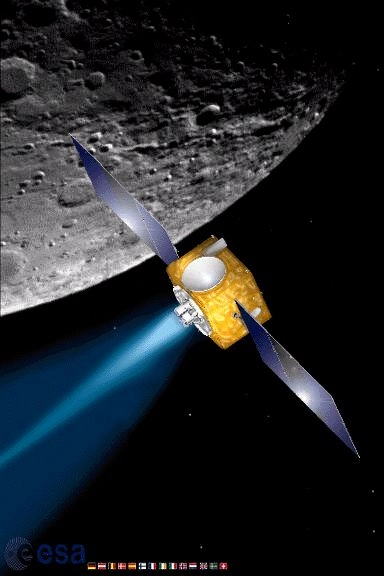
Europe's first mission to the moon is just days away from its goal after taking the slow route from Earth more than a year ago.
The spacecraft, dubbed SMART-1, will make its first close pass by the moon on the evening of Nov. 15 as it slowly spirals into lunar orbit for at least six-months of orbital observations.
"It's been an interesting cruise," said Bernard Foing, SMART-1 project scientist and chief scientist for the European Space Agency (ESA), which is controlling the mission. "So far we've accomplished about 80 percent of our technology objectives, but clearly we'd like more."
SMART-1, short for Small Missions for Advanced Research and Technology-1, launched into space on Sept. 27, 2003, atop an Ariane 5 rocket and is now 13 months into its lunar journey.
The spacecraft isn't setting any speed records for lunar missions - NASA launched and landed astronauts on the moon, then returned them to Earth in little over a week during the Apollo spaceflights - but a speedy voyage was never the point. Serving as a technology testbed for propulsion and miniaturization, on the other hand, was, ESA officials said.
"SMART-1 was designed as a technology mission to prepare for future missions to Mercury and maybe Mars," Foing told SPACE.com in a telephone interview. "We wanted to test the technology of building an ion engine and operating it in space."
ESA's lunar probe is the second spacecraft to use the ion propulsion method, using solar energy to power an ion engine that spews a steady stream of xenon ions for thrust. NASA's Deep Space 1 mission, which flew in 1998, also relied on an ion engine for its three-year mission.
"It's a great achievement and marks the first time that Europe has used electrical ion propulsion as the primary engine," explained Giorgio Saccoccia, head of ESA's propulsion division, in a telephone interview.
SMART-1 is largely seen as propulsion technology demonstrator for ESA's planned BepiColumbo probe to Mercury in 2011.
Closer to the moon
ESA flight controllers have learned much during SMART-1's flight, including some good news when they realized the spacecraft was able to conserve some of its precious fuel and make a closer approach to the moon.
"It's part of the lessons learned in this mission," Saccoccia said.
SMART-1 designers expected the probe's solar panels to experience extensive degradation as it passed repeatedly through the high-radiation environment of the Earth's Van Allen radiation belts. To compensate for that loss in power, they added more propellant to fire the engine longer. But SMART-1 weathered the radiation environment quite well, and managed to escape the Earth quicker than anticipated, Saccoccia said.
When SMART-1 first ignited its engine, mission planners expected the spacecraft to reach lunar orbit by March 2005. Of the original 180 pounds (82 kilograms) of xenon fuel, SMART-1 has used about 127 pounds (58 kilograms), leaving additional fuel to tweak its lunar orbit.
SMART-1 should be able to stay closer to the moon than previously anticipated, swinging out to 1,864 miles (3,000 kilometers) at the farthest point in its orbit instead of 6,213 miles (10,000 kilometers). At closest approach, SMART-1's orbit will bring the spacecraft within 186 miles (300 kilometers) of the lunar surface.
"It may be possible to conduct even better science with higher resolution," Saccoccia said of the possibility of swinging closer to the moon. "I think, in principal, we can even extend the science part of the mission, though that still remains to be determined."
While SMART-1 is designed for a nominal six-month mission, Foing said it could survive a one-year - and possibly a two-year - extension depending on available funding.
The science portion of SMART-1's mission involves using a series of miniaturized instruments to scan for signs of frozen water, determine the composition of the lunar surface and provide new clues into the moon's evolution.
"This is the first European mission to the moon," Saccoccia said. "Of course we're all excited."
