UPDATE: Story first posted 6:49 a.m. ET, November 16, 2004
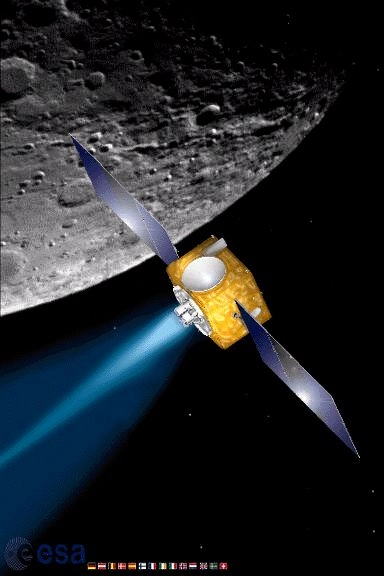
Europe's SMART-1 robotic probe has arrived after taking a long and spiraling road to reach its destination, the Moon.
Launched by an Ariane 5 booster in late September 2003, the European Space Agency's Small Missions for Advanced Research in Technology (SMART-1) has been captured by lunar gravity.
Now in a wide swinging orbit around the Moon, the spacecraft will begin adjusting its orbit over the next several weeks. SMART-1 is slated to begin its scientific study of the lunar surface in January of next year.
Among its tasks, SMART-1 will look for signs of water in the form of ice on the Moon. That ice is thought to be tucked away within permanently shadowed craters at the lunar poles. Those areas are free from the warming rays of the Sun.
A solar-powered electric engine using xenon as a fuel nudged SMART-1 on its 13-month sojourn to the Moon. The long cruise to the Moon involved a spiraling orbit around the Earth -- a trail that eventually brought the spacecraft to its lunar capture point.
Daughter of the Earth
SMART-1 will make the first comprehensive inventory of key chemical elements in the lunar surface. It will also investigate the theory that the Moon was formed following the violent collision of a smaller planet with Earth, some 4.5 billion years ago.
"The Moon is a key witness of the early conditions when life emerged on our planet. As the daughter of the Earth, she holds keys for understanding our origins and for preparing for the future exploration of the solar system," is the view of Bernard Foing, ESA's Chief Scientist and SMART-1 project scientist.
SMART-1 is the first European spacecraft to travel to and orbit around the Moon.
Furthermore, this is only the second time that ion propulsion has been used as a mission's primary propulsion system. The first was NASA's Deep Space 1 probe launched in October 1998. That spacecraft tested a dozen technologies, as well as shot by asteroid Braille in 1999 and comet Borrelly in 2001.
Igneous differentiation
The last craft to orbit the Moon were the U.S. Pentagon's Clementine spacecraft in 1994 and NASA's Lunar Prospector in 1998-1999.
"SMART-1 will add yet more knowledge to humanity's information database for the Moon," said Paul Spudis, a lunar expert at John Hopkins University Applied Physics Laboratory (APL) in Laurel, Maryland.
Spudis told SPACE.com that the most significant data from the European lunar orbiter will be from its X-ray mapping experiment.
"We have some elemental maps of the Moon from Clementine and Lunar Prospector, but are missing information on the critical elements aluminum and magnesium, both key sources of information about the igneous differentiation of the Moon," Spudis said.
The Apollo orbital X-ray data covered only about nine-percent of the Moon. "The new near-global SMART-1 data will enhance our understanding of lunar compositions," Spudis noted.
Intriguing images expected
Ben Bussey, also a lunar specialist at APL, said that SMART-1's imager will likewise add to our knowledge, particularly in the area of high resolution imaging.
The Advanced Moon Micro-Imager Experiment (AMIE) camera will acquire images of the Moon's south polar region.
"These data will complement the Clementine high resolution data which obtained incomplete coverage of the area surrounding the Moon's south pole. These images will also provide snapshots of the lighting conditions of small areas around the south pole. Unfortunately, regional illumination mapping of this region to identify areas of possible permanent illumination will have to wait for a later missions," Bussey explained.
Bussey said that one of the stated goals for SMART-1 is to take long duration exposures of permanent shadowed regions to look for ice.
"This is an interesting idea and extremely challenging given the low signal coming from these regions, which may well be swamped by scattered light within the instrument. We don't know whether the presence of ice would alter the appearance of the lunar surface so these images will certainly be intriguing," Bussey told SPACE.com.
Data of great value
More information of the regional lighting conditions will be obtained by SMART-1 for the Moon's north polar region. "The greatest contribution to our understanding of the lighting in this region will likely come from the fact that SMART-1 will image the north pole for at least six months, providing information on the seasonal variations of the lighting conditions in this region," Bussey said.
Although not comprehensive or extensive, Spudis added, Europe's SMART-1 will obtain some new data of great value. It nicely helps to fill the niche on global elemental mapping and the image data makes a small but nonetheless important enhancement to the extensive Clementine image data, he said.
ESA's Foing is delighted that the Moon probe has reached its destination. The spacecraft is ready for action.
"The team is still so excited by SMART-1's first lunar orbit, thanks to the new technologies. We obtained before lunar capture the first European pictures of the lunar North pole and far side," Foing said. "The spacecraft and the instruments are ready for their lunar tasks: charting lunar minerals, looking at the chemical signature of Earth-Moon violent beginnings, searching for ices at the poles, or prospecting the potential sites for future landing probes and exploration."