





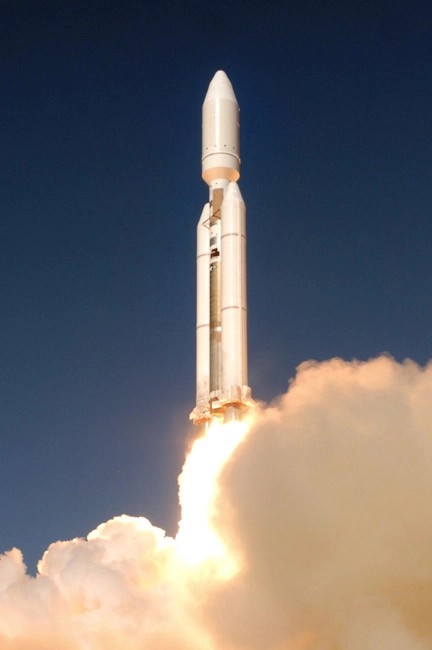
The mighty Titan -- apillar in American rocketry for five decades -- flew into orbit for the finaltime Wednesday, capping a distinguished career of heavy-lifting that hasspanned the nation's space age.
The 16-story vehicle roaredoff its Vandenberg Air Force Base launch pad in California at 11:05 a.m. PDT(2:05 p.m. EDT; 1805 GMT) carrying a top-secret spy satellite for the U.S.National Reconnaissance Office.
Less than 10 minutes later,the Lockheed Martin-built rocket completed its job by deploying the spacecraftpayload. The new satellite will be operated by the NRO, a hush-hush governmentagency responsible for the country's spy satellite fleet. Details of theTitan's payload and its mission were not revealed to the public.
However, experts say thecraft was placed into an orbit that coincides with imaging satellites. Suchspacecraft are telescopes that point back at Earth with powerful vision to seeobjects as tiny as just inches across, observers believe.
Back on Earth hundreds of workers were relieved to see the Titan era concludesuccessfully. The program was born 50 years ago this month to develop atwo-stage intercontinental ballistic missile weapon system. It later morphedinto a launcher for Gemini astronauts and satellites of all shapes and sizes.
"Today's spectacularlaunch is a fitting way to say goodbye to Titan," said G. Thomas Marsh,executive vice president of Lockheed Martin Space Systems Company, Wednesday."The Lockheed Martin employees who have given their utmost efforts to theprogram over the years join with our Air Force and NRO customers, and the manyother organizations that make up the Titan team, in expressing our great pridein this service to our country's space program."
Titan 1's began launchingin 1959, then evolved into the Titan 2 missiles that also found use in the1960s by blasting NASA's manned Gemini missions into orbit in the precursor toApollo and were retrofitted in the 1980s for lofting government spacecraft,including weather satellites.
Various Titan 3, 34B and34D satellite-launchers and finally the largest and most powerful version --the Titan 4 -- were conceived through the years to incrementally increase thecapability of the rocket family.
Wednesday's launch was the200th Titan to fly from Vandenberg including:
- 20 Titan 1 ICBM
- 58 Titan 2 ICBM
- 13 Titan 2 space rockets
- 57 Titan 3B
- 22 Titan 3D
- 11 Titan 34B
- 7 Titan 34D
- 12 Titan 4
Cape Canaveral hosted 168Titan launches including:
- 47 Titan 1 ICBM
- 23 Titan 2 ICBM
- 12 Titan 2-Gemini
- 4 Titan 3A
- 36 Titan 3C
- 7 Titan 3E
- 8 Titan 34D
- 4 Commercial Titan
- 27 Titan 4
"If you take a lookback through history, it's not at all a stretch to say that Titan was really akey part of how we won the Cold War because the advantages we had from spaceallowed us to be successful," said Lt. Gen. Michael Hamel, Space andMissile Systems Center commander.
Besides hauling countlessmilitary and spy satellites, Titans also launched the Viking space probes toMars, Voyagers to the outer planets and Cassini to Saturn.
In a pre-launch letter toemployees, Lockheed Martin's Titan program manager Walt Yager said Wednesday'sliftoff would "place the final brush stroke on the TitanMasterpiece."
"Mission success is anoutgrowth of The Titan program. Titan B-26 will put that trademark on history.The entire team is proud to represent those who have gone before us and closethe book on a National Legend. God Speed the 'Silent Hero.'"
But the need to modernizethe U.S. rocket industry caught up with Titan. Known for its complexity andstiff price tag, at least $411 million for Wednesday's rocket, military leaderstook the first steps to retire the big booster a decade ago with creation ofthe Evolved Expendable Launch Vehicle program. The new-generation EELV rockets-- Lockheed Martin's Atlas 5 and Boeing's Delta 4 -- are supposed to be less expensiveand offer a tailored-feel for a payload's weight. Both made inaugural flightsin 2002.
"TheAtlas 5 and the Delta 4 Evolved Expendable Launch Vehicles are going to provideour assured access to space and become the workhorse launch vehicles for the21st century," Hamel said.
The sadness of seeing thelast Titan soar over the horizon is compounded for about 120 Lockheed Martinworkers at Vandenberg. They have two months to find new jobs before their Titancareers end. The Defense Department is retaining the workers for the extendedperiod after the last liftoff to help ease the transition.
About 110 workers willbegin the effort of closing out the program, including cleanup of the launchpad. Work to decontaminate the Space Launch Complex-4, remove hazardous itemsand dispose of hardware is expected to last several months as the workforcegradually dwindles down.
The company expects toreduce its total Vandenberg workforce to 159 employees in support of the newAtlas 5 rocket.
Meanwhile, another 250 jobsat Lockheed Martin's Denver site will be phased out with Titan. But Yager said60 percent have found new jobs inside the company. That percentage is similarto the rate experienced by Cape Canaveral workers following the final Titan 4from the East Coast this spring.
Also being impacted are theTitan subcontractors like solid rocket booster-maker Alliant, avionics-makerHoneywell and Aerojet, the engine supplier for Titan since the program's start.
"What began as adevelopment project for Aerojet ran for 50 years as a production program with100 percent mission success in space launch applications," said AerojetPresident Michael Martin.
Aerojetproduced 1,182 Titan engines and performed 11,582 engine tests and 368launches.
One of the Vandenbergworkers following Titan into the sunset is a space icon. Tom Heter II, LockheedMartin's director of launch operations on the West Coast, is retiring inJanuary after 44 years working on Atlas and Titan rockets.
"With my age it's timeI take the offramp if you will and let the group go on down the road with Atlas5, Delta 4 and the (United Launch Alliance)," Heter, 66, said in aninterview.
The ULA will marry the EELVrocket programs under one organization for government launches.
Heter says the thrill ofseeing a launch remains strong, as does the pride in his team's role of puttingcritical national payloads in space.
"We're in the businessof protecting the good ol' USA," he added. "Yeah, we don't wear theblue uniform but we're just as dedicated and just as proud. I don't know ifother people that are not in the business can really feel that pride but itcertainly runs rampant out here."
Wednesday's launch paidtribute to the memory of two respected Titan team members who passed away thisyear.
Lenny Hoops, an AerospaceCorp. employee, was an expert on ground control systems used to test and launchrockets.
"Lenny's knowledge ofhis systems was unrivaled within the corporation and recognized within thecontractor community. Lenny's innate ability to teach coupled with his systemknowledge allowed him to conduct several ground system training classes insupport of the 2nd Space Launch Squadron. Lenny was most at home with a LASERpointer in hand and a Power Point briefing displayed on a projectionscreen," a tribute read.
Abe Freels was athree-decade Titan veteran working as the Lockheed Martin senior programengineer at Cape Canaveral. He was one of 30 brought to Vandenberg to helplaunch the last vehicle, but died suddenly earlier this month.
In an interview on the eve ofthe Cape's final Titan launch in April, Freels spoke about his plans to retireafter seeing the last one fly.
"I'm looking to go outand support the B-26 mission at Vandenberg Air Force Base in California, andlooking seriously at retirement after that. Titan has been a good run and Idon't know there is anything else in the industry that would fulfill me as muchTitan has."
Their names were placed onthe rocket's second stage, which now orbits the Earth in peace.
