





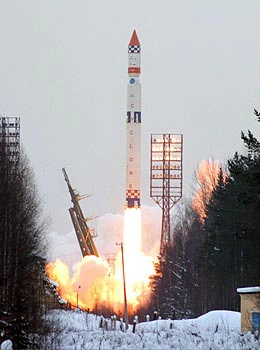
Russia launched a solarobservatory Friday to study the connection between the sun and Earth, markingthe first Russian science mission of its scale in more than four years.
The Coronas Photonspacecraft will spend the next three years circling Earth with a suite ofinstruments designed to measure energetic particles producedby solar flares, the solar atmosphere, and solar activity's relationshipwith magnetic storms around Earth.
The 4,200-pound satellitelaunched from the Plesetsk Cosmodrome in northern Russia at 1330 GMT (8:30 a.m.EST). A Tsyklon 3 rocket hauled the satellite to an orbital perch about 310miles above the planet and released the craft less than 45 minutes afterliftoff, project officials said.
The launch was the firstflight of a large Russian science mission in more than four years. Russia hasorbited a flurry of smaller satellites since then, but none have equaledCoronas Photon's science ambitions, sophistication, or mass.
Russia's last large-scalescientific satellite was Sich 1M, an Earth observatory that was the victim of afailure of the Tsyklon 3 rocket's third stage in late 2004.
No such problems occurredFriday. Officials received the first signals from Coronas Photon a few minutesafter 1500 GMT (10 a.m. EST), confirming the solar panels were deployed and thesatellite was healthy.
The satellite is alsocircling Earth in an orbit "close" to the projected numbers,according to Roscosmos, the Russian space agency.
Coronas Photon, alsotranslated as Koronas Foton, was manufactured by the Research Institute forElectromechanics in Moscow. The science team is led by the Moscow EngineeringPhysics Institute.
Two other satellites fromthe Coronas series were launched in 1994 and 2001 to study the sun. Bothspacecraft have successfully concluded their missions.
Coronas Photon carriesabout 1,190 pounds of scientific equipment to measure solar radiation fromultraviolet to gamma ray wavelengths. The broad spectrum, which includesX-rays, will allow scientists to study the energy produced by solar flares, suddenviolent explosions that unleash magnetic energy and accelerate chargedparticles to nearly the speed of light.
"The main feature ofour project is the study of high energy processes during solar flares,"said Yuri Kotov, Coronas Photon principal investigator.
Solar flares release energyequivalent to millionsof exploding hydrogen bombs, or ten million times the energy of a largevolcanic eruption, according to NASA.
The observatory'sinstruments, provided by Russian, Indian and Ukrainian scientists, will analyzethe mysterious causes of solar flares. The sensors will also capturehigh-resolution images of the sun at least every few minutes, giving scientistsa detailed view of solar flare development.
Scientists expect CoronasPhoton's primary solar telescope to take more than one million imagesof the sun during the mission.
Other payloads will measurethe environment around the spacecraft to detect high-energy particles as theyreach Earth. That data will help scientists investigate the relationshipbetween solar storms and space weather near Earth.
Solar activity can impactglobal climate patterns, communications, power grids, and astronauts andsatellites in space. Radiation from solar flares can begin to reach Earth injust eight minutes, so scientists have long dreamed of reliable space weatherforecasts based on sun observations.
"We must divide theinfluence of the sun and the influence of human activity in order to acceptdecisions of major importance on climate change on our planet," Kotovsaid.
Solar flares are morecommon during peaks in the sun's 11-year activity cycle. The next solar maximumis expected in 2011 or 2012.
Coronas Photon'sinstruments will be used with a handful of other solar observatories to look atthe sun during the upcoming "solar max." The satellite is part of theInternational Living With a Star program, which includes members from theUnited States, Russia, Europe, Japan, China, and Canada.
- Images - Solar Storms
- Video - Space Storm Warning
- Perfect Space Storm Could be Catastrophic on Earth, Study Concludes
Copyright 2009 SpaceflightNow.com,all rights reserved.