





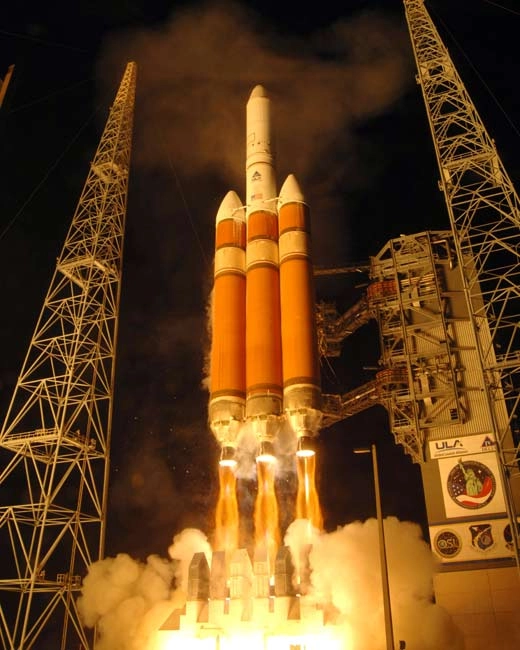
The new National ReconnaissanceOffice (NRO) payload on the Delta 4-Heavy is a 5-to-6 ton eavesdroppingspacecraft with a high tech deployable antenna as wide as 350 feet.
The spacecraft is toenhance the capability for the U.S. to listen in on communications in hostilegovernments like Iran and terrorist organizations like Al Qaeda.
The NROL-26 mission hasworried NRO officials and other intelligence professionals because of concernsabout flying the critical satellite on the new Delta 4-Heavy. The heavy-liftrocket lifted off late Saturday at 9:47 p.m. EST (0247 Jan. 18 GMT) fromCape Canaveral Air Force Station in Florida.
If the mission was to fail,it would spark another crisis in the U. S. intelligence community, alreadyburdened with growing tasks from an increasingly dangerous world.
The satellite is likely an"Advanced Mentor" design, according to GlobalSecurity.Org, a militarythink tank. Earlier versions were designated Orion.
Due to satellitedevelopment delays and a 1998 Titan launch failure involving an earlier"Mercury" eavesdropper design, the U.S.has fallen as much as one or two spacecraft behind its original 10-yearschedule to launch such giant eavesdroppers. These spacecraft provide the kindof information the White House, State Dept. and Pentagon need to make militaryand national foreign policy decisions.
It is also likely a"broad spectrum" satellite that can update key frequency informationon hostile radars and other detection systems that could threaten U.S. forces.
The three earlier Mentorspacecraft introduced a very large 'wrap-rib' deployable antenna designspanning up to 350 feet, says GlobalSecurity.Org.
The National SecurityAgency will be the prime distributor of the spacecraft's data, sendinginformation from the satellite to the other 15 agencies and organizations thatnow make up the intelligence community.
It has been five yearssince a large geosynchronous orbit eavesdropping satellite has been launchedfrom Cape Canaveral. That earlier satellite, believed to have been a lesscapable version of the Mentor, was lofted on board a Titan-Centaur booster inSeptember 2003.
Over the lasttwo-and-a-half years, however, twodifferent eavesdropping satellites have been launched on smaller Delta4-Medium and Atlas 5 rockets from Vandenberg Air Force Base, Calif. Thesespacecraft, with smaller antennas, are in highly elliptical orbits of roughly700 x 23,500 miles.
Instead of remaining parkedover one location above the equator, these Vandenberg-launched satellitestravel up and down over the northern hemisphere. They can listen into radiocommunications from different locations or radio waves monitored from differentangles, compared with geosynchronous orbit satellites.
The data from thesedifferent eavesdroppers is then combined and assessed with other sources ofinformation including that obtained by aircraft such as advanced versions ofthe U-2.
- Images - 20 Great Rocket Launches
- Top 10 Weapons in History
- Video - Successful Satellite Kill
Copyright 2009 SpaceflightNow.com,all rights reserved.