





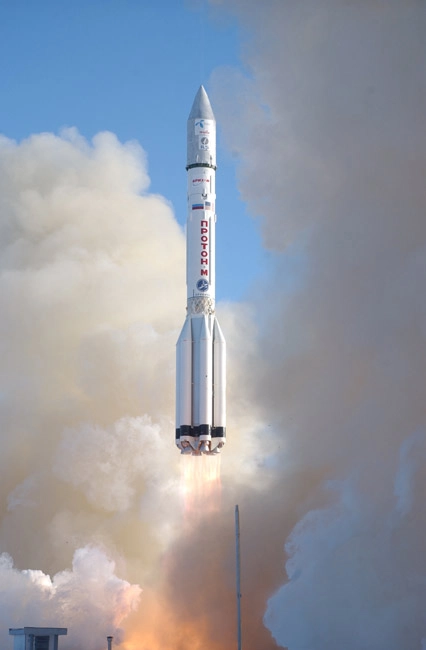
A Proton rocket carrying aNorwegian communications satellite blasted off from the snow-covered plains ofKazakhstan Monday, delivering its $217 million cargo to orbit more than ninehours later.
The 184-foot-tall rocketbegan the marathon mission at 1134 GMT (6:34 a.m. EST) Monday with a fierylaunch from the Baikonur Cosmodrome in Kazakhstan. The Proton's threecore stages each fired during the first nine minutes of the flight, followed byseparation of the Breeze M upper stage and payload from the launcher's thirdstage.
The Breeze M completed fourburns, first to achieve a safe parking orbit about 107 miles above Earth, thento gradually raise its altitude and reduce its orbital inclination to zerodegrees. More than nine hours after liftoff, the stage deployed the 4,321-poundThor 5 communications satellite into a circular geosynchronous orbit.
The Proton was shooting foran orbital altitude of 22,864 miles, according to prelaunch data.
Officials withInternational Launch Services, the joint U.S.-Russian firm responsible formarketing the Proton commercially, declared the mission a success Mondayevening.
The launch was pushed backfrom Sunday due to technical problems encountered during the countdown.
Thor 5 will soon enterservice for Telenor Satellite Broadcasting of Norway, a leading communicationsprovider throughout the Scandinavian region. The satellite was built by OrbitalSciences Corp. of Virginia.
Based at 0.8 degrees westlongitude, the spacecraft will replace the 10-year-old Thor 2 satellite, whichis nearing the end of its design life.
For up to 15 years, Thor 5will provide customers with three times more payload power than itspredecessor, linking regions including Scandinavia, Eastern Europe and theMiddle East.
Thor 5's 24 Ku-bandtransponders, attached to fixed and mobile spot beams, will beam direct-to-homebroadcasting and interactive telecommunications services to its customers.
"The launch of THOR 5represents a milestone for Telenor Satellite Broadcasting and demonstrates ourcommitment to the satellite industry and our firm belief that satellites willcontinue to play an important role as a distribution platform for TVentertainment," said Cato Halsaa, CEO of Telenor Satellite Broadcasting.
Another Thor satelliteshould be ready to launch next year to add additional communications capacityfor Telenor.
"Telenor SatelliteBroadcasting firmly believes that growth in HDTV and niche TV channels willcontinue to create an increased demand for satellite capacity and with oursatellite replacement and expansion program on track, we are confident that we candeliver a highly competitive distribution platform for our customers,"Halsaa said.
Monday's launch was thesecond for the Proton this year, and the first for International LaunchServices.
- IMAGES: 20 Great Rocket Launches
- VIDEO: ESA's New Science Laboratory
- SPACE.com Video Interplayer: NASA's STS-122: Columbus Sets Sail for ISS