


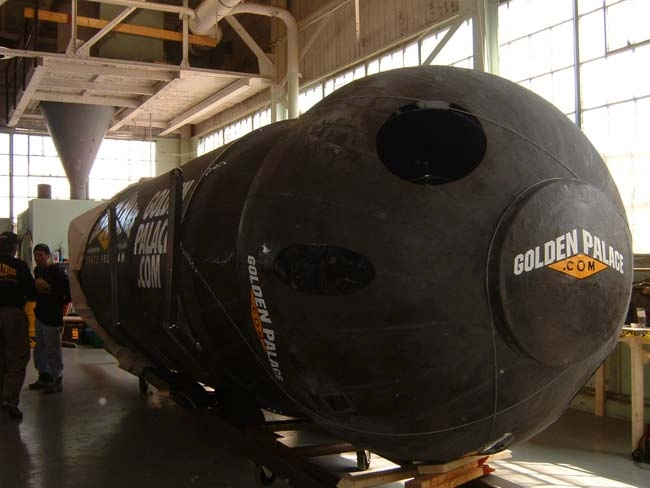
TORONTO, Canada -- A secondteam of rocketeers competing for the $10 million Ansari X Prize, a contest forprivately funded suborbital space flight, has officially announced the firstlaunch date for its manned rocket.
The da Vinci Project, ledby Brian Feeney of Toronto, Ontario, said Thursday the group plans to loft itsWild Fire Mark VI spacecraft on Oct. 2, just days after the planned launch ofanother X Prize contender, the U.S-based SpaceShipOne. The balloon-launchedWild Fire event will be followed by a second launch within two weeks to snagthe X Prize purse, according to the plan.
"We want to win the XPrize, we've got a very good shot of winning the X Prize, we are determined towin the X Prize," Feeney said during today's announcement at Wild Fire'sDownsview Airport hangar. "The most important thing is that wecompete."
Feeney's announcement comes on the heels of a July 27 launch-timetable announcement by the backers of SpaceShipOne, a rocket ship built by aerospace engineer Burt Rutan and his Mojave, California firm Scaled Composites. SpaceShipOne is slated to make its X Prize flights beginning Sept. 29.
"Today is a historicday," said Gregg Maryniak, executive director of the St. Louis,Missouri-based Ansari X Prize Foundation, during today's press event."When you have one space ship, you have a test flight, when you have two,you have a horse race."
X Prize contestants arerequired to give 60 days notice - Feeney's team gave it three days ago --before making their two-flight attempt in order to win the $10 million. Teamsmust successfully demonstrate their vehicle's ability to launch three humans toan altitude of 62 miles (100 kilometers), return them safely, then repeat thefeat within two weeks with the same spacecraft.
More than 20 teams from around the world have registered for the competition.
Racing SpaceShipOne
The competition betweenSpaceShipOne and Wild Fire is fierce, especially after the much-publicizedfirst suborbital flight of SpaceShipOne on June 21. Thatflight was not an X Prize qualifying one and da Vinci team members areconfident they are still in the game.
"It's veryexciting," said Doug Gellatly, a Toronto accountant who has spent twoyears volunteering with the da Vinci team. "I'm so looking forward to thelaunch."
At the time of the SpaceShipOne announcement, Feeney publicly disclosed today's rollout but acknowledged that his team was still $500,000 short of the funds needed for launch. Since then, the effort has found a new title sponsor, the online casino firm Golden Palace.com, which has pushed the effort forward. In honor of that, the da Vinci Project has been renamed the Golden Palace.com Space Program powered by the da Vinci Project.
The all-volunteer da Vinci team spent about $350,000 of cash, $4 million of in-kind donations and they've put in 150,000 man-hours in pursuit of the X Prize, Feeney said.
Feeney himself will pilot the first flight of his team's rocket ship, which is to be staged from above the team's launch site in Kindersley, a town in the Canadian province of Saskatchewan.
The 8,500-pound Wild Fire spacecraft will also carry the weight of two additional people - X Prize vehicles must be able to launch three humans - as well as an eight-track tape, a laptop computer, and a ball kicked by famed soccer player David Beckham.
Unlike SpaceShipOne, Wild Fire has not undergone any test flights and Feeney said he would not disclose when such shakedowns - if any - were scheduled before the Oct. 2 flight.
"We do have a few droptests scheduled," he told SPACE.com. "We will fly."
Feeney said Wild Fire and the da Vinci team will most likely arrive at the Kindersley launch site about a week before the first space shot. It should take about three days for the two trailer trucks packed with the Wild Fire rocket, balloon and other equipment to travel from the team's Toronto hangar to the launch site, he added.
Balloon launch from KindersleySpaceport
Like SpaceShipOne, Wild Fire will launch from high above the Earth after hitching a ride with a mother ship. But where SpaceShipOne is carried under the belly of a parent airplane, Wild Fire is towed with the world's largest reusable helium balloon.
Wild Fire's current flight plan calls for its wide balloon to fly up to an altitude of 80,000 feet (24,384 meters) with the spacecraft dangling by a cable about 750 feet below the balloon's crew quarters. From balloon top to rocket bottom, the entire assembly measures about 1,000 feet. Once the balloon-rocket duo reaches the proper altitude, Wild Fire will ignite its engine - a hybrid rocket fueled by nitrous oxide and a "proprietary blend" of solid propellant - and launch spaceward at a target height of 71.5 miles (115 kilometers).
"It is not based on rubber," Feeney said of the special solid fuel blend. Rutan's SpaceShipOne uses a hybrid engine powered by nitrous oxide and rubber material commonly used in tires.
A laptop computer equipped with modems will be Feeney's primary communications hub with ground crews, supported by a short wave back up system if it is needed.
During reentry, the spherical 6.5-foot (2-meter) crew compartment separates from Wild Fire's cylindrical body and both sections renter the Earth's atmosphere, protected from the heat by a carbon-fiber thermal protection system. Parachutes are then designed to deploy for both the crew compartment and detached body, ensuring that at least 90 percent of the spacecraft returns home to be launched again two weeks later.
"It's going to be onehell of a ride," Feeney said.
Meanwhile, officials in Kindersley are preparing their agricultural town - affectionately dubbed Cape Kindersley - of 5,000 residents for Wild Fire's flight.
The town's website not only highlights the merits of Cape Kindersley, but also lists supposed launch times - between 5:00 a.m. and 6:00 a.m. to avoid high winds - and offers viewing information for both of Wild Fire's X Prize qualifying flights.
"It will take relatively bad weather to keep us on the ground," Feeney said.
Family support
Feeney has spent eightyears leading the da Vinci Project charge, with the backing of his family.
"This is somethinghe's always wanted to do," Joan Feeney -- Brian's mother - told SPACE.com."We didn't really quite understand it at first, but we support him."
John Feeney, Brian'sfather, added that both he and his wife are concerned. "But we'reparents," he said.
Melissa Feeney, Brian's20-year-old daughter, said that while she wouldn't necessarily be the first tostand in line for an X Prize flight, she stands behind Wild Fire, the da VinciProject and her father.
"I am so proud of him," she said.


