





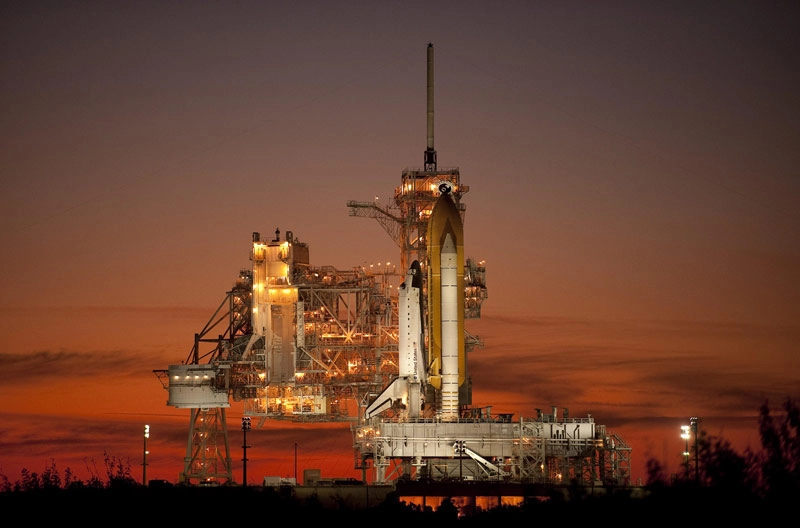
The end is beginning for NASA?s three aging space shuttles,with just five more missions on tap this year before the orbiter fleet retiresin the fall.
That is, unless NASA needs a few more months to fly those remainingmissions or President Barack Obama chooses to extend the shuttle program tofill a looming gap in U.S. human spaceflight capability.
Though the ultimate path forward for NASA has not yet beendecided, the space agency is at a turning point after nearly 29 years ofshuttle flight.
"Obviously it's the end of an era," said RogerLaunius, space history curator at the Smithsonian's National Air and Space Museum. "There's a certain amount of nostalgia and a sense of loss, noquestion."
The very last space shuttle flight, the STS-133mission of the shuttle Discovery to the International Space Station, isscheduled for September 2010. The launch will be the 134th shuttle voyage sincethe fleet?s debut in 1981.
"It's starting to hit home, I have to admit to you,"said NASA's shuttle launch director Mike Leinbach after the Nov. 16 liftoff ofAtlantis on the STS-129 flight, the fifth and last shuttle trip of 2009. "Afterthis one, there's one more scheduled for Atlantis, two more for each of theother vehicles."
Shuttle legacy
The shuttle has had incredible highs, and terrible lows,over its decades-long history since the launch of Columbia on STS-1on April 12, 1981. Fourteen astronauts have been killed and two shuttles,Challenger and Columbia, lost during accidents.
"It had some very notable and public failures, andthose are often what it's remembered for," Launius told SPACE.com. "Theloss of the two vehicles with the crews was just tragic. But overall, it was a prettysuccessful program."
The space shuttle, officially NASA's Space TransportationSystem (STS), was the first-ever reusable spacecraft. It consists of a payloadbay-equipped orbiter to carry crew and cargo, with separate reusable solidrocket boosters to help it lift to space, and a disposable orange external tankto hold the chilled liquid fuel for its main engines.
"They built a reusable vehicle," Launius said. "That?spretty remarkable that they pulled that off. Nobody had ever done that before."
But the space shuttle fleet hasn't achieved all its goals.Originally, NASA conceived it as a system that could fly frequent andinexpensive trips to space on almost an airline-like brisk schedule.
"It was supposed to be routine, safe and affordable, inaddition to being highly capable. But it was never routine, [and] it was veryexpensive," said John Logsdon, a space policy expert and professoremeritus at George Washington University in St. Louis.
The shuttle's safety record was "decent, but not decentenough," he said. "It's riskier than we would like for a vehiclecarrying people."
Nonetheless, it accomplished a lot, including the launch andmultiple servicing trips of what's probably the world's best-known and lovedobservatory, the Hubble Space Telescope. And the shuttle has played a vitalrole in constructing the InternationalSpace Station, the world's largest space laboratory and residence.
"The assembly of the space station could not have beendone without the space shuttle, and the assembly of the space station is one ofthe great engineering achievements of mankind," said space shuttle programmanager John Shannon. "So the space shuttle will have done a goodjob."
Of course, an unforgettable part of the space shuttle'slegacy will always be its tragic accidents. On Jan. 28, 1986, the world watchedstunned as the shuttle Challenger and its seven-member crew, including teacherChrista McAuliffe, were lost in a fiery explosion shortly after launch. Andagain on Feb. 1, 2003, disaster struck when the shuttle Columbia and its sevenastronauts perished while re-entering the atmosphere during their descent backto Earth.
"You know, we lost seven astronauts, and that was awful,just devastating," Leinbach said of the Columbia tragedy. "But wealso lost an orbiter. And it's hard to explain to people, that when we lost Columbia that was like losing a family member almost. It's almost that deep when you workon these machines day in and day out."
After each catastrophe, NASA took a break to investigate thefailures, and was able to regroup and resume the shuttle program.
The final flights
If the current schedule stays on track, 2010 will see thelaunches of the lastfive shuttle flights.
Getting so many missions off the ground is a tall order, butone that NASA has accomplished before ? indeed, the agency launched fiveflights in 2009. The record for most shuttle launches in a single year (ninemissions in all) was set back in 1985.
"In terms of next year, I think the teams are very wellprepared," said Bill Gerstenmaier, NASA's associate administrator forspace operations, after the final launch in 2009. "We're at the rightpace, the tempo feels good, it doesn?t feel rushed. The challenge will be tojust stay focused, just take it one flight at a time."
These last shuttle missions are all slated to travel to thespace station to deliver final rooms and experiments, and to drop off spareparts to keep it functioning beyond the shuttle's retirement.
After the shuttles are grounded, Russia's Soyuz spacecraft willbe the only vehicle approved to carry humans to the station. NASA has said itplans to field its replacement craft for the shuttle, the Ares I rocket and theOrion crew capsule, by 2015.
But outside experts have said it will likely be later,sometime in 2017, when the new spacecraft will be ready to launch astronautsinto space. An independent committee that reviewed NASA?s plan to replace theshuttle fleet and return astronauts to the moon said last year thatcommercially built spacecraft may be able to help ease the coming gap in U.S. manned spaceflight capability.
While the future is uncertain, the year 2010 will be sure tobe an eventful one for NASA, and could mark the end of the space shuttle era.
Shannon said that finale was likely to be bittersweet.
"I'm sure it will be emotional," he said."But I suspect that it will not be sadness over the passing of that era,but happiness that we were a part of it."
- FinalCountdown: A Guide to NASA's Last Space Shuttle Missions
- ImageGallery - Shuttle Discovery's Midnight Launch
- Video Show- How Astronauts Prepare to Ride Space Shuttles
