


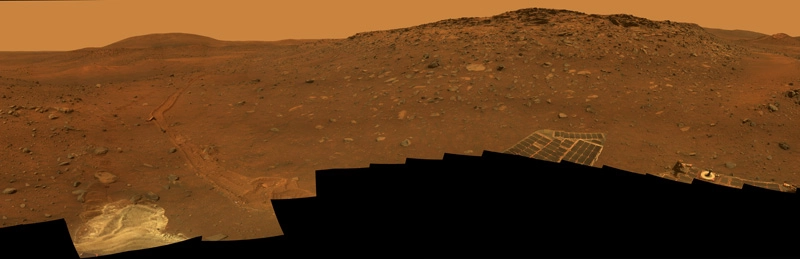
Months ofplanning are finally coming to fruition: NASA engineers are ready to begintrying to maneuver the plucky rover Spirit out of its sandy trap on Mars.
Mission managers are sober about theprospects forfreeing Spirit. They will send the first commands to the rover to try tomove on Monday, "but this process could take quite awhile if it's possibleat all," said Doug McCuistion, director of the Mars Exploration Program atNASA Headquarters in Washington, D.C.
The newplan will command Spirit to try to backtrack and use the tracks it left beforegetting stuck to make the escape attempt.
Spirit hasbeen stuck in a spot of soft, sandy dirt (called "Troy") on theMartian surface since April when it broke through what mission scientists calla "dirt crust" ? a hard top layer of dirt disguising a layer of soft,talcum powder-like material below.
"Spiritdid the equivalent of falling through the ice over a frozen pond," McCuistionsaid.
Escapeplan on Mars
The rover'sengineering team has spent months devising a strategy to extricate thespacecraft, working with replicas of Spirit (and its twinspacecraft, Opportunity). That effort is complicated by the fact thatSpirit has a bum right front wheel, forcing it to drive backwards.
The teamhas tried driving the replica rovers in a variety of ways ? forward, backward,and sideways ? in a mixture of dirt similar to that in which Spirit is stuck tosee what has the best chance of getting the rover out and what might make thesituation worse.
"Ifthere is a way to get the rover out, we'll find it," said rover projectmanager John Callas of NASA?s Jet Propulsion Laboratory (JPL) in Pasadena, Calif.
The plan isto begin driving the rover on Monday, trying to move forward out of Troy, following the same tracks it made to get into the predicament.
The roverdrivers suspect that moving through the soft material already churned up willbe easier than breaking through more of the dirt crust. Moving backwards alsomeans the rover won't have to try to move uphill, said Ashley Stroupe a roverdriver, also from JPL.
When movingthe rover, the team also has to be careful not to scrap against a rock underthe rover's belly. Moving forward should minimize the interaction between therover and this rock, Stroupe said.
"Thisis clearly going to be a long process to either get to extrication or determineif extrication is going to work," Stroupe said.
The commandto move will be sent up on Monday night and mission controllers expect to hearback from Spirit on its progress on Tuesday. The command will be for 5 meters(16 feet) of wheel spin, though mission managers don't expect the rover toactually move that far, Callas said. The team will take a day to analyze anymovement Spirit makes before sending more commands, repeating this process aslong as needed.
"Thereality is that we're going to see very little motion each day at leastinitially," Callas said. "It's kind of like watching grass grow."
Callas saidhe has confidence in the rover team and the plan they have as being the bestchance to extricate Spirit.
"We'rein good shape; we're ready to roll on Monday," he said.
The?spirit? of Spirit
Marsenthusiasts have been worried that Spirit's predicament could spell the end forthe rover's mission, which so far has lasted 24 times longer than its originalplanned 90 days.
Also ofconcern are Spirit's periodic memorylapses, the most recent of which occurred on Oct. 24, preventing Spiritfrom saving science observations in its flash memory.
Spirit'ssticky situation hasn't been all bad though. Mission scientists have used the forceddowntime to conduct science observations of the site, which has turned out tobe one of the most interesting that the rovers have encountered on Mars.
"Ofcourse no place is a nice place to be embedded, but this turns out to be ageological treasure trove," said Ray Arvidson, deputy principalinvestigator for the rovers from Washington University in St. Louis.
While therover has detected sulfate sands in a spot (called Cyclops_eye) where itpunched through with its robotic arm, it detected a completely differentmaterial at another nearby spot (Polyphemous_eye), suggesting the rover isstraddling some type of geologic boundary. The rover is also perched on theedge of a crater.
If therover does remain stuck in Troy, it could end up doing more observations there."There's still a lot of science to be had from the current location,"Arvidson said.
Spirit and Opportunity have been roamingthe Martian surface for nearly six years now, after landing on differentsides of the planet in January 2004.
McCuistionasked fans of the rover to be "hopeful but realistic" about Spirit'sprospects.
If Spiritcan't get out, "it's likely that this lonely spot straddling the edge ofthis crater might be where Spirit ends its adventure on Mars," he said.
- SPACE.com Video Show - Rover Tracks on Mars
- Mars Rover FAQ: The Martian Lives of Spirit and Opportunity
- Video - Spirit: The Little Mars Rover That Could
