


Thisstory was updated at 10:38 a.m. EDT.
NASA fueledthe space shuttle Endeavour early Wednesday in an apparently successful test ofrepairs aimed at eliminating a potentially dangerous hydrogen gas leak.
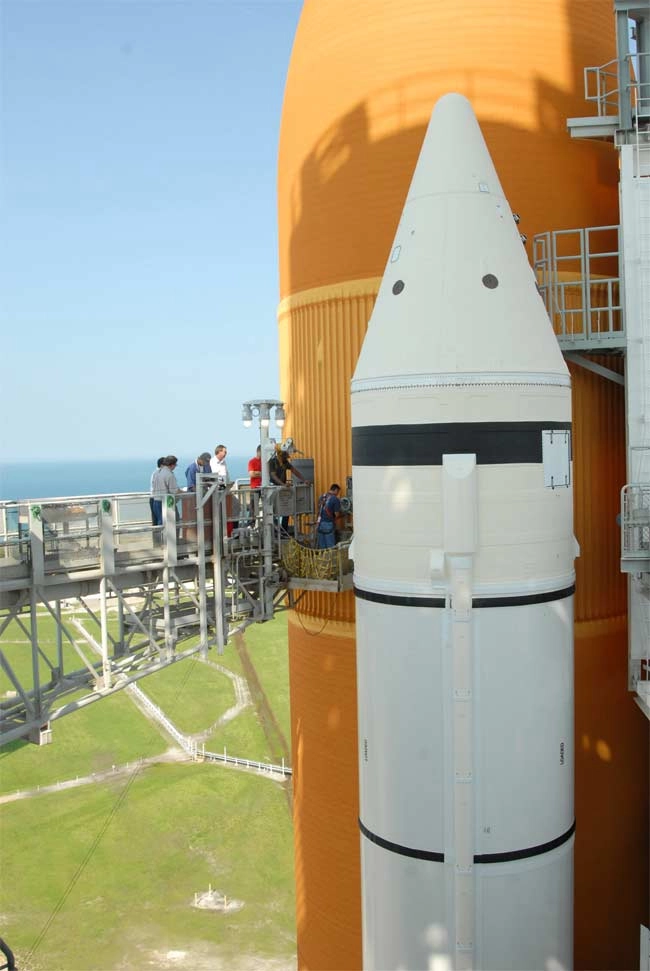
During thetest at the Kennedy Space Center in Florida, NASA loaded Endeavour?s massiveexternal tank with super-chilled liquid hydrogen and liquid oxygen whilewatching a hydrogen gas vent line for excessiveleaks. But after filling the 15-story tank with 526,000 gallons of propellant,no abnormal leaks were detected, boosting confidence that Endeavour willbe ready for a July 11 launch.
?We thinkwe?ve got this licked,? said NASA test director Steve Payne during the fuelingtest. ?This should solve it, and the test we?re doing today is to verify itbefore we go launch next week.?
Thehydrogen gas leak prevented NASA from launching Endeavour during twoconsecutive attempts on June 13 and June 17. After the second try, NASAstood down to study the leak in more detail and allow an unmanned rocket tolaunch a pair of new U.S. moon probes.
Shuttleengineers traced the flammable gas leak to a misaligned plate linking Endeavour?sfuel tank with a Teflon seal and vent line that carries excess hydrogen awayfrom the launch pad. During fueling, a shuttle?s cryogenic liquid hydrogenpropellant boils off over time, so the resulting flammable gas must be ventedto a nearby flame stack to be burned off safely. An excessive leak of hydrogengas at the launch pad could pose an explosion risk during liftoff.
?Preliminaryresults indicate that repairs to the ground umbilical carrier plate, or GUCP,were successful,? NASA spokesperson Candrea Thomas said as the fueling testconcluded.
NASA willupdate the public and reporters on the results of today?s test later todayduring a televised briefing at 1:00 p.m. EDT (1700 GMT).
Leakrepairs
To plug Endeavour?shydrogen gas leak, NASA engineers replaced the single-piece Teflon seal with atwo-piece version and attempted to fix the misalignment with specialwasher-like shims. Payne said shuttle engineers worked through weekends andaround the clock, when weather permitted, to repair Endeavour in time fortoday?s test.
NASA beganpumping Endeavour full of fuel at 6:48 a.m. EDT (1100 GMT) at its seasidelaunch pad in Cape Canaveral, Fla. By about 9:00 a.m. EDT (1300 GMT), the tank wasabout 98 percent full with no indications of a hydrogen as leak.
NASAspokesperson Kyle Herring said the test results are encouraging, but a finalinspection of the fuel tank by engineers must be completed first.
?We?vepassed the point where we?ve had problems before, and once you?ve done that youtypically don?t see leaks, historically,? Herring told SPACE.com. ?I?d say we?recautiously optimistic at this point.?
Endeavouris currently slated to launch at 7:39 p.m. EDT (2339 GMT) on July 11 to begin aplanned 16-day mission to the International Space Station. The shuttle?s seven-astronautcrew plans to deliver the last piece of the station?s massiveJapanese lab Kibo, perform five rigorous spacewalks and replace one memberof the outpost?s six-man crew during the marathon spaceflight.
The missionhas until July 14 to launch before NASA would have to stand down until July 27so a previously scheduled unmanned Russian cargo ship can launch and dock atthe space station, mission managers have said.
Stuckknob freed
Whiletoday?s fueling test was performed on Endeavour, another team of engineers isinspecting a flight deck window on the shuttle Atlantis, which flew asuccessful mission to the Hubble Space Telescope in May.
A worklight knob had inadvertentlywedged itself between the window and shuttle dashboard while Atlantis wasin space, forcing engineers on Earth to pressurize the orbiter?s cabin toexpand it slightly in order to remove the part. A team will inspect the windowfor damage to determine if needs repairs or replacement.
Atlantis isslated to launch supplies to the International Space Station on Nov. 12.
NASAwill update the public and media on the results of today?s fueling test aboardEndeavour at 1:00 p.m. EDT (1700 GMT) on NASA TV. Click here forSPACE.com?s live shuttle mission updates and a link to NASA TV.
- New Video - Space Station to Get Japanese Porch
- New Video - Meet the STS-127 Shuttle Astronauts
- Video Show - The ISS: Foothold on Forever
