


This story was updated at 9:15 a.m. EDT.
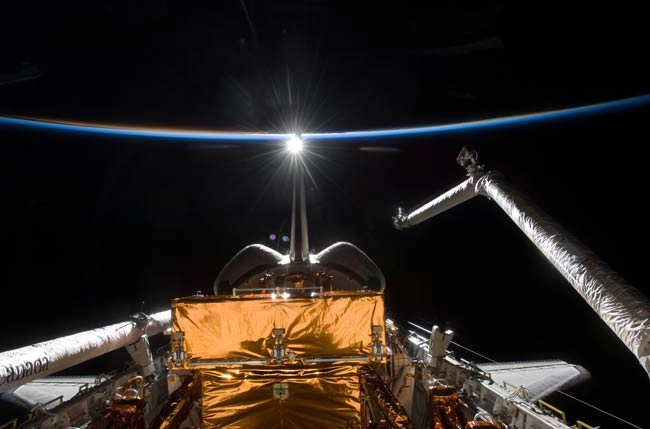
CAPE CANAVERAL, Fla. — Stormy weather in Florida prevented the shuttle Atlantis from an on-time landing Friday, forcing its seven-astronaut crew to spend at least one more day in orbit following their successful repair of the Hubble Space Telescope.
Atlantis astronauts had hoped to return home at about 10:00 a.m. EDT (1400 GMT) here at NASA's Kennedy Space Center, but rainy weather thwarted that plan and a second attempted landing. The shuttle will try again early Saturday at 9:16 a.m. EDT (1316 GMT).
Low clouds, nearby thunderstorms and lightning were to blame, Mission Control said. They were part of a storm system that stretched from Florida's eastern coast out to the Bahamas.
"We're going to formally wave off for the day," Mission Control radioed the Atlantis crew. "The weather at KSC is really moist and unstable."
The weather forecast was so bleak it was pointless to continue, NASA said. The call came early enough that the astronauts had not yet donned their bulky orange pressure suits or closed Atlantis' cargo bay doors.
"We know you looked at it hard, we appreciate you making the call early," shuttle commander Scott Altman replied.
The Atlantis crew is completing an 11-day mission to repair and upgrade the Hubble Space Telescope for the fifth and final time. The astronauts are the last humans ever to touch or see Hubble up close since NASA plans to retire its three space shuttles - the only vehicles currently capable of hauling the telescope's spare parts and repair crews - next year.
Set to land aboard Atlantis with Altman are pilot Greg H. Johnson and mission specialists Michael Good, Megan McArthur, John Grunsfeld, Michael Massimino and Andrew Feustel. They are returning home after adding $220 million worth of new instruments to Hubble, swapping out old batteries, gyroscopes and other gear, as well as repairing two long-broken instruments that were never designed to be fixed in space.
The shuttle's four spacewalkers worked in two-man teams to steam through five exhausting spacewalks in as many days to upgrade the iconic observatory, which is now more powerful than ever. The overhaul is expected to add between five and 10 years onto Hubble's already long-lived legacy.
Atlantis astronauts also attached a docking ring on the telescope to prepare for its ultimate death. It will allow a robotic spacecraft to latch onto Hubble sometime after 2020 and steer it down to a watery grave in the depths of the Pacific Ocean.
NASA will try for a Florida landing again on Saturday, but it will also call up a backup runway at the Edwards Air Force Base in Southern California. The weather in California is favorable for the next three days.
John Madura, chief of the Kennedy Space Center weather office, said Atlantis has only has a "slightly better" chance of landing in Florida tomorrow or Sunday. Rain and thunderstorms are expected to continue, but the air will be more stable, he said. Atlantis can stay aloft as late as Monday before the oxygen supply would run out, mission managers said.
NASA prefers to land space shuttles in Florida because it is the home port and launch site for the fleet. It saves $1.8 million in transport costs and a week of time associated with ferrying a shuttle from the California landing site to the Kennedy Space Center atop a modified 747 jumbo jet carrier craft.
"We don't want to go there," Madura said. "It's a long flight back."
NASA initially canceled the Hubble repair mission in 2004, a year after the Columbia disaster, because of its added risk since the flight put the Atlantis crew in higher orbit with more space junk and beyond reach of the International Space Station if their ship was damaged.
The agency kept a second shuttle — Endeavour — ready to fly a rescue mission to retrieve the Atlantis astronauts, if required. No rescue was needed and Endeavour stood down from rescue status on Thursday so shuttle workers can prime it for a June launch to the space station.
The Hubble flight launched on May 11 and cost about $1.1 billion. To date, about $10 billion has been invested in Hubble since its inception and 1990 launch.
SPACE.com is providing continuous coverage of NASA's last mission to the Hubble Space Telescope with senior editor Tariq Malik in Cape Canaveral, Fla., and reporter Clara Moskowitz in New York. Click here for mission updates and SPACE.com's live NASA TV video feed.
