


Thisstory was updated at 4:18 p.m. EDT.
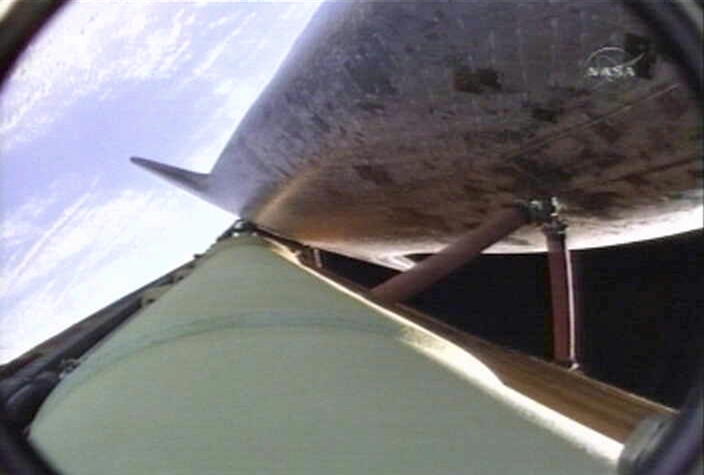
HOUSTON -Astronauts spotted a trail of small dings on the starboard wing of the spaceshuttle Atlantis Tuesday during a heat shield inspection as they race towardthe Hubble Space Telescope.
The dingswere caused by launch debris that fell from the shuttle?s external tank asAtlantis rocketedtoward Hubble on Monday afternoon, but an initial analysis suggests thedamage is minor.
Leadshuttle flight director Tony Ceccacci said the dings are spread across a21-inch (53-cm) area that includes four heat-resistant tiles. They are locatedon the bottom right side of Atlantis just ahead of where the shuttle?s bodymeets its starboard wing.
?Theylooked very minor, but we?re going to let the folks go ahead and take a look atit, follow the standard process and determine what to do next on it,? Ceccaccitold reporters during a briefing here at NASA?s Johnson Space Center.
Launchdebris blamed
The dingedtiles were found in a spot where wing-mounted sensors recorded a slight debris impactabout 103 seconds after Atlantis launched, Ceccacci said. They appeared assmall nicks in images beamed to Earth from today?s heatshield inspection, but more analysis is required.
?Everybodyis feeling pretty good that it's not something particularly serious,? astronautDaniel Burbank radioed up to Atlantis from Mission Control here. ?We justwant to make sure we do the right thing and complete all the analysis.?
Atlantiscommander Scott Altman and his crew are flying an 11-day mission to overhaulthe 19-year-old Hubble Space Telescope for the fifth and final time. They aredue to arrive at the space telescope on Wednesday.
Fiveconsecutive spacewalks are planned to install twonew cameras and repair two others that were never designed to be fixed inspace among other upgrades.
Extrainspection possible
While thedings appear to be minor, Atlantis is carrying a suite of repair tools just incase they might be needed. NASA has also primed the space shuttle Endeavour ona second launch pad in the unlikely event that Atlantis is damaged beyondrepair and its crew needs to be rescuedin space.
NASA haskept a constant lookout for any shuttle damage from launch debris after a pieceof fuel tank foam struck the shuttle Columbia in 2003 leading to itsdestruction during re-entry. Seven astronauts were killed in the disaster.
Now,astronauts scan their shuttle heat shields at least twice every mission.Today?s inspection was the first for Atlantis? crew. The astronauts will takeanother look later in the flight to spot any new damage from space junk. Theregion of space around Hubble?s 350-mile (563-km) orbit is littered with spacedebris, adding a slightly increased risk to the shuttle mission.
MissionControl told Altman that the astronauts might have to keep trying to beam backimages from a stubborn camera on the shuttle?s belly that took snapshots ofAtlantis? external tank during launch. The images could reveal where the debriscame from, but the camera has experienced glitches sending the images.
Altman andhis crew may also have to perform a more detailed scan of the dings during afocused inspection. The astronauts would have to cram that survey in betweentheir challengingspacewalks.
?We know ittakes awhile to get the story together,? Altman said. ?We?ll get you whateverdata we can.?
ButCeccacci said that if a second look is required, there is a 90-minute window onFriday just before the mission?s second spacewalk.
?I don?texpect it to take very long to get that complete,? Ceccacci said.
Launchpad also damaged
While theAtlantis crew works in space, NASA is examining unexpected damage on Earth to theshuttle?s launch pad at the Kennedy Space Center in Cape Canaveral, Fla.
The blastfrom Atlantis? engines damaged some nitrogen and pressure lines, as well as a25-square-foot section of flame retardant material lining the trench beneaththe shuttle?s Launch Pad 39A,NASA spokesperson Allard Beutel told SPACE.comfrom the Kennedy Space Center in Florida. The so-called flame trench is used to funnel rocket exhaust away from the spacecraft during liftoff.
Beutelsaid pad workers are expected to be able to repair the launch pad damage intime for the planned June 13 blast off of NASA?s next shuttle mission.
SPACE.comis providing continuous coverage of NASA's last mission to the Hubble SpaceTelescope with senior editor Tariq Malik in Houston and reporter ClaraMoskowitz in New York. Clickhere for mission updates and SPACE.com's live NASA TV video feed.
- New Video Show - Hubble's Final Shuttle Service Call
- New Video - The Hubble Rescue Mission Revealed
- Image Gallery - Hubble's Latest Views of the Universe: Part 1, Part 2
