


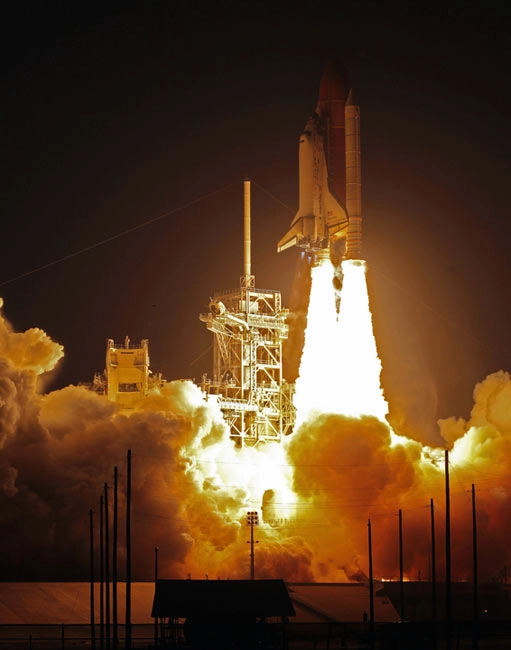
CAPE CANAVERAL, Fla. - A Japanese astronaut is usheringhis country into the realm of endurance spaceflight as Japan?s first long-termresident on the International Space Station after rocketing into space aboardNASA's space shuttle Discovery late Sunday.
Koichi Wakata, a veteran spaceflyer with the JapanAerospace Exploration Agency (JAXA), is riding toward his new orbital home for the next three months, where he willserve as an Expedition 18 flight engineer.
"This mission is a giant leap for the Japanesemanned space activity program," JAXA vice president Yukihide Hayashi saidthrough a translator at briefing here at NASA?s Kennedy Space Center afterlaunch. "It will accumulate valuable knowledge and experience for thefuture Japanese space and aviation program."
Wakata was one of seven astronauts, led by commander LeeArchambault, to launch aboard Discovery's STS-119 mission tonight. The spacecraft lifted off in a purple twilight sky at 7:43 p.m.EDT (2343 GMT) from the seaside pad here.
"I've seen a lot of launches?this was the mostvisually beautiful launch I have ever seen," said NASA shuttle launchdirector Mike Leinbach. "It was just spectacular. When the orbiter and thetank and boosters got up into the sunlight, that had just set about 10 minutesprior, it was just gorgeous."
The shuttle lifted off to "perfect" weatherconditions, U.S. Air Force Lieutenant Colonel Patrick Barrett of the 45thWeather Squadron said. About two hours before Discovery's liftoff, shuttleweather officers upgraded the forecast from an 80 percent to 100 percent chanceof favorable weather conditions for launch.
The launch went smoothly, in contrast to a series ofglitches that have kept Discovery grounded for more than a month past itsoriginal launch date.
"I think when we work a little extra hard to get tothe launch I think it's even a little sweeter when the launch actuallyoccurs," said Bill Gerstenmaier, NASA?s associate administrator for spaceoperations. "I think this just worked out really wonderful."
A small fruit bat that fell asleep on the side of the shuttle'sexternal tank this morning apparently held on throughout Discovery's liftoff.
"We had a bat that was on the side of the externaltank," Leinbach said. "We characterize him as unexpected debris, andhe's probably still unexpected debris somewhere."
Discovery is carrying a huge girder to complete the spacestation's backbone truss, and the final set of solar arrays to power theorbital outpost. After dropping off Wakata at the station, Discovery will ferryhis predecessor, NASA astronaut Sandra Magnus, home.
The nation of Japan will be following this missionclosely, eager for their countryman to live onboard the space station and useits largest laboratory, the Japanese-built Kibo module, which was installedlast May.
"So many Japanese people are very, very happy andwatching Mr. Wakata's successful flight," Hayashi said. "The meaningof this mission for the Japanese people is that this marks the very firstlong-stay mission by the Japanese astronauts. It is very, very meaningful forthe Japanese manned space program."
SPACE.com is providing continuous coverage of STS-119with reporter Clara Moskowitz in Cape Canaveral and senior editor Tariq Malikin New York. Click here for mission updates and SPACE.com's live NASA TVvideo feed.
- New Video - Meet Discovery's STS-119 Shuttle Astronauts
- New Video - Discovery's Mission: Space Station Power Up!
- New Show - NewSpace: The Orbital Industrial Revolution
