





This story was updated at 2:18 p.m. EDT.
Astronauts aboard the International Space Station took refuge inside their Russian-built Soyuz lifeboat Thursday when a potentially life-threatening piece of space debris zipped too close to their orbiting laboratory.
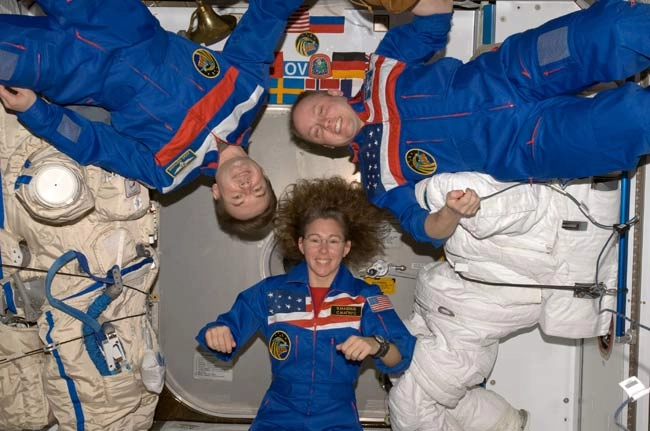
The three astronauts, two Americans and one Russian, moved into the station's attached Soyuz TMA-13 spacecraft at 12:35 p.m. EDT (1635 GMT) as a safety precaution in case the debris — a small piece of a spent satellite motor — slammed into the orbiting lab and ripped a hole in its outer hull. The astronauts were ready to evacuate the space station if the debris hit the station and depressurized its living space.
Notice of the incoming debris came overnight, too late for flight controllers to plan a maneuver to fire the station's thrusters and put more space between it and the space trash, NASA officials said. But the debris apparently did not impact the $100 billion orbiting lab as it flew 220 miles (354 km) above Earth.
"We're all happy the [debris] passed with no impact," NASA's Mission Control radioed up to the crew from the Johnson Space Center (JSC) in Houston. "That's great news."
NASA spokesperson Brandi Dean at JSC told SPACE.com that the astronauts did not fully close the hatches between the Soyuz and the rest of the space station during the precaution, but they were prepared to do so if required. The satellite motor remnant was expected to zoom past the station at a distance of about 2.4 miles (4 km), Dean said.
"The closure of the hatches ensures the safety of the crew and the ability to quickly depart the station in the unlikely event the debris collided with the station causing a depressurization," NASA officials said. "Moving the crew into the Soyuz is a precaution, as the probability of impact is low."
Space station commander Michael Fincke and flight engineer Sandra Magnus, both of NASA, and Russian cosmonaut Yury Lonchakov told Mission Control that they could not see the space debris, but were glad it missed the space station.
"Sandy kept her eyes out the Soyuz windows and we didn't see anything, of course," Fincke radioed down to Mission Control. "But we were wondering how close things were. We'd be interested in that."
Space debris threat
Dean said NASA flight controllers are refining their estimates to how close the debris came to the space station.
The wayward satellite motor part came from an outdated PAM-D rocket engine that was once used to boost a satellite from low-Earth orbit a few hundred miles above Earth out to a geosynchronous position about 22,300 miles (36,000 km) above the planet. The debris was small, just 1/3 of an inch long, and was flying at about 19,800 mph, NASA officials said. The space station orbits the Earth at about 17,500 mph.
The space station has fired its Russian rocket engines to avoid space junk before, and astronauts have sought shelter in their attached Soyuz spacecraft - which doubles as a lifeboat in emergencies - at least once before, she added.
"It has happened before," Dean said.
The last time astronauts sought refuge from space debris in their Soyuz spacecraft was on Nov. 17, 2008, when the remains of an old SL-12 rocket flew within 12 miles (19 km) of the space station, according to the European Space Agency. That debris event also did not impact the space station.
The satellite motor made its closest pass by the space station at 12:39 p.m. EDT (1639 GMT). By 12:46 p.m. EDT (1646 GMT), Fincke and his fellow crewmates were given the all clear to reenter the space station.
Space debris has been a growing threat for spacecraft in low-Earth orbit.
NASA officials said the recent Feb. 10 collision between a Russian military satellite and a U.S. communications satellite has increased the risk of debris impacts during a space shuttle mission by about 6 percent.
The unprecedented Feb. 10 collision occurred 490 miles (790 km) above Siberia and created two large clouds of debris in Earth orbit. Some of the debris particles are expected to start re-entering the Earth's atmosphere this week.
