





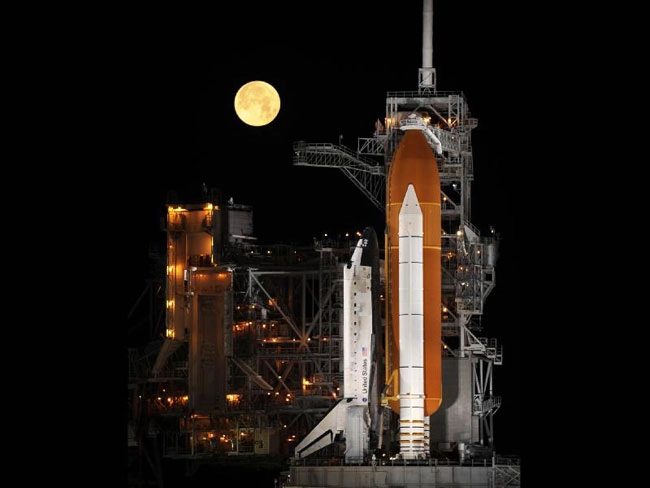
CAPECANAVERAL, FLA. ? The launch of NASA?s space shuttle Discovery will fly noearlier than March 15 after a gas leak thwarted an attemptedliftoff on Wednesday, mission managers said today.
NASA postponed?Discovery?s spaceflight earlier today after detecting a leak in a hydrogengas vent line as the shuttle began fueling up for a planned launch tonight at 9:20p.m. EDT (0120 GMT March 12).
Mike Moses,head of Discovery?s mission management team, said engineers will begin inspecting the faulty gas line on Thursday and shuttle officials will meet that afternoon to review launch plans.
Moses said that delaying until March 15will mean having to cut one spacewalk and three days from Discovery?s flight,which was planned to last 14 days and includefour spacewalks.
If themission is delayed even more, to March 16, Discovery astronauts would completeonly two of four spacewalks and the mission will run only 10 days, Moses saidduring a briefing here at NASA?s Kennedy Space Center after the launch attempt.
The changesare necessary to make room for a Russian Soyuz spacecraft that is alreadyscheduled to launch toward the International Space Station on March 26. IfDiscovery doesn?t launch by March 17, NASA would have to stand down until afterthe Soyuz launch and a space station crew change. The next launch window wouldopen on April 7.
"Thisis life in the space business. Sometimes things happen," said Moses. IfDiscovery?s flight shifts to April, it would likely cause a ripple of delaysfor NASA?s other shuttle launches this year and the planned shift to a larger,six-person crew aboard the space station this May, he added.
At about 2:30p.m. (1830 GMT) today, about two hours after ground crews began fueling Discovery'smassive orange external tank, engineers noticed a leak in a gaseous hydrogenline coming from the tank. The line vents off flammable hydrogen gas, createdas the super-cooled liquid hydrogen propellant in the tank boils, in order tokeep the tank at the right pressure.
NASAofficially scrubbed the launch plan at 2:37 p.m. EDT (1837 GMT).
"Our businessrequires perfection and our vehicle was not perfect today," said NASAlaunch director Mike Leinbach.
Missionmanagers say today's scrub has nothing to do with earlierissues on the shuttle related to fuel control valves in the orbiters mainengines. This problem forced Discovery's launch to be delayed about a monthfrom an initial launch date set for Feb. 12.
Engineersultimately replaced the three valves on Discovery with a set proven to be freeof damage, after a similar valve cracked on the shuttle Endeavour during itsNovember 2008 launch. Though that issue posed no problem to Endeavour, missionmanagers spent weeks testing to make sure Discovery would be safe.
Discovery'sseven-astronautcrew, commanded by veteran astronaut Lee Archambault, is due to head towardthe International Space Station on NASA?s first construction flight of the year.The shuttle will ferry up a final pair of U.S.-built solar wings and the lastsegment of the space station's backbone-like main truss.
It also isset to deliver Japanese astronaut Koichi Wakata, who will serve as hiscountry's first long-duration astronaut when he stays aboard the station as anExpedition 18 flight engineer for six months. Wakata is set to replace NASAastronaut Sandra Magnus, who will fly home aboard Discovery.
Filling outDiscovery's crew are STS-119 pilot Tony Antonelli and mission specialistsJoseph Acaba, Steven Swanson, Richard Arnold II and John Phillips.
SPACE.comis providing continuous coverage of STS-119 with reporter Clara Moskowitz atCape Canaveral and senior editor Tariq Malik in New York. Click here for missionupdates and SPACE.com's live NASA TV video feed. Live launch coverage beginsat 4:00 p.m. EDT (2000 GMT).
- New Video - Meet Discovery's STS-119 Shuttle Astronauts
- New Video - Discovery's Mission: Space Station Power Up!
- New Show - NewSpace: The Orbital Industrial Revolution
