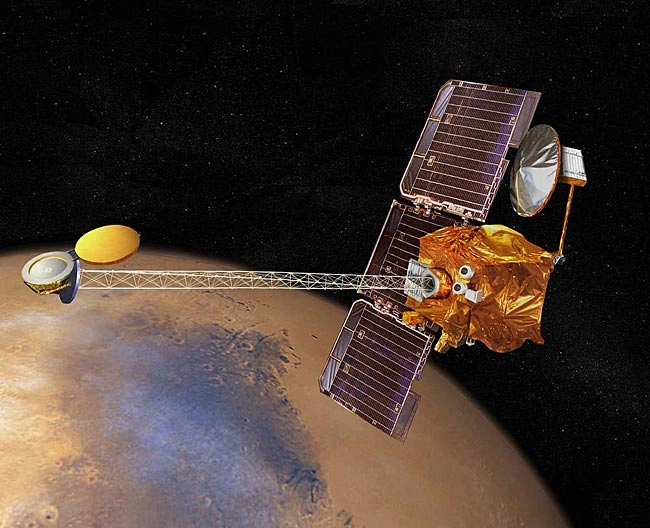
NASA's Mars Odyssey orbiter, which has been circling the red planet for nearly eight years, needs a risky reboot to address a long-known, potential vulnerability in its memory system.
The Odyssey team plans to perform the operation next week.
The chief concern about the potential memory vulnerability stems from the length of time that the spacecraft has been exposed to the accumulated effects of the space radiation environment since the last reboot, which occurred on Oct. 31, 2003.
As an additional benefit, the cold-reboot procedure will demonstrate whether Odyssey's onboard backup systems will be available should they ever be required.
"We have lost no functionality, but there would be advantages to knowing whether the B side [backup system] is available," said Odyssey Mission Manager Gaylon McSmith of NASA's Jet Propulsion Laboratory in Pasadena, Calif. "We have developed a careful plan for attempting to determine that."
NASA also recently revived its Mars Reconnaissance Orbiter after a glitch sent it into its protective safe mode last week.
In all the years since its April 7, 2001, launch, Odyssey has not needed to use its set of spare components. The spares are called the spacecraft's "B side," which includes an identical set of a computer processor, navigation sensors, relay radio and other subsystems. To use any of them, Odyssey would have to shift to all of them at once from its primary set of components, called the "A side."
On March 21, 2007, the B side spare of an electronic component for managing the distribution of power, called the high-efficiency power supply, became inoperable. If it is permanently disabled, then none of the B side is available for use. Engineers have investigated the inoperability of the power supply and that the component can probably be made to work properly again by rebooting the orbiter's computer, although the memory-vulnerability issue that is the current concern is not directly related to the March 2007 event that affected the power supply.
Odyssey is in the third two-year extension of its mission at Mars.
Some A side components, such as the UHF radio used for communications with spacecraft on the surface of Mars, have worked as long as they were designed to last.
In addition to its own major scientific discoveries and continuing studies of the planet, the Odyssey mission has played important roles in supporting the missions of the Mars rovers Spirit and Opportunity and the Phoenix Mars Lander.