Thisstory was updated at 1:10 pm EDT.
AEuropean spacecraft caught sounds from NASA?s Phoenix Mars Lander during itsscreaming Sunday descent to the red planet?s arctic surface.
TheEuropean Mars Express beamed the audio data to Earth shortly after NASA?sPhoenix Mars Lander touched down in the Martian arctic late Sunday. The signal fromPhoenix?s descent comes through loud and clear after processing by the MarsExpress Flight Control Team.
Ashift occurred in the signal received by Mars Express due to the so-calledDoppler Effect, not unlike hearing the whistle of a passing train, as theorbiter moved away from the lander.
MarsExpress successfully tracked Phoenix throughoutdescent using the Mars Express Lander Communication system (MELACOM), evenduring the expected transmission blackout window when ionization builds uparound the lander as it falls through the atmosphere.
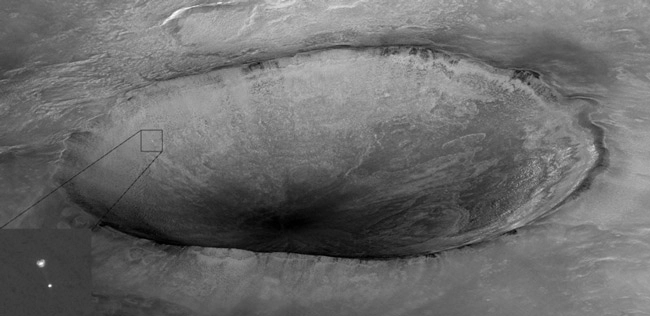
Thesignal finally cut out as Mars Express flew away and the lander passed out ofview. NASA?s Mars Odyssey and Mars Reconnaissance Orbiter also watchedover Phoenix?s successful landing.
Phoenixis equipped with a microphone that was originally slated to record soundsduring landing in conjunction with a camera designed to take aerial photographsof the probe?s arctic landing site. While that plan was scrapped to avoidcomplications with Phoenix?s landing, the microphone may still be used on thesurface, mission managers said.
?We?dall love to hear some noises from the surfaceof Mars, that would be a first," said Phoenix principal investigatorPeter Smith of the University of Arizona.
The$422 million Phoenix lander is a stationary probe equipped with a scoop-tippedrobotic arm to search for buried water ice beneath the arctic plains of itsVastitas Borealis landing site. The spacecraft carries a Canadian-built weatherstation, ovens and wet chemistry lab, and is designed to study Mars for atleast three months to determine if the planet?s arctic circle could have oncesupported primitive life.
MarsExpress will continue monitoring Phoenix by using MELACOM fifteen more times.That should help demonstrate that the European Space Agency?s spacecraft canrelay data from the Martian surface to Earth, and also transmit commands fromEarth to the lander.
Editor?sNote: This report has been changed to clarify that the Doppler Effect applies toa shift in signal transmitted by Phoenix and received by Mars Express.
- Video: Sounds From Phoenix Mars Lander's Descent
- New Images: Phoenix on Mars!
- Video: The Nail-Biting Landing of Phoenix on Mars