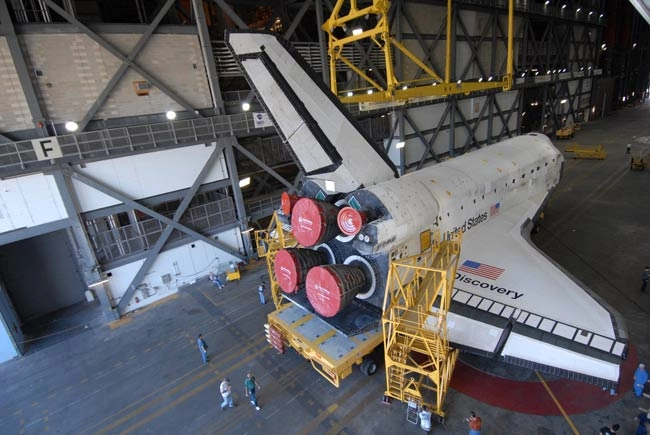
The spaceshuttle Discovery moved a step closer to launch early Saturday as NASA engineershauled the spacecraft into a massive hangar to join its fuel tank and twinrocket boosters.
Discoverymade the short morning move from its processing building to the cavernous,52-story Vehicle Assembly Building at NASA?s Kennedy Space Center in CapeCanaveral, Fla., to prepare for its planned May 31 launch.
The shuttle?sseven-astronaut crew, commanded by veteran spaceflyer Mark Kelly, will deliverKibo - a massiveJapanese laboratory the size of a tour bus - to the International Space Stationduring a planned 13-day mission.

Engineers rolledDiscovery out of its processing facility atop a 76-wheel transporter at 7:17a.m. EDT (1117 GMT) and into the Vehicle Assembly Building at about 8:05 a.m.EDT (1205 GMT), where engineers will hoist it into a vertical position forexternal tank attachment. The move occurred two days earlier than planned dueto swift work by shuttle workers, NASA officials said.
?That?susually a pretty good sign when you can gain some time in the schedule,? NASAspokesperson Allard Beutel told SPACE.com. ?They just didn?t encounter alot of problems and things have been going extremely well.?
The extratwo days will give shuttle workers more flexibility should they encounter anyunexpected issues later, Beutel added.
Discoveryis slated to roll out to its Pad 39A launch site at 12:01 a.m. EDT (0401 GMT)on May 3, where shuttle workers will prepare it for a planned 5:02 p.m. EDT(0902 GMT) liftoff on May 31.
Duringtheir mission, Kelly and his crew will install the 37-foot (11-meter) Kibolaboratory, relocate its attic-likestorage module delivered on an earlier flight and swap out one member ofthe space station?s crew. Two spacewalks are planned for the mission, NASAsaid.
Discoveryastronauts will perform a full dress rehearsal of their launch day on May 9.
Kibo?sdelivery will mark the second laboratory added to the space station this year.Astronauts installed Europe?sColumbus laboratory during a February shuttle mission, with a March flightdelivering Kibo?s storage module and a Canadian-builtmaintenance robot.
- NEW VIDEO: Space Shuttle Bloopers
- VIDEO: Japan's First Space Station Room
- IMAGES: NASA's STS-123 Shuttle Mission in Pictures
