





This story was updated at 7:45 a.m. EDT.
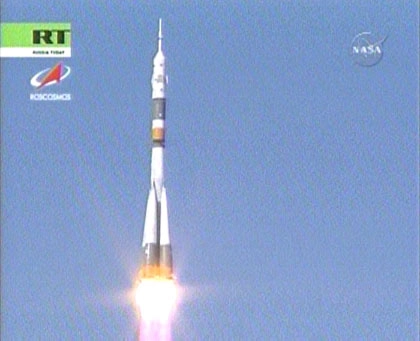
Two Russian cosmonauts and South Korea'sfirst astronaut soared into space aboard a Russian rocket Tuesday morning tobegin a two-day trek toward the International Space Station (ISS).
Russian cosmonauts Sergei Volkov and Oleg Kononenko, along with SouthKorea's So-yeon Yi, lifted offaboard their Soyuz TMA-12 spacecraft at about 7:16 a.m. EDT (1116 GMT) from theCentral Asian spaceport of Baikonur Cosmodrome in Kazakhstan, whereit was late afternoon. Thespaceflyers are set to dock at the station on Thursday at 9:00 a.m. EDT(1300 GMT).
"We're feeling fine,everything is nominal," Volkov said as they launched into space.
Russian Mission Control congratulated the astronauts after theyreached orbit, with a special nod to Yi as her country's first spaceflyer.
"Thank you!" she replied in Russian. An excited Yi wavedto the onboard camera with a big smile on her face during the launch, which was broadcast on Russian and NASA television. Yi's family members were seen cheering her on as they watched the launch from the ground.
The current space station crew watched the launch on video fromspace, where their orbital lab was over the Pacific Ocean, just westof Pitcairn Island.
Volkov, son of famed Russian cosmonaut Alexander Volkov, became the firstsecond-generation spaceflyer to reach space withthe successful launch. He will serve as commander for the six-month Expedition17 space station mission, with Kononenko as his flight engineer.
"I never thought about it, really, thatI am going to be the second generation of the space cosmonauts," Volkov said in a pre-flightNASA interview. "I just want to do my job as best as is possible andthat?s it, honestly."
Yi, 29, is the second Asian woman to fly inspace and is due to visit the orbital lab for a 10-day mission under a $25million commercial arrangement between Russia and South Korea. She plans toperform science experiments and educational events duringher orbital stay before returning aboard a Soyuz TMA-11 spacecraft with ISSExpedition 16 commander Peggy Whitson and flight engineer Yuri Malenchenko on April 19.
"I am hoping the people of North Koreaare happy about my flight as well," Yi, a mechanical engineer, toldreporters in Russia?s cosmonaut training center in Star City before flight, thecountry?s Interfax News Agency reported.
Selected from a field of 36,000 applicants,Yi was originally chosen as South Korea?s backup astronaut behind artificialintelligence expert San Ko. She moved to theprime crew last month after Russian spaceflight officials pulled Ko from the flight dueto reading rule violations.
Volkov and Kononenko will join their third Expedition 17crewmate, U.S. astronaut Garrett Reisman, already aboard the station when they dockThursday. During their tenure, the three first-time spaceflyers will helpinstall the new massive Japanese Kibo laboratory on the station during NASA?sSTS-124 shuttle mission, oversee the departure of Europe'scargo ship Jules Verne and perform at least one spacewalk.
"The main goal of Expedition 17 of courseis to continue station exploitation," Volkov said. "We expect that STS-124 willbring probably the biggest module on the station, the Japanese pressurizedmodule, and we will take part as a team to install and work with [the]module."
The new crew will arrive at a roughly70-percent complete space station, and help make it even bigger when they addits largest room, Kibo.
"It will be quite an interestingexpedition," Kononenko said in a pre-flightNASA interview. "The reason for that is that the station is almost fullyassembled, I mean, the pressurized modules. In addition, the station willalready have the Japanese module docked to it and the European module, so itwill be quite an interesting construction there in space."
The current station crew has spent their lastdays aboard the ISS preparing for their relief crew's arrival.
During the busy, six-month Expedition 16mission, Whitson,Malenchenko and their fellowcrewmembers completed five spacewalks, hosted three visiting shuttle missions,and performed a slew of scientific experiments. The crewmembers helped installthe hub-like Harmony connecting node, the European Columbus laboratory, a smallJapanese storage module, and a giant Canadian robot on the space station.
While the two crews overlap this week, thespaceflyers will share more than mission tips and scientific expertise. Yi isplanning to prepare Korean food for her U.S. and Russian crewmates and may evensing for them on April 12, Cosmonautics Day in Russia, to celebrate theanniversary of cosmonaut Yuri Gagarin?s historic 1961 launch that began humanspaceflight, Interfax and the Associated Press reported.
"I hope they will like it," shesaid.
NASA will broadcast the docking of Expedition17 with the ISS live on NASA TV Thursday, April 10 beginning at 8:30 a.m. EDT(1230 GMT). Click here for SPACE.com'sNASA TV feed and live ISS mission updates.
- NEW VIDEO: Europe's First ISS Cargo Ship Arrives
- VIDEO: ISS Commander Peggy Whitson Takes Charge
- Complete Space Station Mission Coverage
