


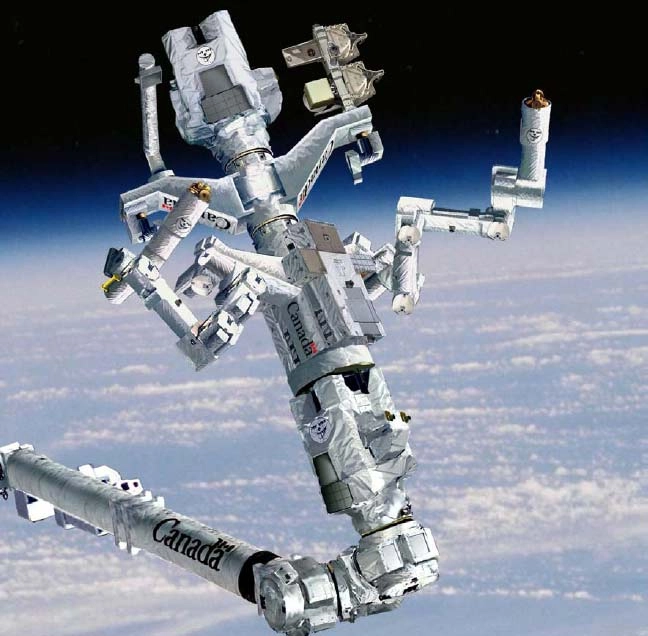
CAPECANAVERAL, Fla. — Mr. Dextre stands taller than a house, has two seven-jointedarms and can fly around the Earth in about 90 minutes. But he is not asuperhero, nor is "he" a person.
"Mr.Dextre," as NASA's latest space shuttle Endeavour crew has coined it, isactually a Canadian space-age robot bound for the International Space Station(ISS) earlyTuesday morning along with Japan's first orbital room. Led by commanderDominic Gorie, the seven-astronaut STS-123 crew will startassembly of the giant robot in space later this week.
"Dextreis probably the most sophisticated robot to go on orbit," said Pierre Jean, acting program managerfor the Canadian space station program, during a press conference here at Kennedy Space Center.
The specialpurpose dexterous manipulator, as Jean referred to Dextre, is a3,440-pound (1,560-kilogram) maintenance tool designed to cut back on thenumber of dangerous trips astronauts make outside of the space station.
Robotic helper
Dextre cangently replace failed space station devices as small as a phonebook to phone booth-sized objects weighing more than 1,000 pounds (450 kilograms). Jean saidchanging batteries, for example, is a routine yet delicate task the robot can dowith a person at its controls, either inside the ISS or on the ground.
"It's a dumb operation. You move thebattery, you put a new one in," Jean said. "When you have to do theseoperations over and over, every time you have to use a [space station] crewperson."
And usingcrewmembers means conducting risky spacewalks that expose astronautsto dangerous micrometeoroids, severe heat and cold, and strong radiation.
"Insome ways a human may do the task quicker. Dextre, on the other hand, may takelonger than a human to do certain servicing tasks," Jean said. He noted,however, that the device gives space station managers valuable options when itcomes to performing orbital busy work, including the ability to fetch items forastronauts when they do have to work outside the ISS.
"Yougive the ability to not tax the crew by forcing them to conduct an[extravehicular activity]," he said of utilizing Dextre's five cameras, two gripper "hands" and a belt full of tools.
Out ofwork?
One mightthink an astronaut would feel threatened by such technological prowess. Wrong,says Canadian Space Agency astronaut Julie Payette, a veteran spaceflyer slatedto journey to the ISS later this year.
"Therobot, I think, is never going to replace humans in space," Payette told SPACE.com."Humans will always need to be around to perform tasks robots may never beable to achieve."
Payetteexplained that Dextre will be extremely useful when assembled on orbit, but itwill never match the mobility, dexterity or independent thinking abilities ofpeople in almost any situation. She also thinks the design, construction and futureoperation of Dextre — the final piece of Canada's ISS mobile servicing system —will inform the creation of even better on-orbit robots.
That's aprospect she said is not the least bit threatening to astronauts, but rather exciting.
"It'sabsolutely essential, necessary step for want we want to do in the future,"Payette said. "Just imagine beingon the moon and being able to send a robot outside to do some dangerouswork. I think that's where this is headed."
- NEWVIDEO: Danger on the Pad: Shuttle Astronauts Practice Escape Drill
- VIDEO:ESA's New Science Laboratory
- VIDEO:Part 1: Europe's First ISS Cargo Ship, Part2