





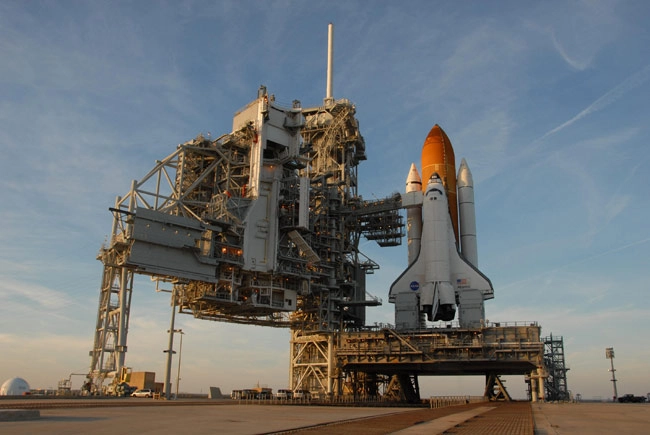
NASA willrefill the space shuttle Atlantis' large external tank next week in hopes ofisolating a sensor glitch that foiled two attempts to launch an orbital constructionmission this month, the agency's shuttle chief said Tuesday.
Wayne Hale,NASA's space shuttle program manager, said a team of engineers will outfitAtlantis' 15-story fuel tank with new monitoring equipment and then fill itwith super-cold propellant on Dec. 18 to better understand why some fuelgauge-like sensors failed during the shuttle's launch attempts.
"Wehave hopes that it will yield the definitive location of our problem andthereby allow us to solve it," Hale said of the test in an afternoonteleconference.
Three ofthe four fuel gauges, known on enginecut-off sensors, in the liquid hydrogen portion of Atlantis' external tank failedstandard checks during the shuttle's first launch attempt last Thursday. Whenthe problem resurfaced on Sunday, NASA postponed Atlantis' mission to deliver a newEuropean-built lab to the International Space Station (ISS) to no earlierthan Jan. 2.
"We'regoing to go find out where this problem is, whether it's the sensors, thewires, the connectors, what have you," said Hale, adding that otherengineering teams will perform bench tests of individual circuits in parallelwith the fueling test.
During textweek's test, engineers will splice in monitoring equipment into circuits forthe four erratic hydrogen sensors and a fifth sensor that detects when the tankis about 5 percent full, Hale said.
Theapproach uses the same tools as those used on Earth to find breaks in telephoneand cable television lines, and will hopefully trace where the glitchis hiding among the 100 feet (35 meters) of wiring between the fuel tanksensors and an electronics box inside Atlantis, he added.
The methodhas been used with empty shuttle external tanks in the past, but Tuesday's testwill mark the first on a tank that is fully fueled with more than 500,000gallons (1.9 million liters) of super-cold liquid hydrogen and liquid oxygenpropellant. Unlike past fueling tests, engineers will be on Atlantis' launchpad to help monitor the new equipment, Hale said.
Based on1960s technology developed for NASA's Apollo moon missions, the engine cut-offsensors are designed as a backup system to shut down a space shuttle's threemain engines before their external tank runs dry of propellant. If the engines continueto fire without fuel, they could rip apart and cause catastrophic damage, NASAhas said.
Intermittentglitches with the sensors have afflicted NASA shuttle launch attempts since2005, when the agency resumed orbiter flights following the Columbia accident, mostrecently in September 2006.
Engineerstraced the malfunctions to what appeared to be faulty connectors on somesensors, replaced them with a new batch and installed a set of voltage monitorsthat ensure the new devices work properly. But the source of the glitch'sreappearance aboard Atlantis remains an enigma.
NASA hopesto root out the sensor problem once and for all before forging ahead with theup to 12 planned shuttle missions to complete the ISS, as well as one more toupgrade the Hubble Space Telescope. The agency is facing a looming September2010 deadline to complete the ISS and retire its three-shuttle fleet.
"Untilwe come to the bottom of this mystery, that we are in no better shape forlaunching any other orbiter and any other tank than we are with this orbiterand tank," Hale said. "So we need to find the solution."
- SPACE.com Video Interplayer: NASA's STS-122: Columbus Sets Sail for ISS
- Test Your Smarts: Space Shuttle Countdown Quiz
- VIDEO: ISS Commander Peggy Whitson Takes Charge
