While the sevenastronauts aboard NASA?s shuttle Discovery head back toward Earth, the agencyis already looking ahead to the planned December launch of its next flight tothe International Space Station (ISS).
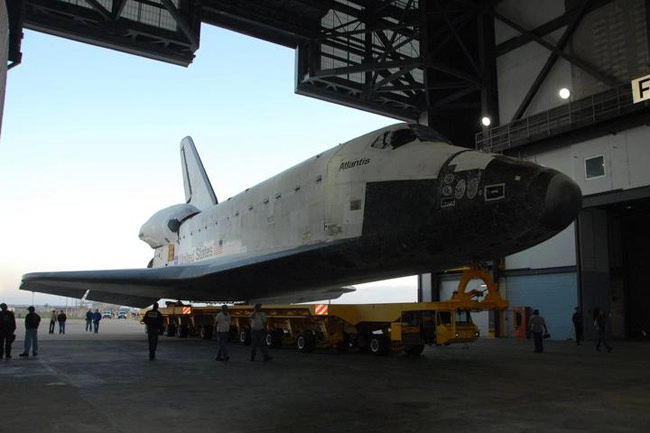
Discovery?ssister ship Atlantis stands poised for flight inside NASA?s cavernous Vehicle Assembly Building at the agency?s Kennedy Space Center (KSC) in Cape Canaveral, Fla., two days after leaving its protective hangar. The shuttle is slated to launch as earlyas Dec. 6 pending the completion of Discovery?s currentmission.
?It issuccessfully mated with its fuel tank and solid rocket boosters,? NASA KSCspokesperson Allard Beutel told SPACE.com of Atlantis.

Led by veteranNASA spaceflyer Stephen Frick, a commander in the U.S. Navy, Atlantis?s seven-mancrew will deliver the European Space Agency?s Columbuslaboratory and a new ISS astronaut to join the station?s Expedition 16mission. The shuttle rolled out of its processing hangar early Saturday and isnow undergoing a series of integration tests to ensure it is connected properlyto its 15-story external fuel tank.
NASA spaceshuttle program manager Wayne Hale told reporters today that Atlantis?s heatshield has been cleared for spaceflight after close inspection of theprotective reinforced carbon-carbon (RCC) panels lining its wing leading edges.Similar heat-resistant panels, which experience the hottest temperatures duringreentry, on Discovery showed indications of exterior coating blemishes, thoughthe orbiter was ultimately found safe to fly.
?We have noconcerns with our RCC panels on Atlantis at this time,? Hale said.
If all goeswell, the Columbus laboratory will roll out to NASA?s Pad 39A launch site onWednesday, with Atlantis set to follow early Nov. 10.
Commandedby veteran shuttle flyer Pamela Melroy, the STS-120 crew successfully delivereda Harmony connecting node to the ISS, moved a massive solar power truss to thestation?s port-most edge, and then unfurled its pair of wing-like solar arrays.The astronauts also stitchedup a ripped solar panel during the last of four spacewalks outside the ISS.
Harmonywill serve as the docking port for Europe?s Columbus module and thethree-segment Kibo laboratory built by Japan.
Busymonth ahead
But first,NASA must land its shuttle Discovery and prepare the ISS for Atlantis?sDecember arrival. Discovery undockedfrom the ISS early Monday and is slated to land Wednesday just after 1:00p.m. EST (1800 GMT).
The shuttle?sreturn then sets the stage for a Friday spacewalk by ISS Expedition 16commander Peggy Whitson and flight engineer Yuri Malenchenko.
Whitson,Malenchenko and flight engineer Daniel Tani plan to stage a trio of spacewalks,move a shuttle docking port to the end of the newly installed Harmony node,then move Harmony and its new berthing port to the front of the station?s U.S.Destiny laboratory before month?s end. Each of those tasks must go smoothly ifAtlantis is to launch within its slim, week-long window.
?From aprocessing point of view, we?re on track to do that,? Beutel said of launchingAtlantis. ?It all really depends on what they?ll be able to do in space.?
NASA is broadcastingDiscovery's STS-120 mission live on NASA TV. Click here for mission updatesand NASA TV from SPACE.com.
- SPACE.com Video Interplayer: Delivering 'Harmony' with NASA's STS-120 Mission
- Looking Back on 50 Years of Spaceflight
- Complete Space Shuttle Mission Coverage
