





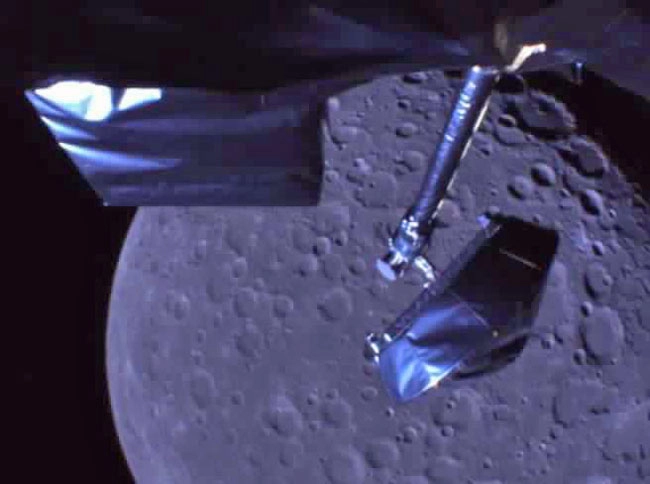
Almost onemonth after Japan's successful launch of the Kaguya lunar probe, the unmannedobservatory has begun its first major activities in orbit around the moon.
In additionto snapping its first lunar images, the probe jettisoned one of two 110-pound (50-kilogram) "baby" satellites thatwill help create a detailed gravity map of the moon.
Theseparation of the miniature satellite, called Rstar, occurred on Oct. 8 at 8:36p.m. EDT (0036 GMT Oct. 9). Mission managers expect Japan Aerospace ExplorationAgency's Kaguya tojettison its second 3.3-foot-diameter (1-meter-diameter) mini-satellite called VRADon Oct. 14.
The 55billion yen ($480 million) Kaguya spacecraft, formally known as the SELenological and ENgineeringExplorer (SELENE), is named after a moon princess in Japanese folklore. Thespacecraft successfully was launched on Sept. 14 from the Tanegashima Space Center in Japan and enteredlunar orbit on Oct. 5.
Kaguya willconduct detailedstudies of the moon using 14 different science instruments from a height ofabout 62 miles (100 kilometers) above the lunar surface during its mission.Japanese engineers and scientists designed the spacecraft to producehigh-resolution surface and gravity maps, observe the moon's magnetic fieldsand even search for water ice, among otherscience objectives, during the one-year mission.
China plansto launch the next moon-bound spacecraft, called the Chang'e-1, by the end ofthe year, followed by NASA's Lunar Reconnaissance Orbiter and India'sChandrayaan-1 spacecraftin 2008.
- VOTE Now! Lunar Legacy: The Best Moon Images
- VIDEO: Moon 2.0: Join the Revolution
- Top 10 Cool Moon Facts