





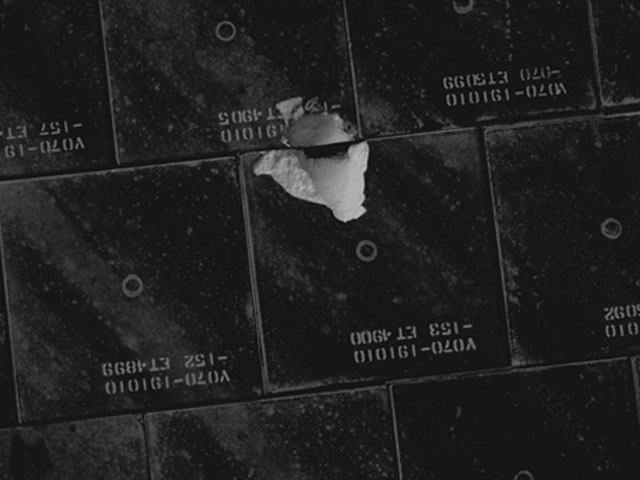
HOUSTON --NASA engineers are running a battery of tests to determine whether Endeavourshuttle astronauts will have to repair a deep gouge on their orbiter's underbelly,while a separate team weighs the best of three options for any fix required,mission managers said Monday.
JohnShannon, chairman of Endeavour's mission management team, said a decision onwhether any repair is required is expected by Wednesday.
A piece of fueltank debris struck Endeavour's belly-mounted tiles 58 seconds after launchon Aug. 8, carving the 3 1/2-inch by 2-inch (9-centimeter by 5-centimeter)gouge. The debris did penetrate through the tile to expose a small strip offelt about one inch (2.5 centimeters) wide and 0.2 inches (0.5 centimeters)long.
The damagedtile, however, does not represent to risk for Endeavour's STS-118 astronaut crew,but rather the orbiter itself, Shannon said. The shuttle's heat shield is soundenough to return its crew to Earth safely in an emergency, but mission managershope to avoid causing any additional damage to the spacecraft that wouldrequire lengthy repairs before its next construction flight to theInternational Space Station (ISS), he added.
"Thisis not a catastrophic loss of orbiter case at all," Shannon told reportersduring a briefing here at NASA's Johnson Space Center. "This is a casewhere you want to do the prudent thing for the vehicle."
Engineers aresubjecting mockups of the damaged tile to the same searing temperaturesEndeavour will experience during its planned reentry and landing on Aug. 22, aswell as running computer model analysis. The results of those tests shoulddetermine whether a repair is required, Shannon said.
NASA haskept a watchful eye on fuel tank debris and the health of its shuttle heatshields since the 2003 Columbiaaccident, when a piece of foam insulation breached that orbiter's left wingand led to the loss of the spacecraft during reentry.
Weighingoptions
Meanwhile,a second team is evaluating whether a heat-resistant paint, a carbon-compositeoverlay or an ablative goo-like material would be the best method of repairingEndeavour's dinged tile.
Joel Montalbano,NASA's lead ISS flight director for STS-118, told reporters that any repair, ifrequired, would not occur before a planned Friday spacewalk.
Montalbano addedthat mission managers are also eyeing options of extending Endeavour's constructionflight up to three extra days should any fix be required. Another optionincludes the possibility of adding a fifth spacewalk to the already extendedmission, he added.
Endeavour'sSTS-118 mission to the ISS is delivering cargo, spare parts and a new pieceto the station's starboard truss. The success of a new powertransfer system, which allows Endeavour to siphon electricity from thestation's solar power grid and conserve its own resources, led mission managersto stretch the orbiter's flight from an initial 11 days to 14 days and add a fourthspacewalk to the STS-118 crew's docket.
Mysterydebris
The debristhat struck Endeavour fell from a fuel tank bracket at a rate of about 204miles an hour (328 kph) 58 seconds after the shuttle'sAug. 8 launch, bounced of a metal strut and hit the orbiter's tiles atabout 141 miles per hour (226 kph), NASA said.
About thesize of a baseball, the debris was initially thought to be ice before engineersshifted on foam insulation. But it may actually have been foam, ice or a pieceof ablative material a bit denser than foam, Shannon said.
"Wewouldn't expect just foam to look like that," Shannon said. "So it'sa little bit of a mystery."
That thedebris managed to damage Endeavour in the first place also surprised engineers,since previous studies showed that foam debris from the bracket region would eithermiss an orbiter entirely or be destroyed if it hit a tank strut.
Engineerswill study the debris event to determine if the foam-covered shuttle fuel tankbrackets, which secure a liquid oxygen fuel line in place, will have to bemodified in any way before NASA's next shuttle flight in October. Any lengthyfix, if required, could temporarily stall shuttle flights and delay NASA's alreadytight schedule to launch at least 11 more missions to complete assembly of theISS.
"Thetank is going to shed some foam," Shannon said, adding that while NASAcontinues work to minimize such debris but there will also be some shedding."It's our challenge to understand why, and then go and fix that ifpossible."
- VIDEO: Endeavour's STS-118 Mission Profile
- VIDEO: Teaching the Future: Teacher-Astronaut Barbara Morgan
- Complete Space Shuttle Mission Coverage
