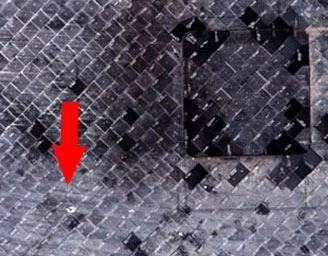
HOUSTON ? Damage found on the belly ofNASA's space shuttle Endeavour has prompted plans for an extra heat shieldinspection, mission managers said Friday.
Mission management team chairman JohnShannon said three bits of debris, believed to be foam, struck the orbiter'sheat-resistant tiles during Endeavour'sWednesday launch. Radar data acquired by Kennedy Space Center shows that a "spray" of debris 58 seconds into flight, however, appears to beice.
"Yesterdaywe were thinking it might be foam, today that radar data said it looked likeice," Shannon said. "That perked up our ears a little bit because iceis much more dense, of course, than foam and can do much more damage to tile."

"Thanksfor the heads up," Endeavour shuttle commander Scott Kelly replied.
Theastronauts, who are now docked with the International Space Station (ISS), willuse a 50-foot (15-meter) sensor-tipped extension boom to Endeavour's roboticarm to get a closer look at the damaged area on Sunday around 12:06 p.m. EDT(1606 GMT).
Images ofthe orbiter's thermal shield revealed damage to a six-by-six-inch(15-centimeter-by-15-centimeter) heat-resistant tile, located four feet (1.2meters) behind the starboard side's retractable wheel cover. Shannon describedthe damage as a three-inch-by-three-inch (eight-centimeter-by-eight-centimeter)gouge, but noted that mission engineers will not be able to determine the fullextent of the damage until after the crew's closer inspection.
"Wehave a rich flight history of tile damage, some of which is more significantlooking than what we have right here," Shannon said. "Instead ofguessing, we'll go and get the right characterization of what exactly thedamage is."
Engineerswill assess the damage with computer models of Endeavour's reentry to Earth,which Shannon said is extremely precise.
Shannonsaid the damage was discovered after reviewing 296 images of Endeavour'sunderbelly taken today by International Space Station (ISS) crew, shortlybefore Endeavour dockedwith the orbital laboratory at 1:02 p.m. EDT (1702 GMT). Temperatures inthe area of damage can reach almost 2300 degrees Fahrenheit (1260 degreesCelsius) during reentry to Earth.
If debrispenetrates deep enough into the heat-resistant tile, the orbiter's thinaluminum skin could be compromised from the heat and pose a threat to the crewon board. If that is the case with Endeavour's damage, Shannon said, there isrecourse.
"We havethree different ways that we can fix tile that we feel very confident in," Shannon said. Although he said it's too soon to know if repair is evennecessary, astronauts could use a heat-resistant paint, a drill-on patch or athick "goop" as a temporary fix.
NASA haspaid close attention to the integrity of its shuttle heat shields since 2003,when a 1.67-pound (757-gram) chunk of foam insulation struck the Columbiaorbiter's heat shield during liftoff and led to the loss of its seven-astronautcrew.
MattAbbott, lead shuttle flight director for the current mission, said theencounter was surprising but didn't require an emergency maneuver to avoidhitting the object.
"Thereare times when really doing nothing is the right thing to do," Abbot said."We do everything we can to make sure that the vehicle is protected."
In thiscase, the 32-year-old Delta 2 rocket came within one to two kilometers (0.6miles to 1.2 miles), which Abbott said did not pose an immediate danger toEndeavour's crew.
CommanderScott Kelly and his STS-118 crewmates are hauling 5,000 pounds (2,267kilograms) of fresh cargo, spare parts and the space station's new Starboard 5(S5) spacer truss into orbit.
Shortlyafter the mission's seven astronauts hooked up to the space station today,mission specialists Tracy Caldwell and Rick Mastracchio transferred the4,000-pound (1,812-kilogram) S5 truss to the space station's robotic arm.
Teacher-astronaut BarbaraMorgan is spending her first days in space on the mission, ending a 22-yearwait for the opportunity after the crew of the 1986 Challenger mission. Shereturned to NASA as a full fledged astronaut in 1998 and was assigned toEndeavour's STS-118 mission in 2002.
- VIDEO: Teaching the Future: Teacher-Astronaut Barbara Morgan
- VIDEO: Endeavour's STS-118 Mission Profile
- Complete Space Shuttle Mission Coverage