


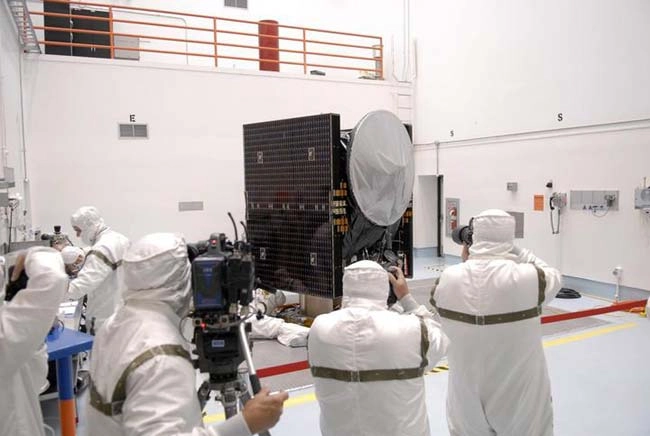
For thethird time in two days, NASA postponed the launch of its asteroid-bound Dawnprobe Saturday, with liftoff now slated for no earlier than September.
The newdelay for Dawn comes after its planned Monday liftoff was moved toJuly 15 earlier Saturday, but now clears the spacecraft?s Cape CanaveralAir Force Station launch site for the August flight of NASA?sMars Phoenix lander.
NASAspokesperson George Diller said mission managers opted for the new launchtarget because of limited liftoff opportunities in July and the need to preparefor the planned Aug. 3 Phoenix flight.
?A Septemberlaunch for Dawn maintains all of the science mission goals that a July launchwould have performed,? Diller said in an update from NASA?s Kennedy SpaceCenter in Cape Canaveral.
The $449million Dawn mission will be the first to launch a probe to bothVesta and Ceres, the two largest space rocks in the solar system, in theAsteroid Belt between the orbits of Mars and Jupiter.
The eight-yearmission is slated to carry Dawn first to Vesta in October 2011, where it willorbit the bright, dense space rock. After a detailed mapping mission, Dawn isslated to move on to spherical Ceres - which is also considered a dwarf planet- by February 2015.
NASAinitially had until July 19 to launch Dawn before standing down to allowpreparations for Phoenix?s August launch.
Dawn?smission has weathered a series ofdelays over the last week. Plans for a Friday launch were reset to Sundayafter nearby storms prevented fueling of the spacecraft?s Delta 2 rocket.Mechanical issues with a telemetry relay aircraft and the unavailability of atracking ship delayed the planned launch from Sunday to Monday, and ultimatelyto July 15.
Dawn alsosurvived an initial cancellation in March 2006, before NASA revived the sciencemission a few weeks later.
NASA hasuntil about Oct. 20 to launch Dawn, after which the Vesta and Ceres begin tomove away from each other in their respective orbits, the mission?s principalinvestigator Chris Russell has said. They two space rocks will be near eachother again in about 15 years, he added.
- VIDEO: The Asteroid Paradox
- GALLERY: Asteroids
- How NASA's Dawn Spacecraft Will Explore Solar System's Origin
