





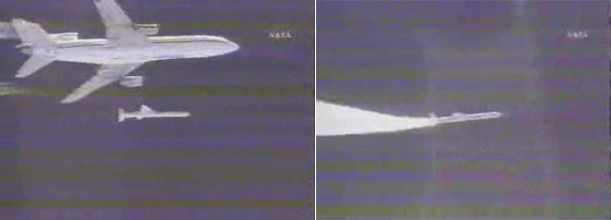
A NASAsatellite the size of a small piano shot into space Wednesday atop anair-launched rocket, kicking off a two-year mission to study odd clouds highabove Earth that shine brightest at night.
The U.S. space agency's Aeronomyof Ice in the Mesosphere (AIM) spacecraft rode an Orbital Sciences-builtPegasus XL booster into to orbit at 4:26 p.m. EDT (2026 GMT, 1:26 p.m. PDT),after falling free from its parent aircraft while flying 39,000 feet (11,887 meters)above the Pacific Ocean.
"It wasnominal, the spacecraft is power positive, the solar arrays are deployed and we'rein the right place," NASA launch director Omar Baez said after the satellitereached orbit. "You can't call it any better than that."
The probebegan its Wednesday space shot at California's Vandenberg Air Force Base, whereits Stargazer L-1011 parent aircraft took off towards an airborne launch zone.
NASA's AIMspacecraft is designed to seek out and study noctilucent- or 'night shining' - clouds, odd collections of ice crystals thatform near the edge of space some 50 miles (80 kilometers) above Earth's polarregions. The clouds form so high above Earth that they reflect sunlight afterthe Sun has dipped below Earth's horizon.
But while thephenomena were first observed in 1885, researchers still don't know how theclouds form, why they vary and their connections to Earth's changing climate orthe Sun's energy.
"They are increasingin frequency. They are getting brighter and are appearing at lower latitudesthan before," AIM principal investigator Jim Russell, of Virginia's HamptonUniversity, said of AIM's cloudy quarry Wednesday just before launch. "We needto know why it's happening and what the relationship is to global climatechange and to what we're doing to our atmosphere."
The $140million AIM mission is the latest addition to NASA's HeliosphericalObservatory, a constellation of now-16 different spacecraft studying the Sun'sinfluence and interactions with Earth and the rest of the solar system.
"Thissystem cannot be studied using a single, isolated satellite," AIM programscientist Mary Mellott, of NASA's Washington, D.C.-based headquarters, saidbefore launch.
Researchersat Hampton University are overseeing the mission for NASA's Goddard SpaceFlight Center in Greenbelt, Maryland.
High-flyingclouds
The OrbitalSciences-built AIM satellite carries threeprimary instruments aboard its 430-pound (195-kilogram) frame to studynoctilucent clouds, which are also known as Polar Mesospheric Clouds (PMCs).
A multitude of onboard cameras will photograph the clouds from different angles, while other instruments study the role of atmospheric temperatures and the role of cosmic dust to their icy formation. The Laboratory for Atmospheric and Space Physics (LASP) at the University of Colorado, which built two of AIM's instruments, will control the spacecraft during its two-year mission. Researchers at Utah State University also built one of AIM's science tools.
"AIM is thefirst mission dedicated to the study of noctilucent clouds," Russell saidTuesday in a prelaunch briefing. "We've had other clouds make measurements, butthey have been serendipitous."
Noctilucentclouds were first observed following the Krakatoa volcano eruption, and someresearchers believe their increasing frequency may be associated with globalwarming.
Russellsaid the build-up of carbon dioxide in the atmosphere, which leads to warmertemperatures near the Earth's surface, can cause colder conditions at highaltitudes that are ripe for noctilucent cloud formation. Other possible culpritsmay be the increase of methane or water vapor, both of which can generate primeconditions for the odd clouds to form.
Wednesday'ssuccessful launch marked the 50th space shot for NASA's LaunchServices Program, which oversees spaceflights that lift off atop expendablerockets.
It also markedthe 38th flight of Orbital Sciences' Pegasus rocket since thebooster made its spaceflight debut in 1990. The rocket carriedthe emblem of Virginia Tech university, where AIM deputy principalinvestigator Scott Bailey is an assistant professor, to honor the memoriesthose killed by a student gunman at the school last week.
AIM is alsoNASA's first space mission ever to be governed by a historically black college,Russell said.
"It's avery big thing for us," he added.
- NASA Satellite Takes AIM at Earth's Highest Clouds
- IMAGES: Sky Scenes
- Space Station Crew Photographs Mysterious Clouds that Shine at Night
