


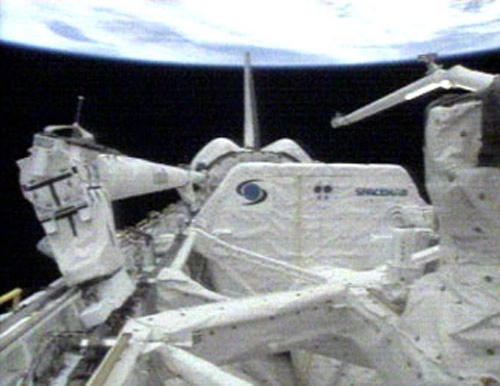
HOUSTON - The first inspections of NASA's shuttle Discovery two days aftera successfulnight launch reveal no significant problems for its seven-astronaut crewbound for the InternationalSpace Station (ISS).
Led bycommander MarkPolansky, the five-man, two-woman team of STS-116 is tasked with installinga new $11 million Port 5(P5) spacer segment to the ISS and rewiring the orbital laboratory'selectrical grid so it can draw power from a new set of solarpanels arrays installed last month.
The astronauts began theirday at 10:47 a.m. EST (1547 GMT), waking up to the Beatles' song "Here Comesthe Sun" beamed up by ground controllers in Houston.
"Good morning,Discovery, and a special good morning to you, Mark," NASA astronaut ShannonLucid, serving as spacecraft communicator, greeted from the ground as shehailed the shuttle'slaunch [image]."We especially want to thank you for the burst of sunshine you broughtinto our lives last night."
Following wakeup, the crew performeda thorough, 5 ?-hour inspection of the tiles shuttle's heat shield tiles tolook for damage from debris shed during liftoff.
"After the amazinglaunch the crew had yesterday, they hit the ground running," Tony Ceccacci,lead flight director for Discovery during the STS-116mission, told reporters today.
During inspections, missionspecialist Nicholas Patrick used the shuttle's 50-foot (15-meter) roboticarm, equipped with a 50-foot boom laden with a laser scanner andhigh-resolution camera, to inspect craft's wing leading edge and nose cap.
A glitch forced Patrick to manuallyorder the arm to grab the boom, but the problem is not expected to impact themission. Patrick and his crewmates also scanned their spacecraft's uppersurface later Sunday, while the tiles lining its will underbelly will bescrutinized during its rendezvous with the ISS tomorrow.
The in-orbit inspectionsbecame a standard part of shuttle flights following the Columbia accident of 2003,during which foam falling from the orbiter's external fuel tank during liftoffpunctured a hole in spacecraft's heat shield, allowing superheated gas to enterand destroy the vehicle during atmospheric reentry.
"Theearly indication is that all of the systems on Discovery and the external tanksand the solid rocket boosters performed very well," said NASA deputy spaceshuttle manager John Shannon. "It was a very typical ascent which followeda very typical trouble free countdown for us."
Data fromshuttle accelerometer sensors revealed four very minor impacts--around onegravity root mean square (GRMS) each--occurred on the shuttle's wing leadingedge about two minutes into Saturday's night launch.
"That'sabout one tenth of what we think can cause can discernable damage," Shannon said. "We've seen this on previous flight at about the same time."
Shannon added that it takes about a 10 GRMSimpact to create a scuff on a heat shield tile, and a 20 GRMS collision to makea crack or hole.
An openquestion during Discovery'sliftoff on Saturday evening--NASA's first night launch since 2002--waswhether ground and shuttle cameras would work as well in darkness as during theday to spot falling debris.
But Shannon said he was pleasantly surprised by the quality of the video taken by the launchinspection cameras.
"We'reable to see better at night if any piece of foam comes off of the [externalfuel tank] stacks, and if it goes into the main engine plume, it reallybrightens and you can see it much better at night," he said, adding that videoof the external tank's separation from the orbiter were clear as well."When the attitude control thrusters fired, it was as bright as it couldbe."
Time isreserved on Friday for further inspections if they are required. However, ifthe tests are expected to run over two hours, an additional docked day forDiscovery and the ISS will be added to the shuttle's 12-dayflight schedule.
- Video: Mission Profile: STS-116 Heat Shield Inspection
- Images: Ready to Fly: STS-116 Training
- Images: Shuttle Discovery Poised for STS-116
- STS-116 Video: Major Tasks
- STS-116 Video: Power is Everything
- STS-116 Video: Back in Business
- STS-116 Video: Building Blocks
- Mission Discovery: The ISS Rewiring Job of NASA's STS-116
- Complete Space Shuttle Mission Coverage
- The Great Space Quiz: Space Shuttle Countdown
- All About the Space Shuttle